

Urbanisation is often framed as a story of scale: more people, more density, more congestion, more infrastructure, more data.
But the more interesting question is not whether cities will become more technological. They already are. The question is whether urban technology will make cities more human.
A sensor does not make a city intelligent. A dashboard does not make a city responsive. A platform does not make a community empowered. Technology becomes meaningful only when it improves the relationship between people and the systems they rely upon.
Trust
Cybersecurity becomes civic confidence. People need to know that digital systems protect privacy, safety and continuity.Connectivity
Data has value only when it becomes responsive action: safer transport, clearer information and better daily decisions.Human-centred design
The city is not a technology stack. It is a lived environment shaped around access, dignity, agency and care.From smart cities to learning cities
The first generation of smart-city thinking was too often infrastructure-led. Cities installed sensors, cameras, platforms, apps and control rooms, then hoped that efficiency would translate into public value. Sometimes it did. Often, however, the citizen remained strangely absent from the design logic. A more mature approach starts elsewhere. It asks:| Question | Old smart-city logic | Human-centred urban logic |
|---|---|---|
| What is the city? | A network of assets | A community of people |
| What is technology for? | Monitoring and optimisation | Confidence, access, safety and agency |
| What is data? | A resource to be extracted | A value exchange requiring trust |
| What is success? | System performance | Better lived experience |
| What is feedback? | A complaints channel | A learning loop |
This is why the idea of the learning city is more powerful than the smart city. A smart city collects data. A learning city listens, adapts and explains. It treats residents not as passive users of infrastructure, but as participants in the ongoing refinement of urban life.
Trust: cybersecurity as civic confidence
In human-centred urban technology, trust is not a final compliance step. It is the foundation on which everything else depends. This is especially true in transport, energy, water, health and communications, where digital systems now interact with physical safety. Australia’s Security of Critical Infrastructure Act applies across 11 sectors, including transport, communications, energy, water, health, data storage and higher education; it also recognises that critical infrastructure includes premises, computers and data functioning together as a system. (CISC Website) That matters because the digital and physical city are no longer separate. A cyber incident is not merely an IT issue when it affects rail signalling, traffic systems, electricity distribution or emergency communications. The Critical Infrastructure Centre explicitly notes that disruption in one infrastructure area can create flow-on effects across others, including transport, telecommunications, banking, water and government services. (CISC Website)Cybersecurity becomes a form of public care. It is not just about preventing intrusion. It is about ensuring that people can rely on the systems that move them, inform them and protect them.
Connectivity: when data becomes action
Connectivity is often misunderstood as the technical ability to link systems. That is necessary, but insufficient. The real question is whether connectivity creates responsive action. A commuter does not care that a signalling platform, train-control system and passenger-information system are technically integrated. Theycare that the train arrives safely, the disruption is explained clearly, and the next best option is visible before stress takes over. This is where the Australian transport examples become instructive.Sydney
Digital signalling as human-centred reliability
Sydney’s Digital Systems Program is replacing legacy signalling and train-control technology on the Sydney Trains network with modern digital systems, including ETCS Level 2 capabilities. (Transport NSW) The human-centred point is not the signalling technology itself. It is what the technology makes possible: safer operations, more reliable services and the potential for greater network capacity. The public value is therefore not “digital signalling”. The public value is a commuter who spends less time waiting, receives clearer information, and experiences the rail network as dependable rather than mysterious.Melbourne
High-capacity signalling and passenger experience
Melbourne’s Metro Tunnel includes twin nine-kilometre tunnels, five new stations and High Capacity Signalling designed to enable turn-up-and-go services. (Victoria’s Big Build) Victoria’s High Capacity Metro Trains add the passenger-facing layer, including more space, clearer walkways, priority seating, accessibility spaces and real-time passenger information displays. (vic.gov.au) The lesson is that technology has public value when it changes the felt experience of the city: less crowding, clearer information, better accessibility and more confidence in the daily commute.Human-centricity: designing for people, not platforms
The human-centred city begins with lived experience. It asks what different people need from the city at different moments.CommuterMaya
Everyday friction: delays, missed connections and unclear alternatives. Human-centred response: integrated transport data, real-time journey options and reliable signalling. Risk: more apps, more confusion, less trust.
Maya
Everyday friction: delays, missed connections and unclear alternatives. Human-centred response: integrated transport data, real-time journey options and reliable signalling. Risk: more apps, more confusion, less trust.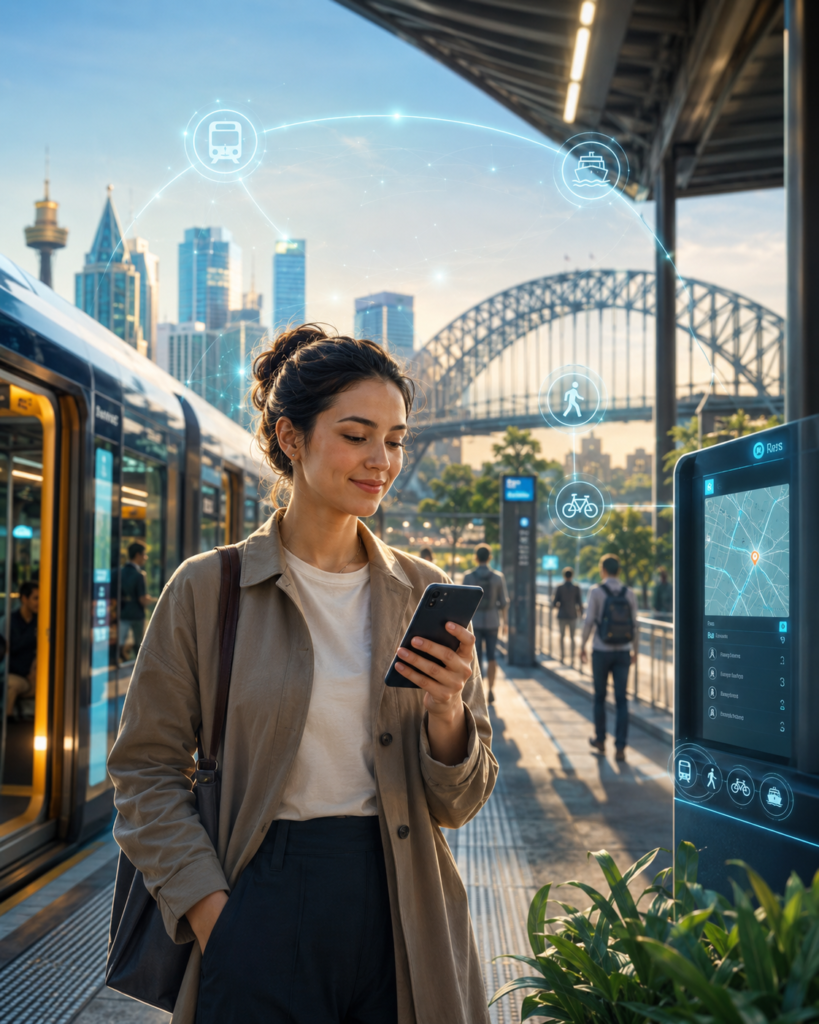
Local enterpriseLiam
Everyday friction: unpredictable foot traffic and staffing needs. Human-centred response: anonymised precinct-level data that helps small businesses plan. Risk: data captured by platforms but not returned to community.
Liam
Everyday friction: unpredictable foot traffic and staffing needs. Human-centred response: anonymised precinct-level data that helps small businesses plan. Risk: data captured by platforms but not returned to community.
Independent livingMrs Chen
Everyday friction: safety, isolation, digital exclusion and privacy concerns. Human-centred response: secure, consent-based systems that support independence. Risk: surveillance, data misuse or loss of autonomy.
Mrs Chen
Everyday friction: safety, isolation, digital exclusion and privacy concerns. Human-centred response: secure, consent-based systems that support independence. Risk: surveillance, data misuse or loss of autonomy.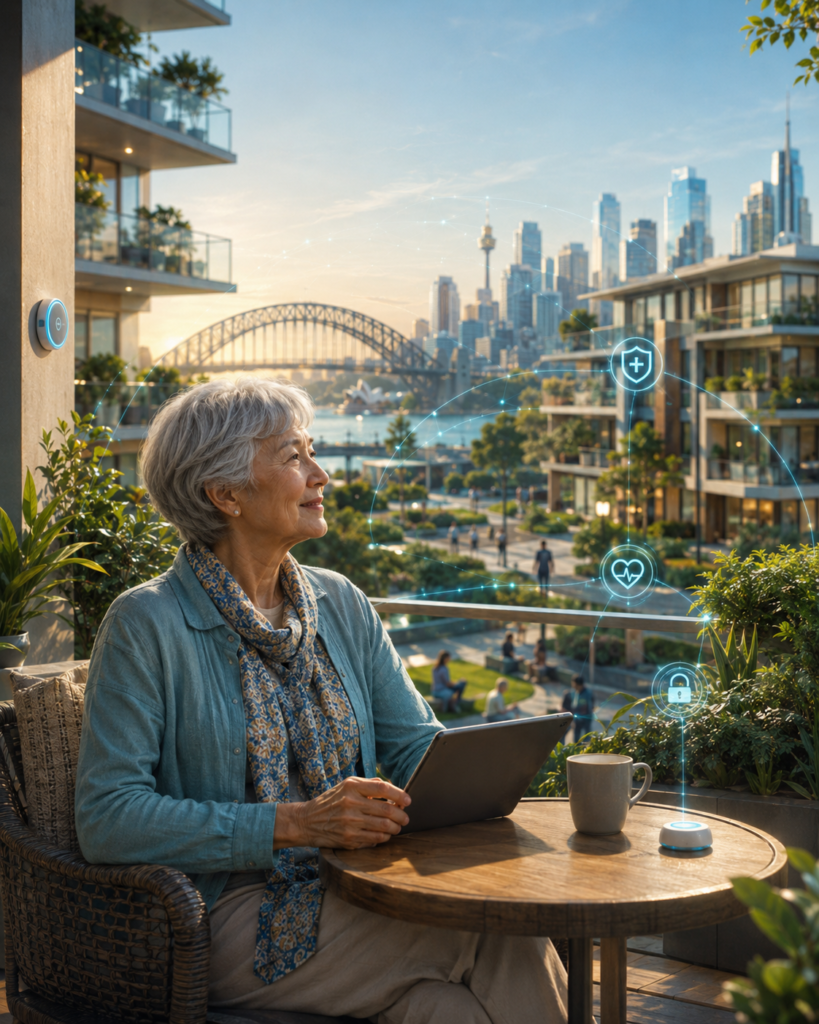
This is where many smart-city projects fail. They focus on capability before legitimacy. They ask, “What can the technology do?” before asking, “What kind of civic relationship does this technology create?”
The SOC as the city’s digital nervous system
A useful way to think about trust in urban technology is the Security Operations Centre, or SOC. In critical infrastructure, a SOC is not simply a cyber help desk. It is closer to a city’s digital nervous system. The distinctive challenge is IT/OT convergence. Traditional IT protects data, accounts and enterprise systems. Operational Technology, or OT, controls physical equipment and processes: signals, switches, power systems, sensors, traffic systems and other machinery that makes the city function. The Australian Signals Directorate notes that critical infrastructure organisations provide vital services such as water, energy and transportation, and that these organisations rely on OT to control and manage the physical equipment and processes behind those services. (cyber.gov.au) This is why cyber resilience is more important than cyber purity. The mature assumption is not “we will never be attacked”. It is “we must continue to protect people when systems are stressed, degraded or under attack”.| Security concept | Infrastructure meaning | Human-centred meaning |
|---|---|---|
| Monitoring | Detect unusual network or equipment behaviour | Prevent disruption before people experience harm |
| Incident response | Contain and recover from cyber events | Keep essential services operating safely |
| Digital twin testing | Simulate changes before deployment | Avoid breaking real-world systems people depend on |
| Threat intelligence | Learn from emerging global risks | Protect local communities before threats arrive |
| Resilience | Fail safely and recover quickly | Maintain confidence during uncertainty |
That is deeply human-centred. It recognises that the public should not be the test environment.
The adoption barriers
The barriers to human-centred urban technology are not only technical. They are institutional, cultural and political.| Barrier | What it looks like | Why it matters |
|---|---|---|
| Legacy infrastructure | New systems must integrate with old tracks, tunnels, stations, depots and control systems | Cities cannot simply rebuild themselves from scratch |
| Interoperability | Agencies, vendors and platforms use different standards | The citizen experiences fragmentation as delay, confusion or failure |
| Cyber risk | More connected systems increase the attack surface | Trust collapses quickly after visible breaches |
| Sovereign data requirements | Sensitive infrastructure data may need local control, storage or governance | Global platforms must be adapted to Australian legal and civic expectations |
| Procurement logic | Governments buy systems rather than capabilities | Cities end up with technology stacks rather than learning systems |
| Public legitimacy | Communities may see sensors and analytics as surveillance | Adoption fails when people do not understand or accept the value exchange |
| Feedback poverty | Residents can complain, but not meaningfully shape system learning | The city optimises what it can measure, not always what matters |
The risk, however, is that integration becomes a managerial achievement rather than a civic one. A city can be technically integrated and still socially alienating. The test is whether integration improves people’s sense of agency, dignity and confidence.
The key shift: from passive users to power users
The next stage of urban technology should treat residents as power users of the city. This does not mean everyone becomes a transport engineer, data scientist or cybersecurity analyst. It means urban systems should be designed with feedback literacy: people should understand what data is collected, why it is collected, how it is protected, and how their lived experience changes the system over time.More than technology
- apps;
- sensors;
- command centres;
- AI dashboards;
- digital twins;
- integrated operating platforms.
Also civic capability
- public explanation;
- consent and accountability;
- community feedback loops;
- inclusive design;
- transparent performance measures;
- mechanisms for local adaptation.
What success should look like
A successful human-centred urban technology strategy should be assessed through human outcomes.Reliability Can people depend on the system when it matters?
Safety Does the technology reduce physical and digital risk?
Accessibility Does it work for older people, disabled people, visitors and digitally excluded residents?
Explainability Do people understand what is happening when systems change or fail?
Reciprocity Does the community receive value from the data it generates?
Resilience Can the city fail gracefully rather than catastrophically?
Agency Can residents influence how the system evolves?
The city of the future should not merely be automated. It should be accountable. It should not merely be intelligent. It should be intelligible. It should not merely be efficient. It should be humane.
Conclusion: the city as a civic relationship
Urbanisation will continue to push cities towards denser, more complex and more technologically mediated forms of life. AI, sensors, digital twins, high-capacity signalling and security operations centres will become normal parts of the urban fabric. The question is whether these systems are designed as instruments of control or as infrastructures of confidence. Sydney and Melbourne show that the most promising urban technologies are not those that make the city look futuristic. They are the ones that make ordinary life work better: the train that arrives more reliably, the station that feels less stressful, the information that appears when needed, the system that is protected before it fails, and the feedback loop that lets citizens shape the next iteration. Humans can be at the heart of urban technology. But that will not happen automatically. It requires a deliberate move from smart cities to learning cities — cities that do not simply sense, compute and optimise, but listen, adapt and earn trust.Reference list
- Australian Cyber Security Centre. (2024). Principles of operational technology cyber security. (cyber.gov.au)
- Critical Infrastructure Centre. (2024). Security of Critical Infrastructure Act 2018. (CISC Website)
- National Institute of Standards and Technology. (2023). How digital twins could protect manufacturers from cyberattacks. (NIST)
- ST Engineering. (n.d.). Smart City. (stengg.com)
- ST Engineering. (n.d.). Urban Solutions & Transportation Management. (stengg.com)
- ST Engineering. (2024). ST Engineering to drive AI-powered smart city transformation for Lusail City. (stengg.com)
- Transport for NSW. (2025). Digital Systems Program. (Transport NSW)
- Victoria’s Big Build. (2026). Metro Tunnel Project. (Victoria’s Big Build)
- Victorian Government. (2026). High Capacity Metro Trains Project. (vic.gov.au)