

Football is often described as a universal language of joy, identity, and belonging. Yet the governance of the FIFA World Cup has long told a more troubling story. Beneath the spectacle sits an institutional system shaped by commercial power, political bargaining, and repeated failures of oversight. The World Cup is not merely a tournament. It is a global governance arena in miniature, where legitimacy, labour, state ambition, and human rights are constantly negotiated. FIFA has undeniably changed over the past decade, but the central question is whether that change amounts to genuine accountability or merely a more sophisticated form of institutional self-protection (Fédération Internationale de Football Association [FIFA], 2017; FIFA, 2024).
The earlier era of FIFA governance is difficult to discuss without returning to the Bin Hammam case. In 2012, the Court of Arbitration for Sport published the award in Mohamed Bin Hammam v. FIFA (CAS 2011/A/2625), a case arising from allegations of cash gifts distributed to Caribbean Football Union delegates during the 2011 FIFA presidential contest. Whatever one makes of the broader legal contestation, the case became emblematic of an older governance culture in football: one marked by patronage, informal influence, and weak ethical controls. Corruption in this setting was not simply an individual moral lapse. It reflected institutional norms that had been allowed to harden over time (Court of Arbitration for Sport [CAS], 2012).
The significance of that period lies not only in scandal itself, but in what scandal forced FIFA to do next. In 2017, FIFA published what it described as a landmark Human Rights Policy. That document explicitly built upon Article 3 of the FIFA Statutes, under which FIFA commits itself to respecting internationally recognised human rights and striving to promote their protection. FIFA also aligned this position with the United Nations Guiding Principles on Business and Human Rights, signalling that it wished to be seen not simply as a sporting organiser, but as a global institution with broader social responsibilities (FIFA, 2017).
This shift mattered. It represented a new vocabulary of governance in which due diligence, remedy, safeguarding, and stakeholder engagement were no longer peripheral concerns. Yet formal language is not the same thing as institutional transformation. Many organisations become highly adept at producing policies that signal reform while leaving underlying power relations substantially intact. FIFA’s rights-based turn should therefore be taken seriously, but not naively. Policy documents create standards and invite scrutiny, but they do not in themselves redistribute authority or guarantee implementation when commercial interests are at stake (FIFA, 2017; FIFA, 2018).
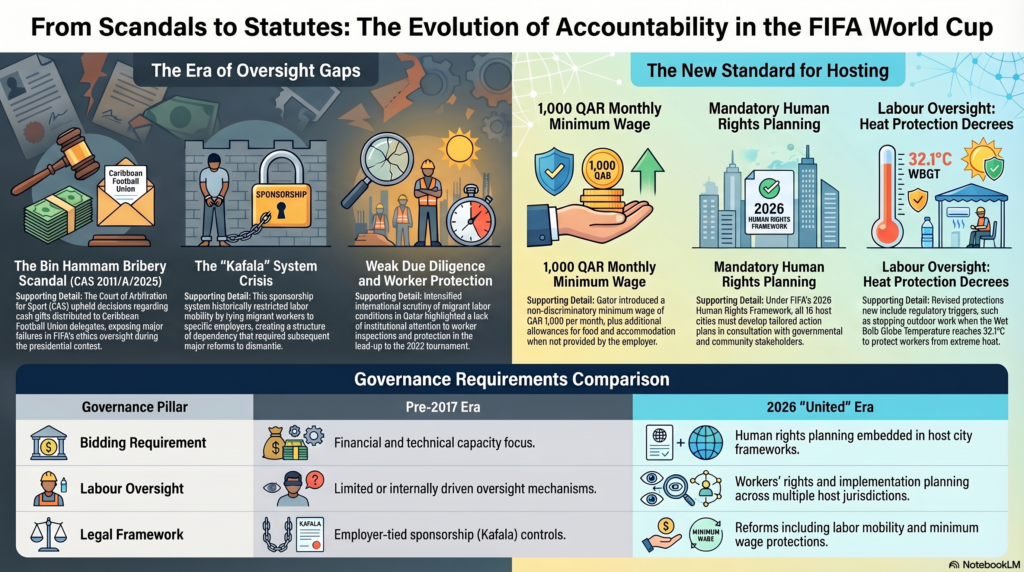
Figure 1. From bribery scandal to human rights planning: a summary of the governance shift in FIFA
Qatar 2022 exposed this tension in particularly sharp form. For many observers, the tournament became shorthand for the moral contradictions of mega-event governance, especially in relation to migrant labour, civil liberties, and the cost of spectacle. That criticism was warranted. At the same time, the International Labour Organization documented major reforms in Qatar, including changes that dismantled key elements of the kafala system, expanded labour mobility, and introduced a non-discriminatory minimum wage. Qatar became the first country in the region to establish such a wage floor, set at QAR 1,000 per month, with additional allowances for food and accommodation where these were not provided directly (International Labour Organization [ILO], 2021).
These developments should not be romanticised. Reform under pressure remains reform under pressure. The ILO itself presents the story as one of progress alongside ongoing challenges rather than a complete ethical resolution. That qualification is important. The labour reforms associated with Qatar do not demonstrate that the World Cup model is inherently just. Rather, they show that institutional change becomes possible when external scrutiny from journalists, labour advocates, international organisations, and civil society becomes intense enough to make inaction politically and reputationally costly (ILO, 2021; FIFA, 2022).
The same pattern is visible in relation to heat protection. The ILO reports that Qatar introduced revised legal protections under which outdoor work must stop when the wet-bulb globe temperature exceeds 32.1°C. This is a concrete and measurable reform. Yet it also reveals something uncomfortable about the governance model surrounding football mega-events: meaningful protection often arrives only after global pressure has made previous neglect impossible to defend. The lesson, then, is not that football governance naturally self-corrects, but that it frequently responds only when public legitimacy is under threat (ILO, 2021).
The next major test is FIFA World Cup 2026, and it poses a different challenge. Instead of a single host state, the event will be spread across Canada, Mexico, and the United States, with multiple host cities operating across varied legal and political contexts. FIFA’s 2024 Human Rights Framework states that all Host City Committees are to develop tailored human rights action plans and identifies three core areas of attention: inclusion and safeguarding, workers’ rights, and access to remedy. This is perhaps the clearest evidence yet that FIFA has internalised some lessons from the last decade. Human rights are no longer framed only as criticism to be managed after controversy; they are now written into planning architecture before the tournament begins (FIFA, 2024).
That change is meaningful because it broadens the moral field of tournament governance. The World Cup affects not only players and spectators, but also workers, journalists, volunteers, migrants, disabled people, local residents, and communities vulnerable to exclusion or displacement. To place these concerns within official tournament planning is a substantial departure from the governance language that dominated football in the early 2010s. In that sense, FIFA has moved beyond the politics of simple denial. It now publicly accepts that mega-events generate social obligations extending far beyond the pitch (FIFA, 2024; FIFA, 2017).
Yet the 2026 framework also reveals the limits of FIFA’s current model. Multi-level governance can improve coordination, but it can also diffuse responsibility. When implementation is distributed across FIFA, host city committees, and federal, state, provincial, and municipal actors, accountability can become harder to locate in practice. The risk is no longer only the old form of football corruption. It is fragmentation: strong principles at the centre, uneven implementation on the ground. A rights framework may look impressive on paper while producing highly variable protections across jurisdictions (FIFA, 2024).

Figure 2. FIFA’s reform trajectory remains constrained by the gap between formal commitments and implementation across complex tournament governance settings (FIFA, 2018; FIFA, 2024; ILO, 2021)
This is the core problem facing FIFA today. The issue is not the absence of policy. It is the divide between policy and implementation. FIFA now possesses a far more sophisticated governance vocabulary than it did a decade ago. It can speak the language of rights, remedy, integrity, and safeguarding. But that vocabulary matters only if it constrains decision-making when ethical commitments become inconvenient. Otherwise, the institutional effect is largely reputational. Rights frameworks become visible proof that reform language exists, without necessarily becoming reliable mechanisms for enforcement, remedy, or structural accountability (FIFA, 2018; FIFA, 2024).
What stronger reform could look like
If FIFA is serious about moving beyond symbolic accountability, it does not need to invent a model from scratch. Other sports have already confronted legitimacy crises and responded with more robust integrity architecture. These cases do not show perfect reform. They do, however, show that meaningful institutional change becomes more plausible when governing bodies cede some control over integrity functions, create independent enforcement structures, and make transparency less optional than before. In that sense, the question is not whether reform is imaginable, but whether FIFA is willing to accept the loss of discretionary power that genuine reform requires.
World Athletics: independent integrity with structural separation
One of the clearest examples comes from World Athletics, formerly the IAAF, after its own crises around corruption and doping governance. In 2016 and 2017, the sport created the Athletics Integrity Unit (AIU), described by World Athletics as an independent body with responsibility for anti-doping and wider integrity functions, including investigations, prosecutions, education, and compliance monitoring. World Athletics presented this as part of a broader constitutional and governance reform agenda, and the AIU now operates through its own board, with independent members and structural separation from the federation’s ordinary leadership. The lesson for FIFA is not that all problems disappear once an integrity unit is created. It is that credibility improves when investigations and enforcement are no longer managed wholly within the same political system they may need to challenge.
Tennis: integrating anti-corruption and anti-doping into an independent agency
Professional tennis offers a second useful example. After prolonged concern about match-fixing and betting-related corruption, the sport commissioned an independent review and later moved to an integrated integrity model. In 2021, the international governing bodies of tennis confirmed that the International Tennis Integrity Agency (ITIA) would assume responsibility not only for anti-corruption work but also for the Tennis Anti-Doping Programme, creating what the ITF described as the first fully independent and integrated global anti-doping and anti-corruption integrity organisation in sport. For FIFA, the relevant lesson is institutional coherence. Integrity cannot sit in a corner as a narrow ethics add-on. It needs budget, authority, investigative scope, and functional independence across the full range of risk areas. A fragmented or advisory-only model is much easier for powerful actors to bypass.
The IOC after Salt Lake City: crisis-driven reform with externalised ethics mechanisms
A third and older example is the International Olympic Committee following the Salt Lake City bidding scandal. Olympic scholarship archived by the Olympic World Library notes that the IOC responded by investigating the corruption allegations, expelling and disciplining members, establishing an independent ethics commission, helping create the World Anti-Doping Agency, and accepting the recommendations of the IOC 2000 reform commission, including changes to membership rules and host-city selection processes. The IOC did not become a model of perfect transparency overnight, and scholars remain divided about how deep the reforms truly went. Still, the episode matters because it demonstrates that legitimacy crises can force even powerful sporting institutions to redesign their governance arrangements when public trust is endangered. For FIFA, the implication is clear: host selection, ethics oversight, and human rights risk cannot remain too close to the same executive structures whose incentives are primarily commercial and political.
What these examples suggest for FIFA
Taken together, these cases point towards three practical reforms FIFA could pursue. First, it could establish a genuinely independent integrity body with authority over investigations, human rights implementation monitoring, ethics complaints, and compliance review across World Cup cycles. Secondly, it could separate commercial tournament decision-making from ethical and rights-based review, so that human rights commitments are not diluted when they become inconvenient. Thirdly, it could strengthen transparency by publishing host-city compliance reporting, implementation benchmarks, and remedy pathways in a way that allows external scrutiny rather than relying mainly on internal reassurance. None of these changes would make FIFA conflict-free. But they would move it closer to a model in which accountability is institutional rather than performative.
Seen in this comparative light, FIFA’s problem is not a lack of available models. It is the reluctance, common to many powerful institutions, to surrender enough internal control for accountability to become genuinely constraining rather than merely reputational.
This concern becomes even sharper when attention turns to future tournaments. Amnesty International argued in 2024 that the human rights strategies associated with the 2030 and 2034 men’s World Cups were dangerously inadequate, and in December 2024 it reported that 21 organisations condemned the confirmation of Saudi Arabia as host of the 2034 tournament. Whether or not one adopts Amnesty’s exact rhetoric, the broader point is difficult to avoid: once FIFA claims a rights-based identity, it raises the ethical standard by which its own hosting decisions will be judged. Human rights cannot credibly function as a branding exercise for some tournaments and a secondary concern for others (Amnesty International, 2024a, 2024b).
The World Cup should therefore not be narrated as a simple story of redemption. FIFA is no longer the organisation it was in the era of overt scandal, and that is important. It has adopted formal human rights language, created advisory and reporting structures, and developed a substantial framework for 2026. These are real developments. But they do not settle the question of accountability. They merely move it to a higher level. The issue is no longer whether FIFA can speak the language of reform. It is whether FIFA can act against its own short-term interests when dignity, labour protection, transparency, or public accountability require it. Until that happens consistently, the World Cup remains suspended between two eras: no longer the age of the suitcase, but not yet the age of full accountability (CAS, 2012; FIFA, 2017; FIFA, 2024). The World Cup is no longer in the age of the suitcase, but it has not yet entered the age of full accountability.
References
Amnesty International. (2024a). *High stakes bids: Dangerously flawed human rights strategies for the 2030 and 2034 FIFA World Cups*.
Amnesty International. (2024b, December 11). *Global: Confirmation of Saudi Arabia as 2034 FIFA World Cup host puts many lives at risk*.
Amnesty International. (2024c). *Playing a dangerous game? Human rights risks linked to the 2030 and 2034 FIFA World Cups*.
Athletics Integrity Unit. (n.d.). *Know us*.
Court of Arbitration for Sport. (2012). *Mohamed Bin Hammam v. Fédération Internationale de Football Association (FIFA), CAS 2011/A/2625*.
Fédération Internationale de Football Association. (2017, June 8). *FIFA publishes landmark Human Rights Policy*.
Fédération Internationale de Football Association. (2018, November 26). *Second report of FIFA’s Human Rights Advisory Board published*.
Fédération Internationale de Football Association. (2022, July 20). *Human Rights – Key focus for FIFA World Cup 2026™*.
Fédération Internationale de Football Association. (2024). *FWC26 Human Rights Framework: A shared platform for positive impact*.
International Labour Organization. (2020, August 30). *Dismantling the kafala system and introducing a minimum wage mark new era for Qatar labour market*.
International Labour Organization. (2021, March 19). *Qatar’s new minimum wage enters into force*.
International Labour Organization. (2021, May 27). *New legislation in Qatar provides greater protection to workers from heat stress*.
International Labour Organization. (2021). *Labour reforms in the State of Qatar*.
International Tennis Federation. (2021, December 29). *World governing bodies confirm integrated approach to integrity for tennis from 2022*.
Kidd, B. (2024). *The problems and prospects of the Olympic Movement*.
Office of the United Nations High Commissioner for Human Rights. (2011). *Guiding principles on business and human rights: Implementing the United Nations “Protect, Respect and Remedy” Framework*.
World Athletics. (2017, April 5). *Independent Athletics Integrity Unit is operational*.
World Athletics. (2020, February 4). *Athletics Integrity Unit continues to seek candidates for two positions on its Board*.
World Athletics. (n.d.). *Integrity Unit Board*.