

R U OK? is necessary, but not sufficient. The question matters; the relational conditions that make an honest answer possible matter even more.
R U OK? Day matters. At its best, it gives Australians permission to ask a question that might otherwise remain unspoken. Its official four-step approach — ask, listen, encourage action, and check in — is a practical and humane framework for beginning difficult conversations.
But there is a problem. In many workplaces, “Are you OK?” can collide with a deeply familiar social reflex: “Good thanks. You?”
This is not always dishonesty. Often, it is phatic communication: language used to maintain social connection rather than disclose substantive information. The phrase performs politeness, keeps the interaction smooth, and protects the speaker from vulnerability.
That is why R U OK? cannot be treated as a one-day script. The question only works when the relationship can carry the answer.
The “Good Thanks” Wall: The Power of Phatic Reflex
In Australia, the greeting “How are you?” is often less of a medical inquiry and more of a social lubricant. Sociolinguists refer to this as phatic communion: language used to perform a social task, such as acknowledging someone’s presence, rather than to convey specific information.
Evidence suggests that in high-pressure workplaces, this reflex can become even stronger. We are culturally conditioned towards stoicism, a trait often associated with self-reliance and a reluctance to acknowledge mental health struggles for fear of being seen as a burden. When a colleague asks if we are OK, the social script often dictates a specific, defensive response: “Good thanks, you?”
This response serves as a wall. It allows us to maintain a professional façade while keeping our internal struggles hidden. But if we cannot get past the “Good thanks”, R U OK? risks remaining a surface-level exercise. To break through, we need to understand the person behind the response.
The Missing Ingredient: Knowing the Person
Before you can truly know if someone is OK, you need to know who they actually are. This does not mean becoming best friends with every person in the office or overstepping professional boundaries. It means moving beyond the transactional and into the relational.
It means exercising the Johari-K muscle: the “K” standing for knowledge of self and others.
At UNSW, one of my favourite topics to teach is the Johari Window. It is a model I wish I could have explained to my 30-year-old self. If I could go back, I would tell that younger version of me that technical skills are the “what”, but the Johari Window is part of the “how” of a meaningful career. It is central to authentic leadership, reflective practice, and psychological safety.
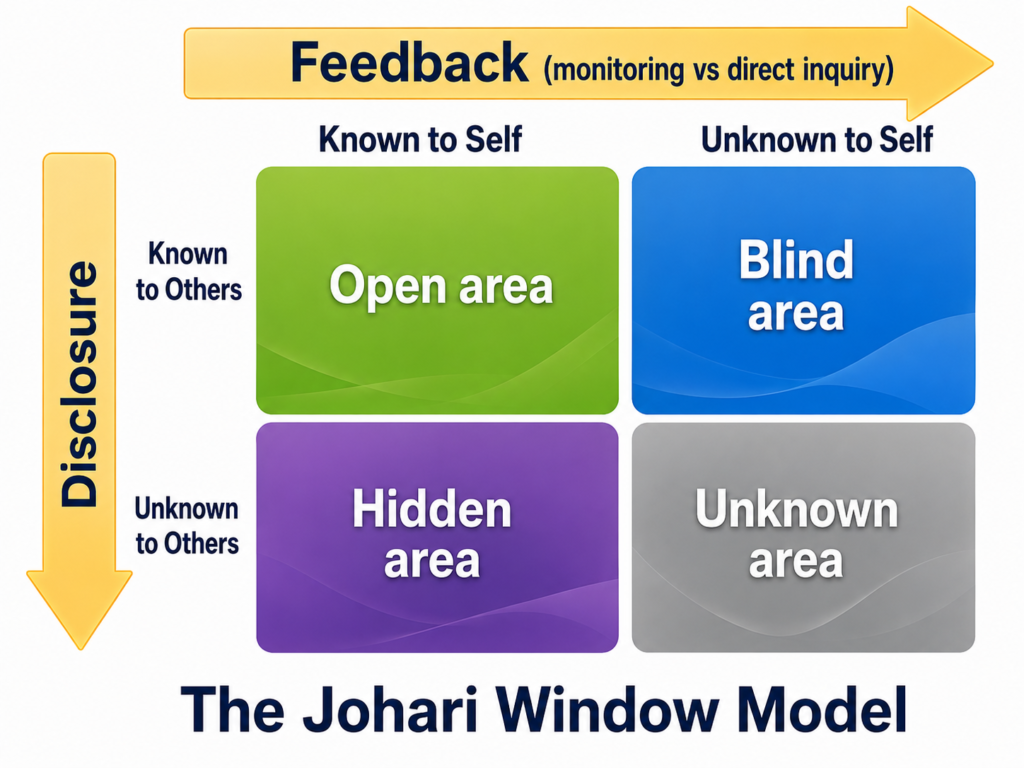
The Johari Window. Adapted from Luft and Ingham (1955).
The Johari Window
The Johari Window was developed by psychologists Joseph Luft and Harrington Ingham in 1955 to help people understand their relationship with themselves and others. It divides our interpersonal awareness into four quadrants:
| Johari quadrant | What it means | R U OK? relevance |
|---|---|---|
| Open area | Known to self and known to others. | This is where honest conversation is easiest. |
| Hidden area | Known to self but not known to others. | This is where distress may sit behind “I’m fine.” |
| Blind spot | Unknown to self but visible to others. | This is where friends, colleagues, or managers may notice changes first. |
| Unknown area | Unknown to self and unknown to others. | This is where deeper reflection, support, and time may reveal new needs. |
Nosce te ipsum — know thyself.
In the context of the Johari Window, you cannot truly know yourself without the feedback of others to illuminate your blind spots. Equally, others cannot know you unless you choose, carefully and appropriately, to reveal something from your hidden area.
The Problem Is Not the Question. It Is the Relationship Before the Question.
The weakness is not in the phrase “Are you OK?” The weakness is in assuming that the phrase can do all the work on its own.
In low-trust environments, people learn to manage appearances. They disclose competence, not vulnerability. They say enough to remain socially acceptable, but not enough to invite concern.
This is why psychological safety matters. Amy Edmondson’s influential work describes psychological safety as a shared belief that a team is safe for interpersonal risk-taking. In practical terms, this means people can ask for help, admit uncertainty, give feedback, or reveal difficulty without fear of embarrassment or punishment.
R U OK? works best where psychological safety already has some foundations. The Johari Window gives us a way to build those foundations.
Make R U OK? Day a Johari-K Practice
To get past the “Good thanks” reflex, we have to intentionally expand the Open Area of our relationships. This requires vulnerability, but it also requires care, consent, and judgement.
This R U OK? Day, do not just ask the question. Practise Johari-K.
| Practice | What to do | Why it helps |
|---|---|---|
| Share something small | Mention a non-sensitive challenge, interest, or learning moment. | Expands the open area without over-sharing. |
| Ask better questions | Try: “What has been taking more energy than usual lately?” | Moves beyond the automatic “How are you?” script. |
| Invite feedback | Ask: “Is there anything I might not be seeing about how I’m showing up?” | Reduces blind spots. |
| Notice changes | Pay attention to withdrawal, irritability, silence, or unusual behaviour. | Distress is often visible before it is verbalised. |
| Check in again | Return to the conversation later. | Care becomes credible when it is repeated. |
The aim is not to turn workplaces into therapy rooms. Nor is it to demand disclosure from people who are not ready, willing, or safe to share. The aim is more modest and more practical: to create the relational conditions in which an honest answer becomes possible.
A Necessary Boundary
There is an important boundary here. Johari-K is not therapy. It is not a diagnostic tool. It should not be used to pressure people into disclosure, especially in workplaces where power, privacy, and performance are entangled.
If someone is in immediate danger or distress, the response must move beyond conversation to appropriate professional or crisis support. The value of Johari-K is that it may help create the conditions in which people feel safer to speak before a crisis point is reached.
Conclusion: The Question Needs a Relationship
R U OK? Day gives us an important question. The Johari Window reminds us that the question depends on a prior relationship.
We cannot expect someone to disclose distress into a vacuum of polite professionalism. We cannot ask for honesty only on the day the posters go up. We have to build the open area before the difficult conversation arrives.
So this R U OK? Day, ask the question. But also do the slower work. Share something human. Invite feedback. Notice what has changed. Return after the first conversation.
The real test is not whether we asked, “Are you OK?” The real test is whether we have built the kind of relationship in which someone can safely answer, “Actually, no.”
Ian Farmer teaches in the Centre for Social Impact and Management schools at UNSW
References
Boyd, C., Aisbett, D., Francis, K., Kelly, M., Newnham, K., & Newnham, K. (2006). Issues in rural adolescent mental health in Australia. Rural and Remote Health. https://doi.org/10.22605/RRH501
Edmondson, A. (1999). Psychological safety and learning behavior in work teams. Administrative Science Quarterly, 44(2), 350–383. https://doi.org/10.2307/2666999
Guerin, B., Leugi, G. B., & Thain, A. (2018). Attempting to overcome problems shared by both qualitative and quantitative methodologies: Two hybrid procedures to encourage diverse research. The Australian Community Psychologist, 29, 74–90.
Luft, J., & Ingham, H. (1955). The Johari Window, a graphic model of interpersonal awareness. Proceedings of the Western Training Laboratory in Group Development, University of California, Los Angeles.
R U OK? (n.d.). How to ask R U OK? https://www.ruok.org.au/how-to-ask
R U OK? (n.d.). A conversation could change a life. https://www.ruok.org.au/
Zuckerman, C. H. P. (2021). The phatic: Communication and communion. https://anthropology.ucsd.edu/people/faculty/faculty-profiles/The_Phatic_Communication_and_Communion.pdf