

#WithHumanitiesYouUnderstand
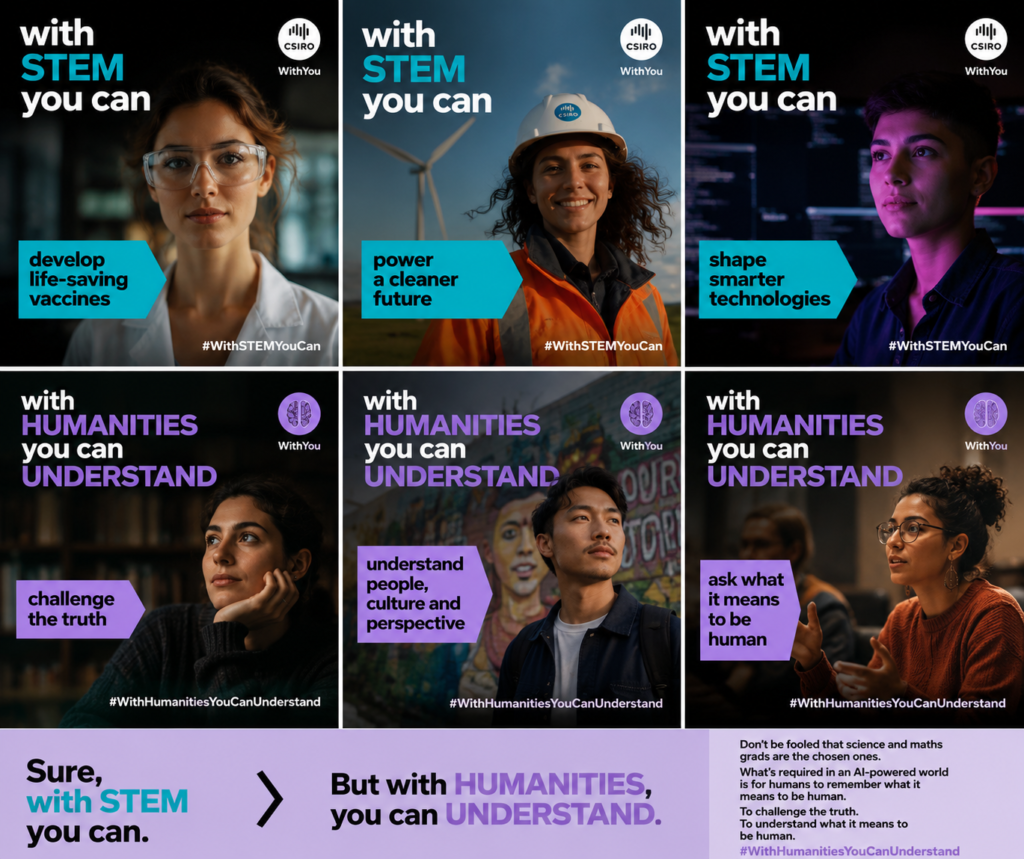
Sure, with STEM you can. But with humanities, you can understand.
CSIRO has a compelling campaign called #WithSTEMYouCan. And yes — with STEM you can build bridges, decode genomes, design vaccines, model climate systems, engineer new materials, write code, launch satellites and imagine technical solutions to some of the world's most urgent problems.
That matters. But in the age of artificial intelligence, perhaps the more urgent question is no longer only what can we build? It is also: what should we build? Who benefits? Who is harmed? Who decides? And what does it mean to remain human in a world increasingly shaped by machines?
That is where the humanities matter.
With humanities, you can understand
The problem with the current STEM story is not that it is wrong. It is that it is incomplete. STEM gives us powerful tools for solving technical problems. But many of the problems now facing the world are not merely technical. They are social, ethical, cultural, political and deeply human.
Artificial intelligence is the clearest example. AI can generate text, images, music, code, forecasts, summaries and decisions at astonishing speed. It can automate tasks, accelerate research and transform education, health, business and government. But AI also forces us to ask older, deeper questions:
Whose knowledge is being amplified?
Whose labour is being hidden?
What happens when judgement is outsourced?
How do we recognise bias when it is embedded inside systems?
How do we keep human agency alive when machines become persuasive?
These are not simply engineering questions. They are humanities questions. They require philosophy, history, sociology, politics, literature, ethics, communication, cultural studies, education, anthropology and the arts. They require people who can interpret, critique, listen, argue, contextualise and imagine. They require humans who know how to be human.
When AI becomes infrastructure, judgement becomes scarce
This is not a theoretical concern. We are watching AI and frontier technology move from the laboratory into the commanding heights of capital markets. SpaceX is moving towards what has been reported as a historic public offering. OpenAI has confidentially filed for a US IPO, with Reuters reporting that it may target a valuation of up to US$1 trillion. Anthropic has also confidentially filed, after a funding round reported at a valuation of US$965 billion (Reuters, 2026).
Whatever one thinks of the precise valuations, the signal is clear. AI and frontier technology are no longer specialist sectors. They are becoming civilisational infrastructure. When companies of this scale shape communication, knowledge, education, labour, defence, transport, energy and public reasoning, the question cannot be left to engineers, investors and platform owners alone.
We need technical competence. But we also need democratic competence.
We need citizens who can ask what these systems are doing to attention, truth, trust, work, privacy, inequality and social cohesion. We need students who can challenge a model's answer, not merely prompt it more efficiently. We need teachers who can help young people distinguish fluency from truth. We need policymakers who understand that an AI strategy is not only an industry strategy — it is also a cultural, educational and democratic strategy.
UNESCO has made this point clearly. Its guidance on generative AI in education calls for the development of human capacity within a human-centred vision of technology, and its digital education work explicitly prioritises human agency, critical thinking and ethics among students and teachers (UNESCO, 2023; UNESCO, 2026). That sounds very much like the humanities.
The chosen ones myth
There is a quiet assumption running through much of the future-of-work conversation: that science, maths, engineering and technology graduates are the chosen ones. They are the ones who will build the future. They are the ones who will survive automation. They are the ones who will understand the systems. They are the ones who will matter.
But that is a dangerously narrow view of what the AI-powered world requires. Yes, we need technical skill. But we also need critical thinking. We need ethical reasoning. We need cultural intelligence. We need historical memory. We need social imagination. We need the capacity to communicate across difference and disagreement.
The quiet contradiction in Australian higher education
This is why Australia's treatment of the humanities in higher education remains so short-sighted. We say we want students prepared for an AI-powered world. We say we want critical thinkers, ethical leaders, agile communicators and citizens able to navigate misinformation, social fragmentation and technological disruption.
Yet under the continuing shadow of the Job-ready Graduates reforms, many humanities, society, culture and communications subjects remain among the most expensive student contribution categories.
$17,399
Per equivalent full-time student load for Law, Accounting, Administration, Economics, Commerce, Communications, Society and Culture (Australian Government, 2026).
$9,537
Per equivalent full-time student load for Engineering, Environmental Studies and Science (Australian Government, 2026).
The contradiction
A country that says it wants AI-ready citizens cannot keep pricing the disciplines of judgement, culture, history, ethics and communication as if they are luxury electives.
If we genuinely believe the future requires critical thinking, civic reasoning and ethical technological development, then humanities education should not be treated as a private indulgence. It should be recognised as national capability.
A lesson from Ghana
This is one reason the Ashesi University story in Ghana is so powerful. As I discussed in the earlier post on Ashesi, its model does not begin by forcing students into narrow professional pipelines. It combines professional preparation with a broader intellectual foundation.
Ashesi's curriculum has been described as pairing a rigorous liberal arts core with undergraduate programmes in fields such as computer science, business, law and engineering. Its humanities and social sciences work includes leadership, ethics, African studies, language and communication, community service and Giving Voice to Values (Ashesi University, 2026). A World Bank case study describes how Ashesi's first two years were designed to include calculus and physics alongside economics, social science theory, writing and African studies, including history, literature, art and music. Students were also expected to learn through discussion, research, writing and presentations, while participating in leadership seminars, internships and community service (World Bank, 2020).
The scientists we need now
As someone who has spent time in the AI deep end, I do not think the future belongs only to those who can build the technology. The scientists we need now are those who can navigate the coming AI wave with a voice that stands up for being human.
We need scientists who can think critically about their own tools. We need engineers who can understand social consequences. We need technologists who can explain complexity without hiding behind jargon. We need data scientists who can ask where the data came from, who is missing from it, and what harm can be done when numbers are treated as neutral. We need AI developers who can ask not only whether a model works, but whether it should be used.
And we need humanities scholars, teachers, writers, artists, philosophers and communicators who are willing to enter the technological conversation rather than stand outside it. The future does not need STEM versus humanities. It needs a better version of both.
A stem-cell reboot of STEM
Perhaps what CSIRO should do next is a kind of stem-cell reboot of STEM. Not a rejection of STEM. A regeneration of it. A version of STEM founded not only on technical competence, but also on critical thinking, reason, ethics and community. A version of STEM that does not treat humanities as decorative or secondary. A version of STEM that recognises that every technology enters a human world.
Every algorithm shapes behaviour. Every platform changes relationships. Every automation redistributes power. Every scientific breakthrough raises questions of access, justice, trust and meaning.
If STEM is to meet the challenges of the AI age, it must be rebuilt with interdisciplinary foundations. Not STEM as a pipeline into jobs.
STEM as a civic practice. STEM as public reasoning. STEM as community-facing problem solving. STEM as technical knowledge held accountable to human values.
The humanities are not the opposite of science
One of the great mistakes in education is to treat STEM and humanities as opposing tribes. STEM is framed as practical, rigorous and future-focused. Humanities are framed as interesting, expressive and perhaps personally enriching, but less useful. This is wrong.
The humanities are rigorous. They train students to read carefully, question assumptions, evaluate evidence, understand context, build arguments and recognise complexity. They teach people to notice what is being said, what is being left unsaid, who is speaking, who is silenced, and why it matters.
Roy Casagranda has argued that critical thinking is not a decorative educational extra, but a foundation for societies capable of renewal (Casagranda, 2025). Timothy Snyder's work makes a parallel democratic point: societies remain free not simply through institutions, but through truth, historical memory, public language, factuality and solidarity (Snyder, 2017; Snyder, 2024). That is not a soft skill. That is disciplined human judgement — and in an AI-powered world, it may become one of the most valuable capabilities we have.
When answers are automated, questions matter more
Generative AI has changed the status of answers. For a long time, education rewarded students for producing answers: essays, reports, calculations, summaries, explanations and presentations. Now machines can produce many of those outputs instantly. That does not make learning irrelevant. It makes the quality of human questioning more important.
Challenge
Can students challenge the answer, identify weak evidence, and recognise hallucination, bias or manipulation?
Contextualise
Can they compare perspectives, understand historical context, and explain why a particular answer matters?
Judge
Can they decide when not to use AI — and defend a judgement in public?
These are precisely the habits of mind the humanities have always cultivated.
A companion compass: talking critical thinking with your child
CSIRO's STEM Conversation Toolkit gives parents a lovely, practical device — a Conversation Compass of four steps (Notice, Ask, Explore, Encourage) for sparking STEM chats with children in years 7–10. It is exactly the right instinct: you do not need to be an expert, you just need to be curious out loud, together.
But in a world where a machine can produce a fluent answer to almost any question in seconds, parents need a second compass alongside it. Not how do we talk about STEM, but how do we help our children think about the answers they are given — by a chatbot, a feed, a headline or a friend. So, with a respectful nod to CSIRO's design, here is a companion: the Critical Thinking Compass.
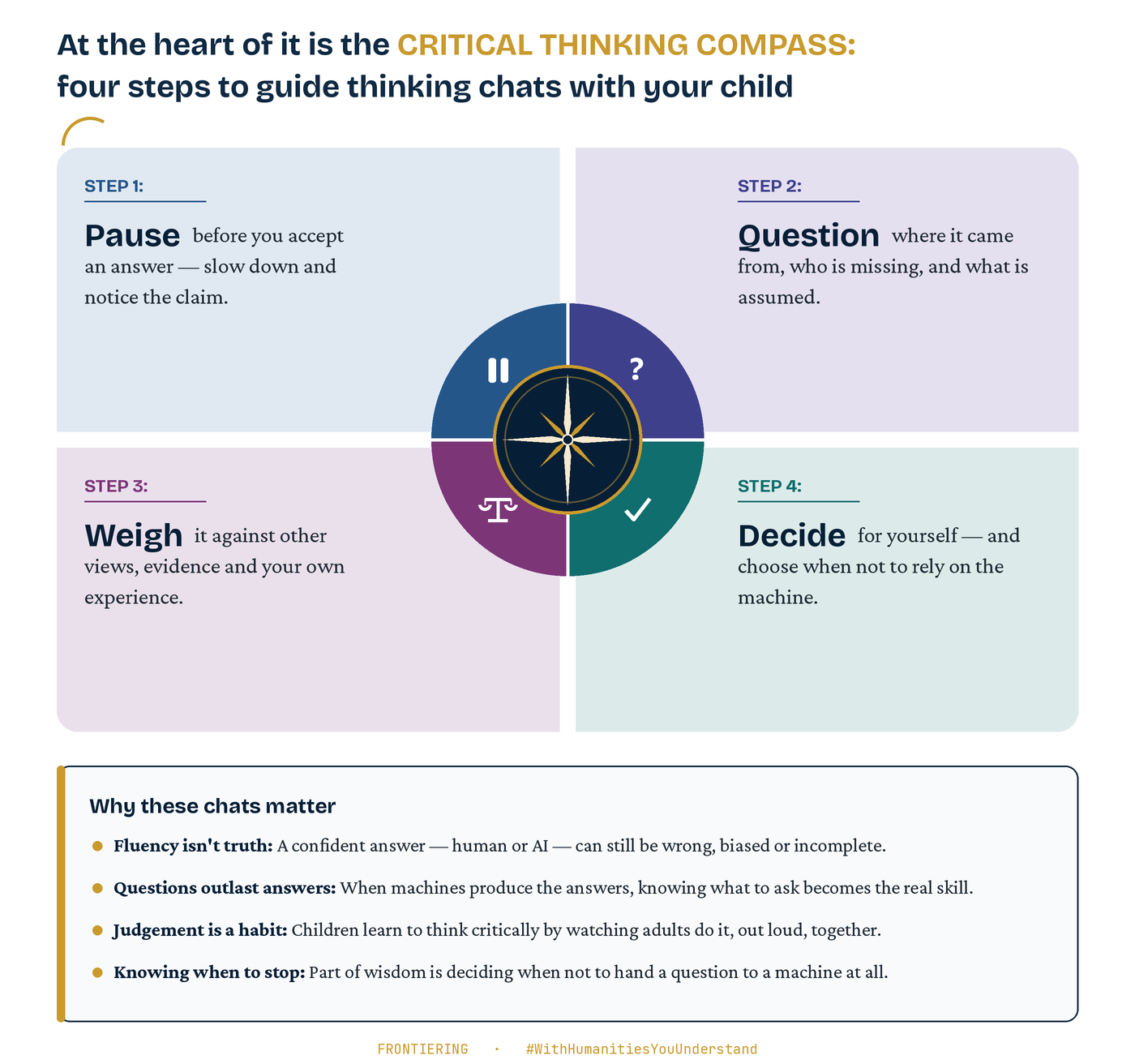
The Critical Thinking Compass — a Frontiering companion to CSIRO's Conversation Compass, built on the humanities habits of judgement.
What to keep in mind
Fluency isn't truth
A confident, well-written answer — human or AI — can still be wrong, biased or incomplete. Polish is not proof.
Questions outlast answers
When machines produce the answers, knowing what to ask becomes the real skill — and it is a skill you can model.
Judgement is a habit
Children learn to think critically by watching adults do it — out loud, together, without pretending to know everything.
The four steps
Step 1 — Pause. Slow down before accepting an answer. Notice the claim being made. A simple opener: "Interesting — how do we know that is actually true?" The pause itself teaches that an answer is the start of thinking, not the end of it.
Step 2 — Question. Ask where the answer came from, who might be missing from it, and what it quietly assumes. Try: "Who would disagree with this?" · "What is not being said here?" · "Where do you think the AI got this from?"
Step 3 — Weigh. Compare the answer against other views, real evidence and your child's own experience. "Let us find one source that agrees and one that does not." · "Does this match what we actually saw?" Weighing is where an opinion becomes a judgement.
Step 4 — Decide. Help them reach their own view — and recognise when not to hand a question to a machine at all. "What do you reckon, and why?" · "Is this a question a chatbot should answer, or one we should think through ourselves?"
Try these conversation prompts
You do not need to know the answers — exploring together is the point. These work when an AI answer, a video or a headline lands in front of you both.
Other openers worth keeping in your back pocket:
- On any AI answer: "It sounds very confident. How could we check if it is right?"
- On a news feed or video: "Why do you think this showed up for us? Who wanted us to see it?"
- On a strong claim: "Who benefits if we believe this? Who might be left out of it?"
- On a disagreement: "Two sources say opposite things — how do we decide who to trust?"
- On the tool itself: "When is it smart to use AI for this, and when is it lazy?"
- On a perfect-sounding essay or image: "What would make us pause before sharing this?"
Hit a roadblock?
"What if I do not know enough to judge the answer myself?"
You do not have to. The skill you are modelling is not knowing — it is checking. Say so out loud: "I am not sure either — let us work out how we would find out." Co-investigating teaches more than having the answer ever could.
"What if my child trusts the AI more than me?"
That is a conversation, not a defeat. Ask why they trust it — speed? confidence? it being always available? Then explore together where that trust is well placed and where it is not. The goal is not to win; it is to build the habit of asking.
"What if I do not have time for a big talk?"
There is no big talk needed. These are thirty-second moments — in the car, over a screen, at the dinner table — whenever an answer appears. One good question is enough.
Why this matters
CSIRO's compass helps children see the STEM already in their world. This companion helps them stay the author of their own judgement as AI fills that world with instant answers. The two belong together — because the future will need young people who can both build with technology and question what it hands them.
#WithHumanitiesYouUnderstand
Structure inspired by CSIRO's STEM Conversation Toolkit (Generation STEM, CSIRO, 2026). All wording here is original to Frontiering; no CSIRO text is reproduced.
Sure, with STEM you can
So yes: with STEM you can. But with humanities, you can understand. You can understand people. You can understand power. You can understand culture. You can understand truth claims. You can understand history. You can understand ethical consequences. You can understand why the most efficient solution is not always the most human one.
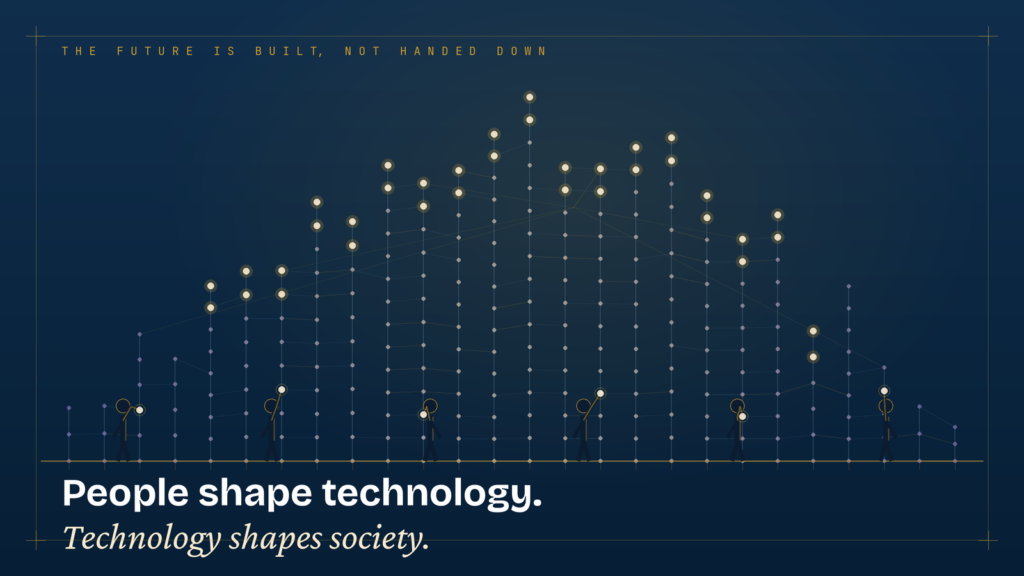
And perhaps most importantly, you can understand that the future should not be something handed down by those with the most technical power. It should be something discussed, questioned, challenged and shaped by all of us.
The future needs more than intelligence
The AI-powered world will not simply need more intelligence. It will need wisdom. It will need judgement. It will need communities that can deliberate rather than merely consume. It will need citizens who can question the systems they are asked to trust. It will need students who can move across disciplines, translate between worlds and ask what kind of society technology is serving.
So perhaps the campaign we need now is not a rival to #WithSTEMYouCan. Perhaps it is its necessary companion.
Sure, with STEM you can. But with humanities, you can understand.
And if we bring them together, perhaps we can tip the balance towards a future in which all humans have the chance to learn, discuss and contribute — not just to the technologies of the future, but to the meaning of the future itself.
#WithHumanitiesYouCanUnderstand
Source notes for the in-text citations
- UNESCO, 2023 — UNESCO's guidance on generative AI in education says the aim is to develop human capacity for a human-centred vision of these technologies, and sets out ethical, safe, equitable and meaningful use.
- UNESCO, 2026 — UNESCO's digital education page states that its AI competency frameworks prioritise human agency, critical thinking and ethics among students and teachers.
- Australian Government, 2026 — StudyAssist lists 2026 student contribution amounts: Communications, Society and Culture in the $17,399 cluster; Engineering, Environmental Studies and Science at $9,537.
- Reuters, 2026 — Reuters reports OpenAI's confidential IPO filing, possible valuation up to US$1 trillion, SpaceX's reported US$75 billion offering at US$1.75 trillion valuation, and Anthropic's filing after a US$65 billion round valuing it at US$965 billion.
- ABC, 2026 — ABC reports SpaceX going public and notes Australian government concerns about reliance on Starlink.
- Ashesi University, 2026 — Ashesi describes its humanities and social sciences work across leadership, ethics, African studies, language, communication, community service and Giving Voice to Values.
- World Bank, 2020 — The Ashesi case study describes the first two years combining calculus, physics, economics, social science theory, writing and African studies, including history, literature, art and music.
- SSIR, 2026 — SSIR's Ashesi case notes that Ghanaian stakeholders valued the liberal-arts model for critical thinking, clear communication and navigating complexity.
- Casagranda, 2025 — Roy Casagranda argues for the civic importance of critical thinking in education.
- Snyder, 2017 / 2024 — Snyder's On Tyranny is widely summarised around truth, institutions, language, investigation and resistance to authoritarianism; On Freedom develops ideas of factuality and solidarity.