

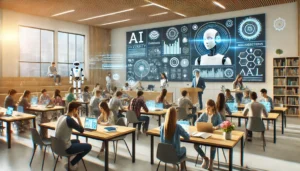
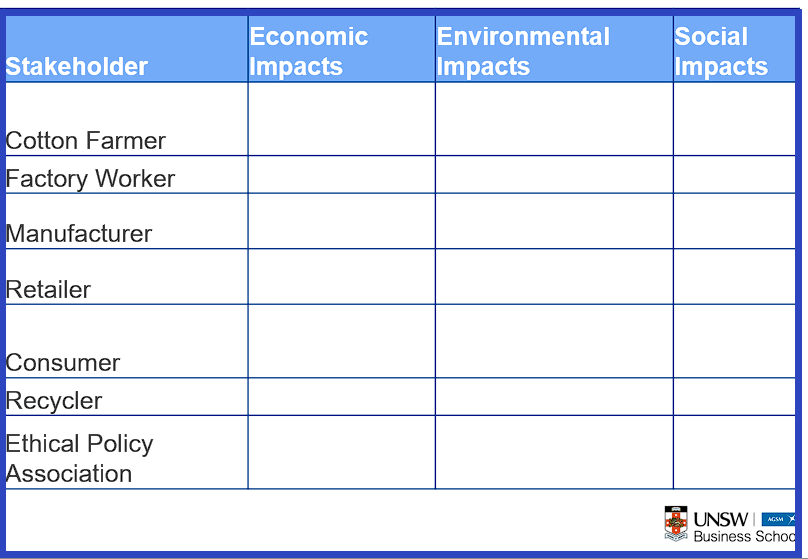
 There is something unique and different about the emotional impact you get when you are given the opportunity to know new things with and through others. Human-AI dialogical engagement provides new opportunties for this , , & (2023). The following post documents one such experience. As part of an Ethics and Sustainability lesson, we played thie Cycle of a T-shirt video in order to promote a discussion about the environmental impact of fast fashion. Following the video student groups were allocated a stakeholder role (Farmer, Manufacturer, Retailer, Consumer, Recycler, Ethics policy association) and asked to come back with what I call the “half PESTLE” or the Economic, Environmental and Social impacts to that stakeholder.
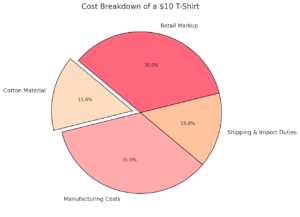
 Getting your “Cotton on” As each group presented their outputs, I encouraged questions to help us collaboratively learn about Cotton. By the end of the exercise, I knew so much more about something I knew very little about. The charts that AI was providing also felt unique to the cohort helping to solidify the collaborative learning, and perhaps provides a good example of how AI can be used within teaching to increase AI literacy.
- How has the price of cotton changed over the last 30 years?

- How does cotton’s environmental impact compare to crops like corn or wheat?
- If a T-shirt costs $10, how would you break down its cost components?
Google Notebook As I travelled home at 10pm, I was reflecting on whether it was worth writing up some notes to summarise our learning. Having wanted to test out Google Notebook for the last couple of weeks, I felt inspired to leverage this experience for that purpose. So the rest of this post talks about Google’s Notebook LLM and how it can be used to quickly summarise a particular area of knowledge. Google’s Notebook LLM is a website tool where you add documents, youtube links, or website links around a particular knowledge area. Once you have a few sources then you are able to chat to some or all of them and leverage Gemini AI to augment the knowledge additional inferences. Of course you can do the same with OpenAI, or Claude AI projects – but 2 things that Google NotebookLLM does it that the process of chatting to your knowledge book seamlessly allows you to store the output of these chats as “Notes” which quickly become part of the knowledge pool further giving scope and definition to it. From last nights class, I captured the charts and some of the information from the breakout group’s discussions around the Cycle of a T-shirt video as well as the additional questions I asked, and the resulting charts into a PDF document. Then to provide more context I added some additional video links (e.g. the Fairtrade video on cotton, and some academic papers including a few systematic reviews on cotton and sustainability. The resulting notebook looks something like this.
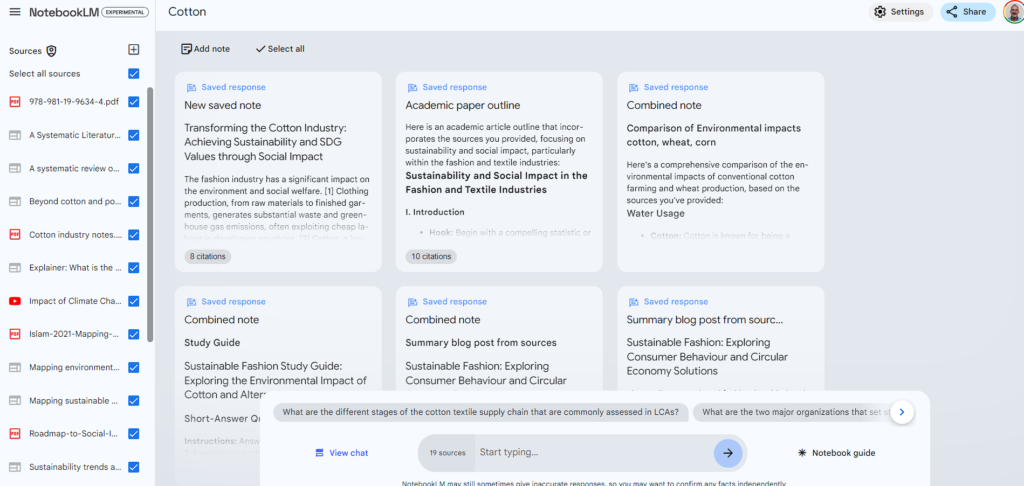
 cotton-on
You can visit this notebook here https://notebooklm.google.com/notebook/a7ec34d0-ac04-46e3-9e3c-e834367cc492 Once you have all that you can create summaries, FAQ’s, and various other automated outputs. One cool feature is located inside Notebook Guide, where there is an option to create an “Audio Overview” which is scripted like a 2 person podcast – fully automatically generated but it sounds like 2 people chatting about Cotton. You can listen to the 6 min podcast here
What I think is cool abour this is that you can generate the same result where any group of people want to collaboratively want to know something new.
Try Google Notebook out now for one of your hobbies
Incidentally, here’s my short synopsis of how to Transform the Cotton Industry through Social Impact
References , , & (2023). Human and artificial intelligence collaboration for socially shared regulation in learning. British Journal of Educational Technology, 54, 1057–1076. https://doi.org/10.1111/bjet.13325