

Generative AI has produced an assessment crisis in education, but perhaps not the crisis we first imagined.
The obvious concern is academic integrity. Can students now submit work they did not really write? Can teachers detect machine-generated prose? Can universities make assignments “AI-proof”? These are legitimate questions. But they are not the deepest ones.
What exactly did we think the submitted artefact was proving?
- The essay was never the learning.
- The report was never the learning.
- The reflective journal was never the learning.
- The slide deck was never the learning.
- The business case, the literature review, the strategy proposal and the polished paragraph were never the learning.
They were artefacts from which educators inferred learning.
That inference used to feel reasonably safe. A well-structured essay probably suggested that a student had read, thought, organised and argued. A clear report probably suggested that the student could analyse a problem. A reflective journal probably suggested some level of personal insight. But generative AI weakens that chain of inference because it can now produce plausible versions of these artefacts at speed and scale.
This does not mean students have learned nothing. It does not mean every use of AI is dishonest. It means the artefact can no longer carry the full evidentiary burden of learning.
AI has exposed the scaffolding
Daniel Miessler recently identified five AI shifts that are likely to matter deeply: autonomous component improvement, intent-based engineering, the move from opacity to transparency, the recognition that much work is scaffolding, and the diffusion of expertise into public knowledge. His post is not primarily about education, but it lands directly in the middle of the assessment problem. (Daniel Miessler)
The most powerful idea is scaffolding.
A great deal of knowledge work is not the “hard thinking” itself, but the surrounding structure: templates, summaries, formatting, workflows, documentation, conventions, introductions, definitions, references, transitions and polished presentation. Miessler argues that AI is especially good at compressing and automating this scaffolding. (Daniel Miessler)
In education, that is uncomfortable. Much of what we assess has traditionally included the scaffolding of academic work.
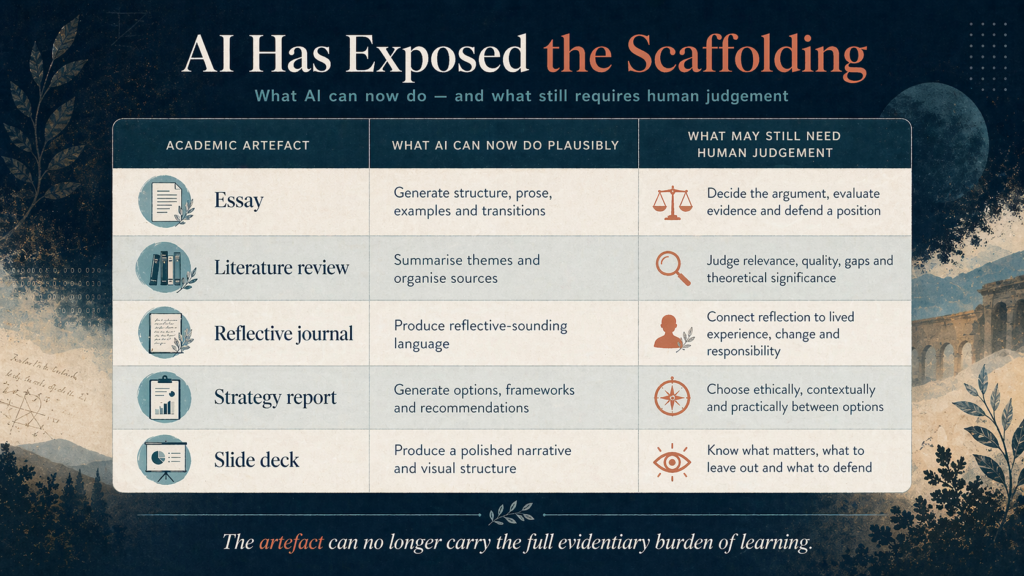
This is why the “AI cheating” frame is too small. AI does not merely help students avoid work. It exposes which parts of the work were scaffolding all along. Once we see that, the educational question changes.
It is no longer enough to ask: Did the student produce the artefact?
We must ask: What capability does this artefact actually evidence?
The problem is assessment inference
Assessment has always involved inference. We look at something a student has produced and infer what they understand, value or can do. A grade is not a direct measurement of learning. It is a judgement made from evidence.
The problem is that generative AI changes the evidentiary value of many familiar tasks.
- A polished report may show that the student used a good tool.
- A fluent paragraph may show that the prompt was well formed.
- A tidy reference list may show that a system can format sources.
- A reflective statement may show that AI can imitate reflective language.
None of these necessarily shows that the student has developed judgement.
The artefact still matters. Students should still write, analyse, design, explain, present and create. But we should stop pretending that the final product is always enough.
Five AI ideas translated into education
Miessler’s five ideas can be translated quite directly into assessment design.
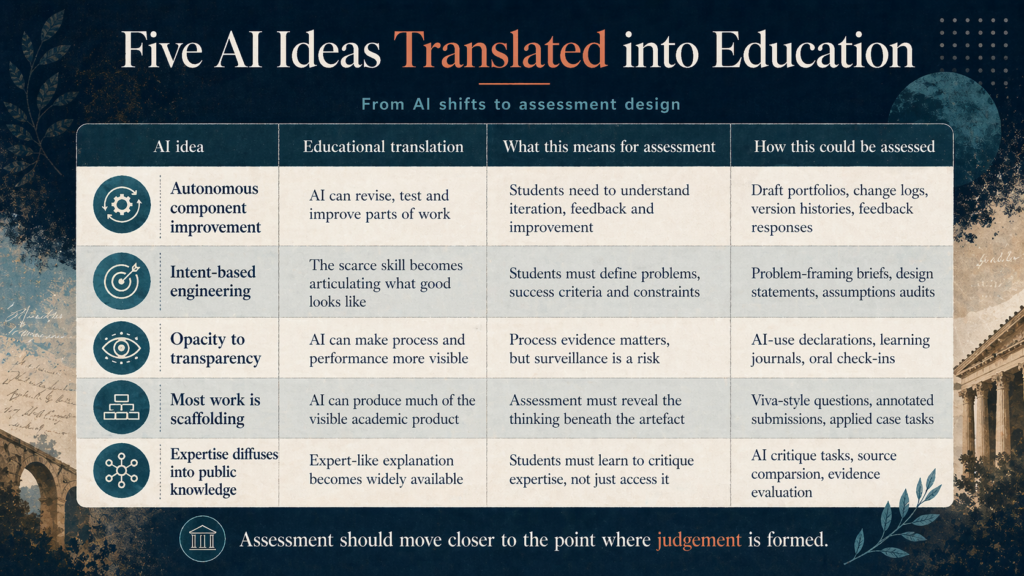
The point is not to abandon traditional assessment. It is to ask traditional assessment to do less pretending.
- An essay can still be valuable. But an essay plus an oral defence tells us more.
- A report can still be useful. But a report plus a decision log tells us more.
- A strategy proposal can still matter. But a strategy proposal plus an assumptions audit tells us more.
- A reflection can still be powerful. But reflection linked to specific choices, failures and feedback tells us more.
AI does not remove the need for assessment. It removes our excuses for assessing the wrong thing.
Intent may become the graduate capability
One of Miessler’s strongest claims is that the new scarce skill is not prompting, coding or tool use. It is the capacity to articulate intent: to say clearly what one wants, what counts as good, and how success can be evaluated. (Daniel Miessler) That is profoundly educational.
In a world of generative AI, students will be able to produce more outputs than ever before. But more outputs do not necessarily mean better thinking. A student can ask AI for ten strategies, five policy options, three business models or a full essay plan.
The harder question is whether the student can judge the output.
- Is this answer any good?
- For whom?
- Under what assumptions?
- With what evidence?
- With what ethical risks?
- What has been left out?
- What would change my mind?
That is where education should be aiming. In professional education, this matters enormously. Poor problem-framing can be more damaging than poor execution. AI can accelerate a badly framed task just as easily as a well-framed one. It can get us to the wrong place faster, with better formatting.
So assessment should move upstream.
- Before asking students for a solution, ask them to define the problem.
- Before asking them for a polished report, ask them to name their assumptions.
- Before rewarding the final recommendation, ask them to explain the criteria by which alternatives were rejected.
This is not anti-AI. It is better education.
What I am seeing in my own teaching
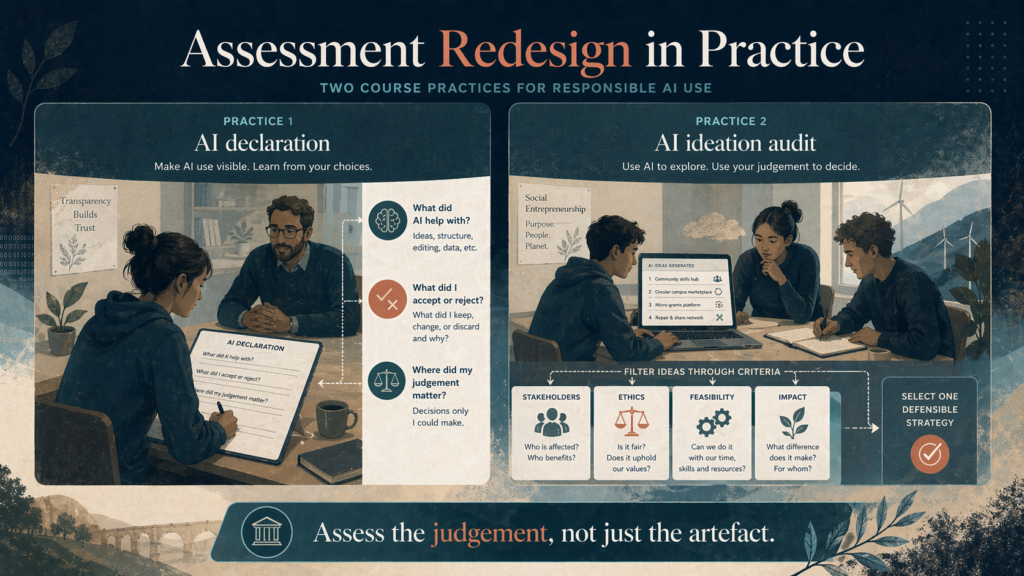
This semester, one of the management subjects I teach on Responsible Business Professionalism used a generative AI declaration form to ask students to reflect on how they used AI. At one level, this is a compliance mechanism. It asks students to disclose whether and how they used AI.
But used well, it can be more than that. It can become a learning artefact.
The important questions are not merely “Did you use AI?” or “Which tool did you use?” The more educational questions are about what AI helped students do, what it did not help them understand, what they accepted, rejected or revised, and where their own judgement entered the work.
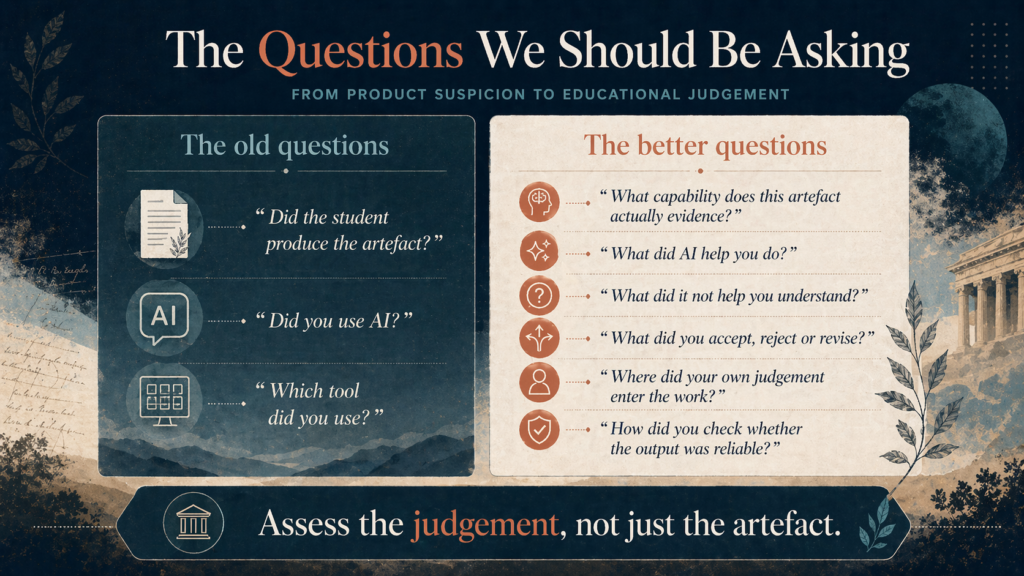
This matters because AI declarations should not become bureaucratic theatre. If they are only tick-box exercises, they will train students in compliance language rather than reflective judgement. But if they ask students to explain their process, they can shift the assessment conversation from concealment to accountability.
In my Social Entrepreneurship subject, we allow AI to be used for the ideation of strategies. That makes sense in this context because social entrepreneurship is not simply about generating ideas. It is about judging which ideas are ethically defensible, socially useful, financially possible and responsive to stakeholder realities.
AI can generate possible strategies very quickly. It can suggest interventions for youth unemployment, disability employment, circular economy ventures, aged care navigation or food insecurity. But ideation is not the same as strategy.
A language model cannot know, by itself, whether a strategy is locally legitimate. It cannot fully understand lived experience. It cannot decide whether an intervention respects the people it claims to help. It cannot know whether a proposal is culturally safe, politically feasible or financially sustainable.
That remains the student’s work. So the assessment challenge is not to ask whether AI was used to produce ideas. The better question is:
Can the student move from many possible ideas to one defensible strategy?
AI ideation audit
A way to assess judgement, not just the artefact.
| Component | Purpose |
|---|---|
| Original prompt | Shows how the student framed the task. |
| AI-generated options | Shows the range of possible strategies considered. |
| Selection criteria | Shows what the student believed mattered. |
| Rejected options | Shows judgement, not just acceptance. |
| Final rationale | Shows why one strategy was chosen over others. |
| Stakeholder and ethics check | Shows whether social value was taken seriously. |
This would not assess the machine’s fluency. It would assess the student’s judgement.
Detection is not enough
There is a temptation for institutions to respond to generative AI with detection systems, locked-down exams and tighter surveillance. Some of that may have a place in specific circumstances. But as a general educational response, it is too thin.
TEQSA’s assessment reform paper argues that generative AI has exacerbated existing assessment challenges, while also noting that higher education already has substantial expertise in designing assessment for a digital world. It calls for assessment practices that both manage risk and take advantage of the opportunities created by generative AI. (TEQSA)
That is the right direction.
The goal should not be to make every assessment AI-proof. That is likely impossible, and in many cases undesirable. The goal should be to make assessment more valid, more transparent and more closely aligned with the capabilities we actually care about.
The AI Assessment Scale is useful here because it recognises that different tasks may legitimately permit different levels of AI use, from no AI through to full AI collaboration. The pilot study at British University Vietnam presented the AIAS as a framework for incorporating generative AI into assessment while focusing on areas requiring human input and critical thinking. (AJET)
This is a more mature position than blanket prohibition. It accepts that AI use is not one thing. It may be inappropriate in one task, acceptable in another, and essential in a third.
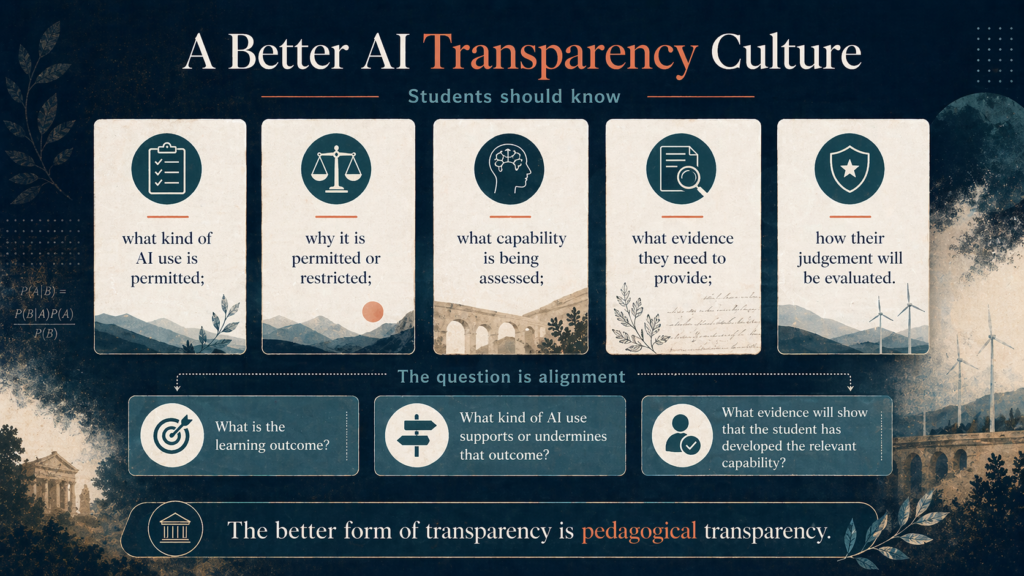
The question is alignment.
- What is the learning outcome?
- What kind of AI use supports or undermines that outcome?
- What evidence will show that the student has developed the relevant capability?
Assessment twins and triangulated evidence
One promising idea is the use of assessment twins. Roe, Perkins and Giray define assessment twins as deliberately linked assessment components that target the same learning outcomes through different modes of evidence. For example, an essay might be paired with an oral defence, or a report with a live case discussion. Their argument is that this can strengthen assessment validity without relying solely on surveillance technologies. (arXiv)
This idea is useful because it avoids a false binary. We do not have to choose between trusting the artefact blindly and distrusting every student. We can design better evidence.
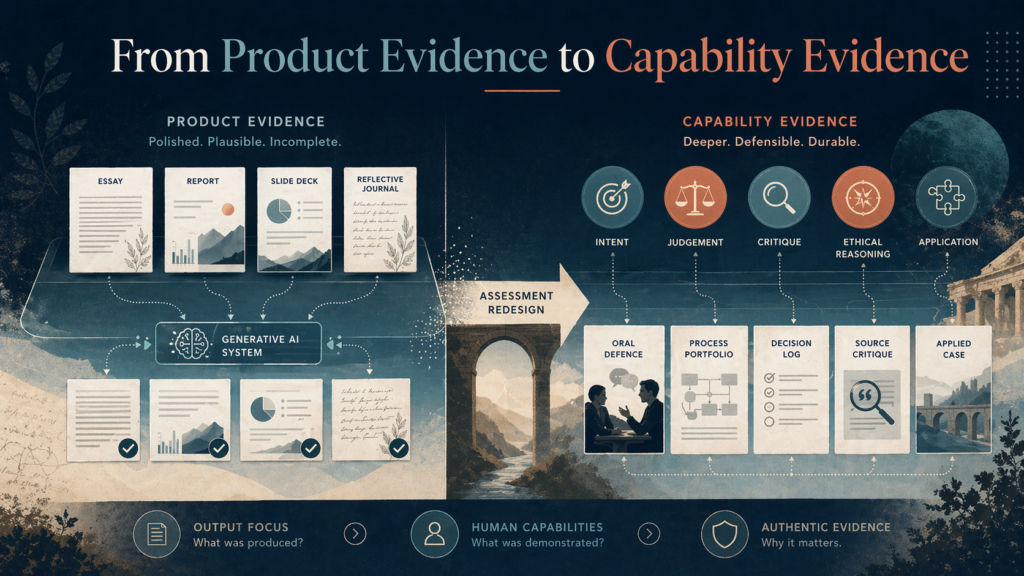
| AI-vulnerable task | Assessment twin | What the twin reveals |
|---|---|---|
| Essay | Oral defence | Whether the student understands and can extend the argument. |
| Strategy report | Decision log | How options were selected, rejected and justified. |
| Literature review | Source critique | Whether the student can judge evidence quality. |
| Reflective journal | Learning interview | Whether reflection is grounded in real experience. |
| Business proposal | Live scenario response | Whether the student can adapt under constraints. |
This is not about catching students out. It is about seeing more of the learning.
The danger of the assessment panopticon
There is, however, a real danger in the language of visibility.
AI can make processes more visible. Draft histories, prompt logs, platform analytics, keystroke records and automated monitoring can all generate more data about students. But more data does not automatically mean more learning. It can also mean more surveillance.
UNESCO’s guidance on generative AI in education and research stresses the need for a human-centred approach, including attention to data privacy, ethical use, equity and meaningful pedagogical design. It also notes that generative AI tools are developing faster than many regulatory frameworks. (UNESCO)
That warning matters.
Students should not be treated as suspects by default. We should not respond to AI by building an educational panopticon where every keystroke is monitored and every draft is treated as forensic evidence.
The better form of transparency is pedagogical transparency.
Students should know:
- what kind of AI use is permitted;
- why it is permitted or restricted;
- what capability is being assessed;
- what evidence they need to provide;
- how their judgement will be evaluated.
That is a very different culture from surveillance. It is not about watching students more closely. It is about designing assessment more honestly.
From product evidence to capability evidence
The shift education needs is not complicated, but it is significant.
| Old assessment assumption | AI-era weakness | Better assessment direction |
|---|---|---|
| The final essay shows what the student knows | AI can produce plausible prose | Essay plus oral defence or annotated reasoning. |
| Referencing shows academic discipline | AI can format references mechanically | Ask students to explain why sources matter. |
| A polished report shows competence | AI can polish weak thinking | Assess assumptions, trade-offs and decision logic. |
| Reflection shows learning | AI can simulate reflective language | Link reflection to specific incidents and feedback. |
| A good idea shows creativity | AI can generate many ideas | Assess selection, adaptation and ethical judgement. |
The future of assessment is not simply more invigilation. Nor is it a naïve embrace of every new tool.
It is a return to a deeper educational question:
What kind of person is this assessment helping the student become?
That may sound old-fashioned, but it is precisely the question AI forces back onto the table.
If AI can produce the artefact, then education must become clearer about the capability beneath the artefact. If AI can generate the summary, then students must learn to evaluate the summary. If AI can produce the strategy, then students must learn to test the strategy. If AI can imitate reflection, then students must learn to connect reflection to actual responsibility and change.
Conclusion: the artefact was never the learning
Generative AI has not made assessment impossible. It has made weak assessment visible.
It has exposed the danger of treating polished artefacts as if they were direct evidence of learning. The essay, report, reflection, business case and slide deck may still matter. But they should no longer be asked to carry the whole burden of proof.
The task now is to design better evidence.
Students should still write, analyse, design, calculate, present and create. But they should also be asked to define intent, document process, critique outputs, defend decisions, respond to feedback and apply knowledge in unfamiliar contexts.
The institutions that adapt well will not be those that simply ban AI. Nor will they be those that adopt it uncritically in the name of efficiency. They will be those that use AI to ask a more honest question:
What human capabilities are worth forming when the scaffolding of knowledge work can increasingly be automated?
That is the real curriculum question. And it is also the assessment question.
References
- Furze, L., Perkins, M., Roe, J., & MacVaugh, J. (2024). The AI Assessment Scale (AIAS) in action: A pilot implementation of GenAI supported assessment. Australasian Journal of Educational Technology.
- Miessler, D. (2026). The most important ideas in AI right now.
- Miao, F., & Holmes, W. (2023). Guidance for generative AI in education and research. UNESCO.
- Roe, J., Perkins, M., & Giray, L. (2025). Assessment twins: A protocol for AI-vulnerable summative assessment. arXiv preprint.
- Tertiary Education Quality and Standards Agency. (2023). Assessment reform for the age of artificial intelligence. TEQSA.