

In a world increasingly shaped by artificial intelligence (AI), taxonomies might seem like a dusty relic of library science or high-school biology. However, far from being archaic, they are a foundational building block of AI literacy. In fact, understanding how classification systems work—how they are built, critiqued, and deployed—is crucial for anyone seeking to comprehend or co-create AI systems, especially in humanistic domains like the arts.
1. What Is a Taxonomy?
A taxonomy is a structured classification system used to organise concepts, objects, or entities based on shared characteristics. At its core, it is a hierarchical model, grouping similar items under broader categories to help make sense of complexity (Nickerson, Varshney & Muntermann, 2013). Taxonomies can be both descriptive (describing what is) and prescriptive (defining how things should be grouped).
In practical terms, a taxonomy is a scaffold for thinking. It enables us to place phenomena into conceptual “boxes,” allowing for faster retrieval, clearer communication, and more coherent analysis.
2. Common Examples of Taxonomies
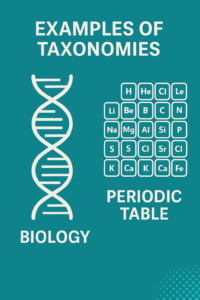
Taxonomies are embedded in the everyday systems we rely on:
- Biology: The Linnaean system classifies life forms from kingdoms down to species.
- Libraries: The Dewey Decimal and Library of Congress systems sort books by subject matter.
- Art and Culture: Movements, genres, mediums, and periods (e.g. Cubism, watercolour, Baroque) form taxonomies used by curators, historians, and AI models alike.
These examples highlight how taxonomies are used not only to classify but also to narrativise—structuring understanding over time and across disciplines.
3. Why Taxonomies Matter for AI (Especially in the Arts)
The contemporary relevance of taxonomies is heightened by their central role in AI systems, which depend on structured datasets to operate effectively. In the arts, where ambiguity and nuance are prized, taxonomies offer a counterbalance—enabling AI tools to interact meaningfully with human creativity.
Applications in AI-Enhanced Arts Practice
| Function | Role of Taxonomy | Example |
|---|---|---|
| Data Organisation | Structures the input datasets AI learns from | Training a model on Renaissance vs. Baroque artworks |
| Search and Retrieval | Supports fast, accurate querying | Museum databases filtered by era, medium, or artist |
| Recommendation Systems | Enables clustering and pattern recognition | Spotify-style art apps suggesting similar paintings |
| Curatorial Decision-Making | Provides a framework for AI-human collaboration | AI-assisted exhibition design based on themes or motifs |
| Creative Augmentation | Helps artists explore adjacent categories and styles | Generative art tools that propose variations based on taxonomy |
Understanding taxonomies thus becomes a literacy in its own right—a way of comprehending how AI classifies, associates, and “makes sense” of the world.
4. How to Learn or Build a Taxonomy for a Given Topic
Developing a taxonomy is both an analytical and creative act. The steps below mirror traditional research processes, but can also be adapted into practical workshops or learning modules.
Step-by-Step Guide to Building a Taxonomy
| Step | Action | Example in Arts Context |
|---|---|---|
| 1. Identify Key Themes | Define the domain’s primary elements | Artistic medium, movement, themes |
| 2. Research Frameworks | Explore existing classifications in scholarship and practice | Museum catalogues, art historical literature |
| 3. Subdivide Thoughtfully | Break down larger categories into finer-grained distinctions | Modernism → Abstract Expressionism → Colour Field |
| 4. Consult Authorities | Engage experts, metadata standards, or institutional guidelines | Getty Vocabularies, Artstor, or academic experts |
| 5. Validate and Iterate | Apply the taxonomy to real data, adjust based on anomalies | Classify a sample of works, adjust overlapping tags |
This approach reinforces the fact that taxonomies are not static—they evolve with usage, discourse, and new knowledge.
5. Alignment with Research Methodology
Taxonomies align with core processes in academic and scientific research, making them an accessible bridge for students transitioning into AI studies or digital scholarship.
- Literature Review: Like a taxonomy, a literature review identifies existing structures in knowledge (Webster & Watson, 2002).
- Conceptual Frameworks: Taxonomies serve as a kind of theory-lite—structuring our lens on phenomena.
- Data Collection and Analysis: Just as datasets require coding and categorisation, so too does a working taxonomy.
- Validation: Peer review in research parallels the testing and refining of a taxonomy with domain experts.
- Ongoing Revision: Like a living document, a good taxonomy adapts to change—new artefacts, perspectives, and applications.
6. Integrating Taxonomy Thinking in Teaching AI Literacy
The following table outlines strategies for integrating taxonomy-building into AI literacy education, especially for students in the humanities and creative disciplines.
Integrating Taxonomy Learning in AI Literacy Curriculum
| Activity Type | Description | Learning Outcome |
|---|---|---|
| Reverse Engineering | Analyse an AI tool’s classifications (e.g. Midjourney outputs) | Understand implicit taxonomies in AI systems |
| Taxonomy Jam | Group-based activity to create taxonomies from raw content | Learn iterative, collaborative classification |
| Compare + Critique | Evaluate multiple taxonomies in a field (e.g. music genres) | Build critical awareness of classificatory choices |
| Metadata Mapping | Tag artworks or texts using an agreed-upon vocabulary | Apply standards; observe gaps or biases |
| AI vs Human Labelling | Compare AI-generated tags to human-curated ones | Explore tensions between machine logic and human nuance |
Such activities position taxonomy not as mere filing but as a foundational cognitive and ethical process. Who gets to define the categories? What is excluded? How does classification shape perception?
7. In Summary
Taxonomies are much more than static hierarchies—they are tools of cognition, communication, and computation. In the age of AI, literacy in taxonomy building and critique offers a critical edge, especially in fields like the arts where meaning, context, and classification intertwine.
By learning how to build and challenge taxonomies, students and practitioners become not just consumers of AI systems, but active interpreters and co-creators.
References
Nickerson, R. C., Varshney, U., & Muntermann, J. (2013). A method for taxonomy development and its application in information systems. European Journal of Information Systems, 22(3), 336–359. https://doi.org/10.1057/ejis.2012.26
Webster, J., & Watson, R. T. (2002). Analyzing the past to prepare for the future: Writing a literature review. MIS Quarterly, 26(2), xiii–xxiii