

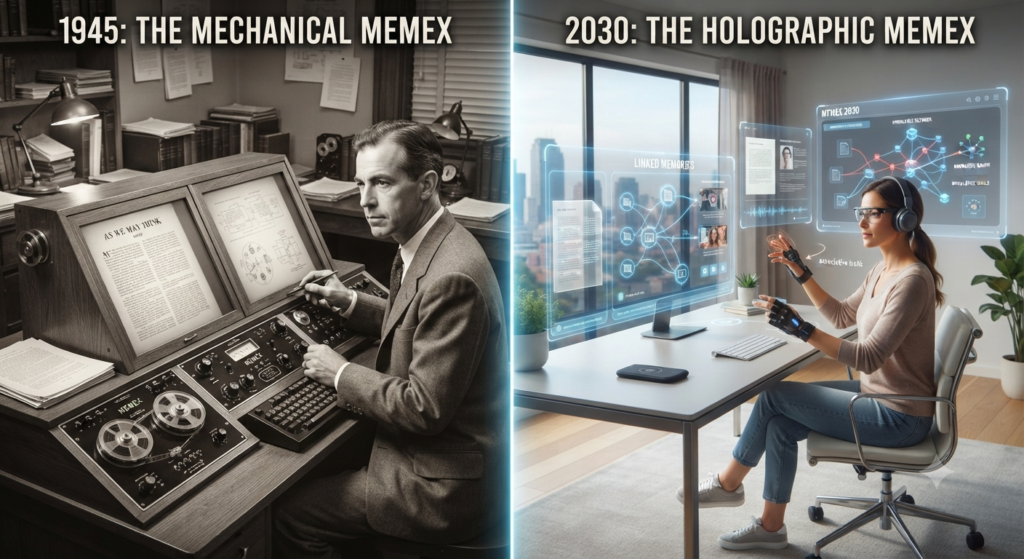
Vannevar Bush imagined a machine that could extend human memory. Eighty years later, artificial intelligence is turning that mechanical vision into an active partner for teaching, research, travel and decision-making.
In 1945, American engineer Vannevar Bush published an extraordinarily prescient essay titled As We May Think.
Bush was concerned about a problem that now feels remarkably familiar: humanity was producing information faster than individuals could organise, retrieve or meaningfully use it. Researchers were becoming overwhelmed by a rapidly expanding “mountain” of knowledge, while conventional filing systems remained rigid, hierarchical and slow.
His proposed solution was the Memex—a combination of memory and index.
The Memex was imagined as a desk-like mechanical device containing a person’s books, records, correspondence and notes on microfilm. Its most important feature was not storage capacity, however. It was the ability to create what Bush called associative trails: persistent links between related pieces of information.
Rather than forcing knowledge into a single filing category, the Memex would allow its user to move between ideas in much the same way that the human mind does—through association.
Bush’s Memex was never constructed as he described it. Yet its underlying philosophy anticipated hypertext, personal computing, digital libraries, knowledge graphs and, perhaps most significantly, today’s AI-enabled “second brain”.
The Memex has moved from furniture to software
The contemporary Memex is not one device. It is an architecture.
It may include:
a personal knowledge repository;
searchable documents and notes;
links between concepts;
an AI model capable of interpreting those materials;
automated processes for organising and updating information; and
a workflow that converts knowledge into decisions.
This is the key distinction between an ordinary digital archive and an AI second brain.
A conventional archive stores information.
A second brain helps us think with it.
That difference is increasingly important. Most people do not suffer from a lack of information. They suffer from fragmentation: documents distributed across email, cloud drives, learning-management systems, bookmarks, messaging applications, notebooks and browser tabs.
Search can help us locate a document we already know exists. It is less effective at identifying relationships we have forgotten, detecting patterns across multiple projects or suggesting what we should do next.
Today’s Memex therefore needs three capabilities:
Memex function Contemporary equivalent
Store the record Files, notes, transcripts and databases
Create associative trails Links, tags, embeddings and knowledge graphs
Extend human reasoning AI synthesis, analysis and recommendation
The third capability is what makes the present moment qualitatively different.
Wes Roth’s AI second-brain model
A useful demonstration of this emerging architecture appears in Wes Roth’s video on building an AI second brain.
Roth’s approach combines three broad layers.
1. Obsidian as the vault
Obsidian provides the underlying knowledge environment. It stores notes as ordinary Markdown files inside a local folder, or “vault”, rather than locking the user’s knowledge inside a proprietary document format. According to Obsidian’s documentation, these files remain accessible through other editors and file-management tools, providing a degree of portability and user control.
This local-first principle matters.
A second brain may contain years of accumulated intellectual work: research notes, teaching materials, project histories, reflections, plans and partially formed ideas. Such a system should not disappear because a subscription ends, a platform changes direction or an online service closes.
The files should belong to the user.
2. The AI as librarian and programmer
In Roth’s model, an AI agent performs work that would otherwise require substantial manual effort. It can:
read newly added material;
summarise it;
classify and rename notes;
identify relevant existing material;
create links between related concepts;
maintain indexes;
update project records; and
propose actions arising from the information.
This is more than an advanced search function. The AI becomes a form of active librarian.
A traditional librarian helps us navigate a collection. An AI librarian can also restructure the collection, generate a synthesis and produce a tailored response to a particular question.
It may also function as a programmer by carrying out repeatable workflows according to written rules. A configuration file can specify how incoming material should be processed, what metadata should be added and where different outputs should be placed.
3. The doctrine as the action layer
The final layer is what Roth describes as the strategic or “doctrine” layer.
This is where the second brain stops merely describing what it knows and begins converting that knowledge into decisions.
For example, an AI-enabled vault might:
identify a recurring theme across several research papers;
compare current performance against previous projects;
detect an approaching deadline;
recommend a sequence of next actions;
update a Kanban board;
produce a briefing note; or
identify gaps in the evidence supporting a proposal.
This is an important evolution of Bush’s vision.
Bush imagined a system that preserved and retrieved an individual’s intellectual trails. The AI second brain can inspect those trails and help determine where they should lead next.
A simple architecture for today’s Memex
A practical second brain does not necessarily require a complicated hierarchy. In fact, deeply nested folder systems may create more friction than value.
A relatively flat structure can be sufficient:
Inbox
Raw
Wiki
Projects
Outputs
Archive
The logic is straightforward.
Inbox receives unprocessed information.
Raw preserves source material, transcripts and extracts.
Wiki contains refined and interconnected knowledge.
Projects holds active work and its context.
Outputs contains material ready to publish, teach or use.
Archive stores inactive material without deleting it.
The AI can then assist with the movement from raw material to usable knowledge.
A video transcript enters the Inbox. The AI extracts the principal arguments, identifies relevant concepts and creates a source note. It links that note to existing themes in the Wiki, highlights possible applications to active projects and suggests an output—perhaps a lecture activity, blog post or research question.
The objective is not perfect organisation.
It is reduced cognitive friction.
NotebookLM as a bounded Memex
My own use of Google NotebookLM provides another model of the contemporary Memex.
Rather than creating one enormous knowledge system, I use separate notebooks for bounded areas of inquiry, including:
each university subject I teach;
individual case studies;
research themes;
prospective travel destinations; and
particular projects or decisions.
This produces something closer to a collection of specialist Memexes.
Each notebook contains a defined set of trusted sources. These can include PDFs, websites, Google documents, presentations, audio, video and copied text. NotebookLM then allows the user to question, compare and synthesise those materials within the boundaries of the selected source collection.
This boundedness is valuable.
A general-purpose chatbot may draw from broad training data and open-web material. NotebookLM is designed to ground its analysis in the sources supplied to a notebook. The user can therefore construct a particular intellectual context before asking the AI to reason within it.
A Memex for every subject
For teaching, I create a NotebookLM notebook for each subject.
A notebook might contain:
the course outline;
weekly readings;
lecture notes;
assessment instructions;
marking criteria;
relevant policies;
case materials; and
selected external resources.
This becomes more than a document repository. It becomes an interactive representation of the subject.
Before preparing a lecture, I can ask:
Which concepts recur across this week’s readings?
Where do the authors disagree?
What assumptions are students likely to find difficult?
Which case examples best demonstrate the central theory?
What discussion questions would require application rather than recall?
How does this week’s material connect with earlier topics?
The result is not a substitute for disciplinary expertise. It is a way of bringing more of the subject’s intellectual context into view at once.
That distinction is essential.
An AI second brain should extend judgement, not replace it.
A Memex for case studies
Case studies are especially well suited to this approach because relevant evidence is often distributed across many sources.
A case-study notebook might include:
company reports;
news coverage;
academic articles;
policy documents;
financial information;
interviews;
videos; and
historical background.
NotebookLM can then assist in constructing a timeline, comparing stakeholder perspectives or identifying contradictions between public claims and available evidence.
For students, this can support more sophisticated inquiry. Rather than asking only, “What happened?”, they can investigate:
Why did different actors interpret the situation differently?
What evidence supports each interpretation?
Which information is missing?
How might the outcome change under another theoretical framework?
What lessons can be transferred to a different context?
The Memex becomes an environment for inquiry rather than a container of answers.
A Memex for travel
The same principle applies outside academic work.
For a travel destination, I might create a notebook containing:
guidebooks and travel articles;
accommodation information;
transport timetables;
maps and itineraries;
cultural and historical background;
restaurant notes;
booking confirmations; and
personal recommendations from friends.
I can then ask the notebook to build an itinerary based on my own constraints and interests rather than a generic ranking.
For example:
> Design a four-day itinerary that minimises unnecessary travel, includes the historical sites in my sources, leaves two afternoons relatively unstructured and accounts for the opening hours listed in the attached documents.
This resembles Bush’s Memex surprisingly closely. It gathers a person’s records, connects them through associative trails and makes them available for a specific moment of decision.
The difference is that the modern system can synthesise the trail on our behalf.
From knowledge graph to action graph
Much discussion of second brains focuses on the knowledge graph: the network of relationships between people, concepts, documents, places and events.
Knowledge graphs are useful because meaningful ideas rarely exist in isolation. A note about artificial intelligence may connect with assessment design, academic integrity, organisational strategy, digital sovereignty and the future of work.
However, the next stage may be an action graph.
An action graph connects knowledge not only to other knowledge, but also to:
decisions;
responsibilities;
deadlines;
dependencies;
risks;
unanswered questions; and
measurable outcomes.
Consider a teaching example.
A collection of student feedback identifies confusion about a concept. The second brain connects that feedback to the relevant lecture, assessment item and reading. It then proposes an action: revise the explanation, introduce a worked example and add a formative activity before the assessment deadline.
The information has moved through four stages:
1. Capture: the feedback enters the system.
2. Connection: it is linked to the relevant subject material.
3. Interpretation: the AI identifies a pattern.
4. Action: the system recommends a response.
This is where the AI Memex becomes genuinely useful.
The reduction of cognitive administration
One of the most attractive claims made for AI second brains is their capacity to reduce the administrative burden surrounding knowledge work.
Many academics, managers, entrepreneurs and students spend considerable energy remembering where information was stored, maintaining filing systems, re-reading documents and reconstructing the context of previous decisions.
This invisible work is cognitively expensive.
It is particularly burdensome for people managing many simultaneous projects or those who experience attention and executive-function difficulties. A well-designed second brain can reduce the cost of repeatedly rebuilding context.
The promise is not that we will remember everything.
It is that we will no longer need to manually reconstruct everything before we can begin useful work.
The risks of outsourcing memory
The case for AI-enhanced knowledge systems should not become technological romanticism.
A second brain also creates new risks.
False confidence
A fluent synthesis may appear more authoritative than its sources justify. Users must still inspect citations, test interpretations and distinguish evidence from inference.
Automated disorder
Poorly designed agents can create excessive links, duplicate notes and superficial summaries. Automation does not eliminate information clutter; it can produce clutter at machine speed.
Privacy and intellectual ownership
A personal knowledge system may contain sensitive correspondence, unpublished research, student information, commercial material or private reflections. Decisions about local and cloud storage therefore require careful consideration.
Cognitive dependence
Remembering, categorising and summarising are not merely administrative tasks. They are part of learning. If every act of synthesis is delegated, the user may accumulate a sophisticated archive without developing corresponding understanding.
The freezing of past assumptions
A second brain learns from the material placed within it. If that material contains outdated assumptions or narrow perspectives, the system may repeatedly reproduce them. The vault must therefore remain open to correction, disagreement and revision.
The appropriate objective is not total automation. It is selective cognitive augmentation.
The real test: does the system improve judgement?
A second brain should not be evaluated by the number of notes it contains or the visual complexity of its graph.
It should be evaluated by whether it improves the quality of thought and action.
Useful questions include:
Does the system help me recover context quickly?
Does it reveal connections I would otherwise miss?
Can I trace its claims back to credible sources?
Does it reduce repetitive administrative work?
Does it help me make better decisions?
Does it support reflection rather than merely accelerate production?
Can I retrieve my data independently of the platform?
A visually impressive knowledge graph that never changes a decision is ornamental.
A modest collection of well-selected sources that improves a lecture, strengthens a case analysis or produces a better travel itinerary is a functioning Memex.
The Memex was always about more than memory
Bush’s deepest insight was not that humans needed a larger filing cabinet.
It was that our tools should better reflect the associative character of thought.
Today’s AI systems take that idea further. They can identify trails we did not deliberately construct, compare distant parts of our personal archive and translate accumulated knowledge into possible action.
Obsidian offers a durable, user-controlled foundation. AI agents can maintain and connect the record. NotebookLM can provide focused, source-grounded spaces for subjects, case studies and destinations. Together, these tools suggest that the Memex is no longer a single speculative machine.
It is becoming a personal intellectual infrastructure.
The central challenge is therefore no longer whether we can build a second brain.
It is whether we can build one that strengthens the first.
> Reader question: What would be the most valuable bounded Memex in your own life: one for your profession, each major project, a field of research, or the places you plan to visit?
---
References
Bush, V. (1945), ‘As We May Think’, The Atlantic, July 1945.
Google, ‘NotebookLM: AI Research Tool and Thinking Partner’.
Google, ‘NotebookLM Help’.
Google, ‘Add or discover new sources for your notebook’.
Obsidian, ‘Obsidian: Sharpen your thinking’.
Obsidian, ‘How Obsidian stores data’.
Obsidian, ‘Internal links’.
Roth, W., ‘Building an AI Second Brain’, YouTube video.
htAI Agent by SiteGround
Hi! I am your WordPress AI Assistant. How can I help you manage your site today?
Improve the style and layout of this post using the global CSS elements
I can help, but I need two details first:
Which post should I edit?
Please send the post title, URL, or ID.
What do you mean by “global CSS elements”?
For example:
Existing global CSS classes you want applied
Brand typography/spacing/colors already defined in the theme
Reusable blocks or design system classes
A specific style reference you want matched
One important note: I can safely make surgical content/style-related updates while preserving Gutenberg blocks, shortcodes, and existing markup. If the improvement requires changing the post’s block structure or rebuilding the layout, that should be done in the WordPress Gutenberg Editor or AI Studio sidebar to avoid damaging block markup.
The one we are looking at on this page.  The latest draft post on memex
I found the latest draft post matching “memex”:
Today’s Memex: Building a Second Brain That Does More Than Remember
https://frontiering.com.au/?p=224352
I haven’t changed it yet because the improvement you’re asking for is a layout/style restructure: the post is currently mostly one very long paragraph with line breaks. To improve the design properly, it needs to be converted into headings, lists, tables, pull quotes, callouts, and reference sections. That changes the Gutenberg block structure, which is safest to do directly in the WordPress Gutenberg Editor or via the AI Studio sidebar inside the editor.
You can paste this instruction into the AI Studio sidebar for that draft:
Improve the layout of this post using existing global theme styles and core Gutenberg blocks. Preserve all wording unless small readability fixes are needed. Convert the single long paragraph into a well-structured article using:
a strong introductory lead paragraph after the featured image
H2 headings for each major section
H3 subheadings where appropriate
bullet lists for examples and capabilities
a clean table for the “Memex function / Contemporary equivalent” section
a pull quote or styled quote for the Reader question
a clearly separated References section
consistent spacing using the site’s global styles
no custom inline CSS unless absolutely necessary
preserve the image and caption
Recommended article structure:
Intro
Keep the image and caption.
Add a lead-style opening paragraph.
The Memex Has Moved from Furniture to Software
What Makes an AI Second Brain Different
Convert the “It may include” section into a bullet list.
Convert the “Memex function / Contemporary equivalent” section into a table.
Wes Roth’s AI Second-Brain Model
Use H3 subheadings:
Obsidian as the Vault
The AI as Librarian and Programmer
The Doctrine as the Action Layer
A Simple Architecture for Today’s Memex
Convert Inbox / Raw / Wiki / Projects / Outputs / Archive into a styled list.
NotebookLM as a Bounded Memex
A Memex for Every Subject
A Memex for Case Studies
A Memex for Travel
From Knowledge Graph to Action Graph
The Reduction of Cognitive Administration
The Risks of Outsourcing Memory
Use H3 subheadings for:
False confidence
Automated disorder
Privacy and intellectual ownership
Cognitive dependence
The freezing of past assumptions
The Real Test: Does the System Improve Judgement?
The Memex Was Always About More Than Memory
Reader Question
Style this as a quote or callout.
References
Convert references into a proper list.
If you want, I can still make a safe, non-structural pass from here — for example, tightening wording, fixing line-break clutter inside the existing paragraph, or improving the excerpt — but the full visual/layout upgrade should be done inside the editor so the block structure remains valid.
https://frontiering.com.au/wp-admin/post.php?post=224352
That URL confirms the draft post is:
Today’s Memex: Building a Second Brain That Does More Than Remember
https://frontiering.com.au/?p=224352
I can’t safely rebuild the post layout from here because the article is currently stored mostly as one large paragraph block, and improving the layout properly would require changing the Gutenberg block structure into headings, lists, tables, quotes, and separated sections. That kind of structural block work should be done in the WordPress editor so your theme’s global styles and block markup are preserved correctly.
Please open the post at the admin URL you shared, then use the AI Studio sidebar inside the Gutenberg Editor with this prompt:
Improve the layout and readability of this draft post using the site’s existing global styles and core Gutenberg blocks. Preserve the article’s wording unless small readability fixes are needed. Do not add custom inline CSS. Use the theme’s global typography, spacing, colours, and block styling.
Please restructure the article into:
A clean lead paragraph after the image
H2 headings for each major section
H3 subheadings for subsections
Bullet lists where the article currently uses semicolon-separated examples
A table for the “Memex function / Contemporary equivalent” comparison
A quote or callout block for the reader question
A clearly separated References section
Consistent spacing between sections
Preserve the existing image and caption
Suggested heading structure:
The Memex Has Moved from Furniture to Software
What Makes an AI Second Brain Different
Wes Roth’s AI Second-Brain Model
Obsidian as the Vault
The AI as Librarian and Programmer
The Doctrine as the Action Layer
A Simple Architecture for Today’s Memex
NotebookLM as a Bounded Memex
A Memex for Every Subject
A Memex for Case Studies
A Memex for Travel
From Knowledge Graph to Action Graph
The Reduction of Cognitive Administration
The Risks of Outsourcing Memory
False Confidence
Automated Disorder
Go to divi WordPress global CSS
I can’t directly open or edit Divi’s global CSS area from here because Divi theme options, theme files, and builder-level settings aren’t exposed to me safely.
To edit Divi global CSS manually:
Go to your WordPress admin: https://frontiering.com.au/wp-admin/
In the left menu, open: Divi → Theme Options
Scroll down to: Custom CSS
Add your global CSS there.
Click: Save Changes
For post-specific styling, you can also use:
Divi Builder → Page Settings → Advanced → Custom CSS
Appearance → Customize → Additional CSS
Theme Builder / Global Presets if you’re styling reusable Divi modules
If your goal is to style the Memex post, I can draft the CSS for you. For example, I can create global CSS for:
better article width and spacing
styled intro/lead paragraphs
improved headings
responsive tables
quote/callout styling
references section styling
image caption styling
Then you can paste it into Divi → Theme Options → Custom CSS.
Can you give me the updated html code I can insert to replace what I have
Yes. Paste the code below into the WordPress Code Editor to replace the current giant paragraph block.
Keep your existing image block at the top, then replace everything after the image with this.
Html
<!-- wp:group {"className":"memex-article"} -->
<div class="wp-block-group memex-article">
<!-- wp:paragraph {"className":"memex-lead"} -->
<p class="memex-lead">Vannevar Bush imagined a machine that could extend human memory. Eighty years later, artificial intelligence is turning that mechanical vision into an active partner for teaching, research, travel and decision-making.</p>
<!-- /wp:paragraph -->
<!-- wp:paragraph -->
<p>In 1945, American engineer Vannevar Bush published an extraordinarily prescient essay titled <em>As We May Think</em>.</p>
<!-- /wp:paragraph -->
<!-- wp:paragraph -->
<p>Bush was concerned about a problem that now feels remarkably familiar: humanity was producing information faster than individuals could organise, retrieve or meaningfully use it. Researchers were becoming overwhelmed by a rapidly expanding “mountain” of knowledge, while conventional filing systems remained rigid, hierarchical and slow.</p>
<!-- /wp:paragraph -->
<!-- wp:paragraph -->
<p>His proposed solution was the Memex—a combination of memory and index.</p>
<!-- /wp:paragraph -->
<!-- wp:paragraph -->
<p>The Memex was imagined as a desk-like mechanical device containing a person’s books, records, correspondence and notes on microfilm. Its most important feature was not storage capacity, however. It was the ability to create what Bush called associative trails: persistent links between related pieces of information.</p>
<!-- /wp:paragraph -->
<!-- wp:paragraph -->
<p>Rather than forcing knowledge into a single filing category, the Memex would allow its user to move between ideas in much the same way that the human mind does—through association.</p>
<!-- /wp:paragraph -->
<!-- wp:paragraph -->
<p>Bush’s Memex was never constructed as he described it. Yet its underlying philosophy anticipated hypertext, personal computing, digital libraries, knowledge graphs and, perhaps most significantly, today’s AI-enabled “second brain”.</p>
<!-- /wp:paragraph -->
<!-- wp:heading -->
<h2 class="wp-block-heading">The Memex Has Moved from Furniture to Software</h2>
<!-- /wp:heading -->
<!-- wp:paragraph -->
<p>The contemporary Memex is not one device. It is an architecture.</p>
<!-- /wp:paragraph -->
<!-- wp:paragraph -->
<p>It may include:</p>
<!-- /wp:paragraph -->
<!-- wp:list -->
<ul>
<li>a personal knowledge repository;</li>
<li>searchable documents and notes;</li>
<li>links between concepts;</li>
<li>an AI model capable of interpreting those materials;</li>
<li>automated processes for organising and updating information; and</li>
<li>a workflow that converts knowledge into decisions.</li>
</ul>
<!-- /wp:list -->
<!-- wp:paragraph -->
<p>This is the key distinction between an ordinary digital archive and an AI second brain.</p>
<!-- /wp:paragraph -->
<!-- wp:quote {"className":"memex-pullout"} -->
<blockquote class="wp-block-quote memex-pullout">
<p>A conventional archive stores information.</p>
<p>A second brain helps us think with it.</p>
</blockquote>
<!-- /wp:quote -->
<!-- wp:paragraph -->
<p>That difference is increasingly important. Most people do not suffer from a lack of information. They suffer from fragmentation: documents distributed across email, cloud drives, learning-management systems, bookmarks, messaging applications, notebooks and browser tabs.</p>
<!-- /wp:paragraph -->
<!-- wp:paragraph -->
<p>Search can help us locate a document we already know exists. It is less effective at identifying relationships we have forgotten, detecting patterns across multiple projects or suggesting what we should do next.</p>
<!-- /wp:paragraph -->
<!-- wp:paragraph -->
<p>Today’s Memex therefore needs three capabilities:</p>
<!-- /wp:paragraph -->
<!-- wp:table {"className":"memex-comparison-table"} -->
<figure class="wp-block-table memex-comparison-table">
<table>
<thead>
<tr>
<th>Memex function</th>
<th>Contemporary equivalent</th>
</tr>
</thead>
<tbody>
<tr>
<td>Store the record</td>
<td>Files, notes, transcripts and databases</td>
</tr>
<tr>
<td>Create associative trails</td>
<td>Links, tags, embeddings and knowledge graphs</td>
</tr>
<tr>
<td>Extend human reasoning</td>
<td>AI synthesis, analysis and recommendation</td>
</tr>
</tbody>
</table>
</figure>
<!-- /wp:table -->
<!-- wp:paragraph -->
<p>The third capability is what makes the present moment qualitatively different.</p>
<!-- /wp:paragraph -->
<!-- wp:heading -->
<h2 class="wp-block-heading">Wes Roth’s AI Second-Brain Model</h2>
<!-- /wp:heading -->
<!-- wp:paragraph -->
<p>A useful demonstration of this emerging architecture appears in Wes Roth’s video on building an AI second brain.</p>
<!-- /wp:paragraph -->
<!-- wp:paragraph -->
<p>Roth’s approach combines three broad layers.</p>
<!-- /wp:paragraph -->
<!-- wp:heading {"level":3} -->
<h3 class="wp-block-heading">1. Obsidian as the Vault</h3>
<!-- /wp:heading -->
<!-- wp:paragraph -->
<p>Obsidian provides the underlying knowledge environment. It stores notes as ordinary Markdown files inside a local folder, or “vault”, rather than locking the user’s knowledge inside a proprietary document format. According to Obsidian’s documentation, these files remain accessible through other editors and file-management tools, providing a degree of portability and user control.</p>
<!-- /wp:paragraph -->
<!-- wp:paragraph -->
<p>This local-first principle matters.</p>
<!-- /wp:paragraph -->
<!-- wp:paragraph -->
<p>A second brain may contain years of accumulated intellectual work: research notes, teaching materials, project histories, reflections, plans and partially formed ideas. Such a system should not disappear because a subscription ends, a platform changes direction or an online service closes.</p>
<!-- /wp:paragraph -->
<!-- wp:paragraph -->
<p>The files should belong to the user.</p>
<!-- /wp:paragraph -->
<!-- wp:heading {"level":3} -->
<h3 class="wp-block-heading">2. The AI as Librarian and Programmer</h3>
<!-- /wp:heading -->
<!-- wp:paragraph -->
<p>In Roth’s model, an AI agent performs work that would otherwise require substantial manual effort. It can:</p>
<!-- /wp:paragraph -->
<!-- wp:list -->
<ul>
<li>read newly added material;</li>
<li>summarise it;</li>
<li>classify and rename notes;</li>
<li>identify relevant existing material;</li>
<li>create links between related concepts;</li>
<li>maintain indexes;</li>
<li>update project records; and</li>
<li>propose actions arising from the information.</li>
</ul>
<!-- /wp:list -->
<!-- wp:paragraph -->
<p>This is more than an advanced search function. The AI becomes a form of active librarian.</p>
<!-- /wp:paragraph -->
<!-- wp:paragraph -->
<p>A traditional librarian helps us navigate a collection. An AI librarian can also restructure the collection, generate a synthesis and produce a tailored response to a particular question.</p>
<!-- /wp:paragraph -->
<!-- wp:paragraph -->
<p>It may also function as a programmer by carrying out repeatable workflows according to written rules. A configuration file can specify how incoming material should be processed, what metadata should be added and where different outputs should be placed.</p>
<!-- /wp:paragraph -->
<!-- wp:heading {"level":3} -->
<h3 class="wp-block-heading">3. The Doctrine as the Action Layer</h3>
<!-- /wp:heading -->
<!-- wp:paragraph -->
<p>The final layer is what Roth describes as the strategic or “doctrine” layer.</p>
<!-- /wp:paragraph -->
<!-- wp:paragraph -->
<p>This is where the second brain stops merely describing what it knows and begins converting that knowledge into decisions.</p>
<!-- /wp:paragraph -->
<!-- wp:paragraph -->
<p>For example, an AI-enabled vault might:</p>
<!-- /wp:paragraph -->
<!-- wp:list -->
<ul>
<li>identify a recurring theme across several research papers;</li>
<li>compare current performance against previous projects;</li>
<li>detect an approaching deadline;</li>
<li>recommend a sequence of next actions;</li>
<li>update a Kanban board;</li>
<li>produce a briefing note; or</li>
<li>identify gaps in the evidence supporting a proposal.</li>
</ul>
<!-- /wp:list -->
<!-- wp:paragraph -->
<p>This is an important evolution of Bush’s vision.</p>
<!-- /wp:paragraph -->
<!-- wp:paragraph -->
<p>Bush imagined a system that preserved and retrieved an individual’s intellectual trails. The AI second brain can inspect those trails and help determine where they should lead next.</p>
<!-- /wp:paragraph -->
<!-- wp:heading -->
<h2 class="wp-block-heading">A Simple Architecture for Today’s Memex</h2>
<!-- /wp:heading -->
<!-- wp:paragraph -->
<p>A practical second brain does not necessarily require a complicated hierarchy. In fact, deeply nested folder systems may create more friction than value.</p>
<!-- /wp:paragraph -->
<!-- wp:paragraph -->
<p>A relatively flat structure can be sufficient:</p>
<!-- /wp:paragraph -->
<!-- wp:list {"className":"memex-folder-list"} -->
<ul class="memex-folder-list">
<li><strong>Inbox</strong></li>
<li><strong>Raw</strong></li>
<li><strong>Wiki</strong></li>
<li><strong>Projects</strong></li>
<li><strong>Outputs</strong></li>
<li><strong>Archive</strong></li>
</ul>
<!-- /wp:list -->
<!-- wp:paragraph -->
<p>The logic is straightforward.</p>
<!-- /wp:paragraph -->
<!-- wp:list -->
<ul>
<li><strong>Inbox</strong> receives unprocessed information.</li>
<li><strong>Raw</strong> preserves source material, transcripts and extracts.</li>
<li><strong>Wiki</strong> contains refined and interconnected knowledge.</li>
<li><strong>Projects</strong> holds active work and its context.</li>
<li><strong>Outputs</strong> contains material ready to publish, teach or use.</li>
<li><strong>Archive</strong> stores inactive material without deleting it.</li>
</ul>
<!-- /wp:list -->
<!-- wp:paragraph -->
<p>The AI can then assist with the movement from raw material to usable knowledge.</p>
<!-- /wp:paragraph -->
<!-- wp:paragraph -->
<p>A video transcript enters the Inbox. The AI extracts the principal arguments, identifies relevant concepts and creates a source note. It links that note to existing themes in the Wiki, highlights possible applications to active projects and suggests an output—perhaps a lecture activity, blog post or research question.</p>
<!-- /wp:paragraph -->
<!-- wp:quote {"className":"memex-pullout"} -->
<blockquote class="wp-block-quote memex-pullout">
<p>The objective is not perfect organisation.</p>
<p>It is reduced cognitive friction.</p>
</blockquote>
<!-- /wp:quote -->
<!-- wp:heading -->
<h2 class="wp-block-heading">NotebookLM as a Bounded Memex</h2>
<!-- /wp:heading -->
<!-- wp:paragraph -->
<p>My own use of Google NotebookLM provides another model of the contemporary Memex.</p>
<!-- /wp:paragraph -->
<!-- wp:paragraph -->
<p>Rather than creating one enormous knowledge system, I use separate notebooks for bounded areas of inquiry, including:</p>
<!-- /wp:paragraph -->
<!-- wp:list -->
<ul>
<li>each university subject I teach;</li>
<li>individual case studies;</li>
<li>research themes;</li>
<li>prospective travel destinations; and</li>
<li>particular projects or decisions.</li>
</ul>
<!-- /wp:list -->
<!-- wp:paragraph -->
<p>This produces something closer to a collection of specialist Memexes.</p>
<!-- /wp:paragraph -->
<!-- wp:paragraph -->
<p>Each notebook contains a defined set of trusted sources. These can include PDFs, websites, Google documents, presentations, audio, video and copied text. NotebookLM then allows the user to question, compare and synthesise those materials within the boundaries of the selected source collection.</p>
<!-- /wp:paragraph -->
<!-- wp:paragraph -->
<p>This boundedness is valuable.</p>
<!-- /wp:paragraph -->
<!-- wp:paragraph -->
<p>A general-purpose chatbot may draw from broad training data and open-web material. NotebookLM is designed to ground its analysis in the sources supplied to a notebook. The user can therefore construct a particular intellectual context before asking the AI to reason within it.</p>
<!-- /wp:paragraph -->
<!-- wp:heading -->
<h2 class="wp-block-heading">A Memex for Every Subject</h2>
<!-- /wp:heading -->
<!-- wp:paragraph -->
<p>For teaching, I create a NotebookLM notebook for each subject.</p>
<!-- /wp:paragraph -->
<!-- wp:paragraph -->
<p>A notebook might contain:</p>
<!-- /wp:paragraph -->
<!-- wp:list -->
<ul>
<li>the course outline;</li>
<li>weekly readings;</li>
<li>lecture notes;</li>
<li>assessment instructions;</li>
<li>marking criteria;</li>
<li>relevant policies;</li>
<li>case materials; and</li>
<li>selected external resources.</li>
</ul>
<!-- /wp:list -->
<!-- wp:paragraph -->
<p>This becomes more than a document repository. It becomes an interactive representation of the subject.</p>
<!-- /wp:paragraph -->
<!-- wp:paragraph -->
<p>Before preparing a lecture, I can ask:</p>
<!-- /wp:paragraph -->
<!-- wp:list -->
<ul>
<li>Which concepts recur across this week’s readings?</li>
<li>Where do the authors disagree?</li>
<li>What assumptions are students likely to find difficult?</li>
<li>Which case examples best demonstrate the central theory?</li>
<li>What discussion questions would require application rather than recall?</li>
<li>How does this week’s material connect with earlier topics?</li>
</ul>
<!-- /wp:list -->
<!-- wp:paragraph -->
<p>The result is not a substitute for disciplinary expertise. It is a way of bringing more of the subject’s intellectual context into view at once.</p>
<!-- /wp:paragraph -->
<!-- wp:paragraph -->
<p>That distinction is essential.</p>
<!-- /wp:paragraph -->
<!-- wp:quote {"className":"memex-pullout"} -->
<blockquote class="wp-block-quote memex-pullout">
<p>An AI second brain should extend judgement, not replace it.</p>
</blockquote>
<!-- /wp:quote -->
<!-- wp:heading -->
<h2 class="wp-block-heading">A Memex for Case Studies</h2>
<!-- /wp:heading -->
<!-- wp:paragraph -->
<p>Case studies are especially well suited to this approach because relevant evidence is often distributed across many sources.</p>
<!-- /wp:paragraph -->
<!-- wp:paragraph -->
<p>A case-study notebook might include:</p>
<!-- /wp:paragraph -->
<!-- wp:list -->
<ul>
<li>company reports;</li>
<li>news coverage;</li>
<li>academic articles;</li>
<li>policy documents;</li>
<li>financial information;</li>
<li>interviews;</li>
<li>videos; and</li>
<li>historical background.</li>
</ul>
<!-- /wp:list -->
<!-- wp:paragraph -->
<p>NotebookLM can then assist in constructing a timeline, comparing stakeholder perspectives or identifying contradictions between public claims and available evidence.</p>
<!-- /wp:paragraph -->
<!-- wp:paragraph -->
<p>For students, this can support more sophisticated inquiry. Rather than asking only, “What happened?”, they can investigate:</p>
<!-- /wp:paragraph -->
<!-- wp:list -->
<ul>
<li>Why did different actors interpret the situation differently?</li>
<li>What evidence supports each interpretation?</li>
<li>Which information is missing?</li>
<li>How might the outcome change under another theoretical framework?</li>
<li>What lessons can be transferred to a different context?</li>
</ul>
<!-- /wp:list -->
<!-- wp:paragraph -->
<p>The Memex becomes an environment for inquiry rather than a container of answers.</p>
<!-- /wp:paragraph -->
<!-- wp:heading -->
<h2 class="wp-block-heading">A Memex for Travel</h2>
<!-- /wp:heading -->
<!-- wp:paragraph -->
<p>The same principle applies outside academic work.</p>
<!-- /wp:paragraph -->
<!-- wp:paragraph -->
<p>For a travel destination, I might create a notebook containing:</p>
<!-- /wp:paragraph -->
<!-- wp:list -->
<ul>
<li>guidebooks and travel articles;</li>
<li>accommodation information;</li>
<li>transport timetables;</li>
<li>maps and itineraries;</li>
<li>cultural and historical background;</li>
<li>restaurant notes;</li>
<li>booking confirmations; and</li>
<li>personal recommendations from friends.</li>
</ul>
<!-- /wp:list -->
<!-- wp:paragraph -->
<p>I can then ask the notebook to build an itinerary based on my own constraints and interests rather than a generic ranking.</p>
<!-- /wp:paragraph -->
<!-- wp:paragraph -->
<p>For example:</p>
<!-- /wp:paragraph -->
<!-- wp:quote {"className":"memex-example"} -->
<blockquote class="wp-block-quote memex-example">
<p>Design a four-day itinerary that minimises unnecessary travel, includes the historical sites in my sources, leaves two afternoons relatively unstructured and accounts for the opening hours listed in the attached documents.</p>
</blockquote>
<!-- /wp:quote -->
<!-- wp:paragraph -->
<p>This resembles Bush’s Memex surprisingly closely. It gathers a person’s records, connects them through associative trails and makes them available for a specific moment of decision.</p>
<!-- /wp:paragraph -->
<!-- wp:paragraph -->
<p>The difference is that the modern system can synthesise the trail on our behalf.</p>
<!-- /wp:paragraph -->
<!-- wp:heading -->
<h2 class="wp-block-heading">From Knowledge Graph to Action Graph</h2>
<!-- /wp:heading -->
<!-- wp:paragraph -->
<p>Much discussion of second brains focuses on the knowledge graph: the network of relationships between people, concepts, documents, places and events.</p>
<!-- /wp:paragraph -->
<!-- wp:paragraph -->
<p>Knowledge graphs are useful because meaningful ideas rarely exist in isolation. A note about artificial intelligence may connect with assessment design, academic integrity, organisational strategy, digital sovereignty and the future of work.</p>
<!-- /wp:paragraph -->
<!-- wp:paragraph -->
<p>However, the next stage may be an action graph.</p>
<!-- /wp:paragraph -->
<!-- wp:paragraph -->
<p>An action graph connects knowledge not only to other knowledge, but also to:</p>
<!-- /wp:paragraph -->
<!-- wp:list -->
<ul>
<li>decisions;</li>
<li>responsibilities;</li>
<li>deadlines;</li>
<li>dependencies;</li>
<li>risks;</li>
<li>unanswered questions; and</li>
<li>measurable outcomes.</li>
</ul>
<!-- /wp:list -->
<!-- wp:paragraph -->
<p>Consider a teaching example.</p>
<!-- /wp:paragraph -->
<!-- wp:paragraph -->
<p>A collection of student feedback identifies confusion about a concept. The second brain connects that feedback to the relevant lecture, assessment item and reading. It then proposes an action: revise the explanation, introduce a worked example and add a formative activity before the assessment deadline.</p>
<!-- /wp:paragraph -->
<!-- wp:paragraph -->
<p>The information has moved through four stages:</p>
<!-- /wp:paragraph -->
<!-- wp:list {"ordered":true} -->
<ol>
<li><strong>Capture:</strong> the feedback enters the system.</li>
<li><strong>Connection:</strong> it is linked to the relevant subject material.</li>
<li><strong>Interpretation:</strong> the AI identifies a pattern.</li>
<li><strong>Action:</strong> the system recommends a response.</li>
</ol>
<!-- /wp:list -->
<!-- wp:paragraph -->
<p>This is where the AI Memex becomes genuinely useful.</p>
<!-- /wp:paragraph -->
<!-- wp:heading -->
<h2 class="wp-block-heading">The Reduction of Cognitive Administration</h2>
<!-- /wp:heading -->
<!-- wp:paragraph -->
<p>One of the most attractive claims made for AI second brains is their capacity to reduce the administrative burden surrounding knowledge work.</p>
<!-- /wp:paragraph -->
<!-- wp:paragraph -->
<p>Many academics, managers, entrepreneurs and students spend considerable energy remembering where information was stored, maintaining filing systems, re-reading documents and reconstructing the context of previous decisions.</p>
<!-- /wp:paragraph -->
<!-- wp:paragraph -->
<p>This invisible work is cognitively expensive.</p>
<!-- /wp:paragraph -->
<!-- wp:paragraph -->
<p>It is particularly burdensome for people managing many simultaneous projects or those who experience attention and executive-function difficulties. A well-designed second brain can reduce the cost of repeatedly rebuilding context.</p>
<!-- /wp:paragraph -->
<!-- wp:quote {"className":"memex-pullout"} -->
<blockquote class="wp-block-quote memex-pullout">
<p>The promise is not that we will remember everything.</p>
<p>It is that we will no longer need to manually reconstruct everything before we can begin useful work.</p>
</blockquote>
<!-- /wp:quote -->
<!-- wp:heading -->
<h2 class="wp-block-heading">The Risks of Outsourcing Memory</h2>
<!-- /wp:heading -->
<!-- wp:paragraph -->
<p>The case for AI-enhanced knowledge systems should not become technological romanticism.</p>
<!-- /wp:paragraph -->
<!-- wp:paragraph -->
<p>A second brain also creates new risks.</p>
<!-- /wp:paragraph -->
<!-- wp:heading {"level":3} -->
<h3 class="wp-block-heading">False Confidence</h3>
<!-- /wp:heading -->
<!-- wp:paragraph -->
<p>A fluent synthesis may appear more authoritative than its sources justify. Users must still inspect citations, test interpretations and distinguish evidence from inference.</p>
<!-- /wp:paragraph -->
<!-- wp:heading {"level":3} -->
<h3 class="wp-block-heading">Automated Disorder</h3>
<!-- /wp:heading -->
<!-- wp:paragraph -->
<p>Poorly designed agents can create excessive links, duplicate notes and superficial summaries. Automation does not eliminate information clutter; it can produce clutter at machine speed.</p>
<!-- /wp:paragraph -->
<!-- wp:heading {"level":3} -->
<h3 class="wp-block-heading">Privacy and Intellectual Ownership</h3>
<!-- /wp:heading -->
<!-- wp:paragraph -->
<p>A personal knowledge system may contain sensitive correspondence, unpublished research, student information, commercial material or private reflections. Decisions about local and cloud storage therefore require careful consideration.</p>
<!-- /wp:paragraph -->
<!-- wp:heading {"level":3} -->
<h3 class="wp-block-heading">Cognitive Dependence</h3>
<!-- /wp:heading -->
<!-- wp:paragraph -->
<p>Remembering, categorising and summarising are not merely administrative tasks. They are part of learning. If every act of synthesis is delegated, the user may accumulate a sophisticated archive without developing corresponding understanding.</p>
<!-- /wp:paragraph -->
<!-- wp:heading {"level":3} -->
<h3 class="wp-block-heading">The Freezing of Past Assumptions</h3>
<!-- /wp:heading -->
<!-- wp:paragraph -->
<p>A second brain learns from the material placed within it. If that material contains outdated assumptions or narrow perspectives, the system may repeatedly reproduce them. The vault must therefore remain open to correction, disagreement and revision.</p>
<!-- /wp:paragraph -->
<!-- wp:paragraph -->
<p>The appropriate objective is not total automation. It is selective cognitive augmentation.</p>
<!-- /wp:paragraph -->
<!-- wp:heading -->
<h2 class="wp-block-heading">The Real Test: Does the System Improve Judgement?</h2>
<!-- /wp:heading -->
<!-- wp:paragraph -->
<p>A second brain should not be evaluated by the number of notes it contains or the visual complexity of its graph.</p>
<!-- /wp:paragraph -->
<!-- wp:paragraph -->
<p>It should be evaluated by whether it improves the quality of thought and action.</p>
<!-- /wp:paragraph -->
<!-- wp:paragraph -->
<p>Useful questions include:</p>
<!-- /wp:paragraph -->
<!-- wp:list -->
<ul>
<li>Does the system help me recover context quickly?</li>
<li>Does it reveal connections I would otherwise miss?</li>
<li>Can I trace its claims back to credible sources?</li>
<li>Does it reduce repetitive administrative work?</li>
<li>Does it help me make better decisions?</li>
<li>Does it support reflection rather than merely accelerate production?</li>
<li>Can I retrieve my data independently of the platform?</li>
</ul>
<!-- /wp:list -->
<!-- wp:paragraph -->
<p>A visually impressive knowledge graph that never changes a decision is ornamental.</p>
<!-- /wp:paragraph -->
<!-- wp:paragraph -->
<p>A modest collection of well-selected sources that improves a lecture, strengthens a case analysis or produces a better travel itinerary is a functioning Memex.</p>
<!-- /wp:paragraph -->
<!-- wp:heading -->
<h2 class="wp-block-heading">The Memex Was Always About More Than Memory</h2>
<!-- /wp:heading -->
<!-- wp:paragraph -->
<p>Bush’s deepest insight was not that humans needed a larger filing cabinet.</p>
<!-- /wp:paragraph -->
<!-- wp:paragraph -->
<p>It was that our tools should better reflect the associative character of thought.</p>
<!-- /wp:paragraph -->
<!-- wp:paragraph -->
<p>Today’s AI systems take that idea further. They can identify trails we did not deliberately construct, compare distant parts of our personal archive and translate accumulated knowledge into possible action.</p>
<!-- /wp:paragraph -->
<!-- wp:paragraph -->
<p>Obsidian offers a durable, user-controlled foundation. AI agents can maintain and connect the record. NotebookLM can provide focused, source-grounded spaces for subjects, case studies and destinations. Together, these tools suggest that the Memex is no longer a single speculative machine.</p>
<!-- /wp:paragraph -->
<!-- wp:paragraph -->
<p>It is becoming a personal intellectual infrastructure.</p>
<!-- /wp:paragraph -->
<!-- wp:paragraph -->
<p>The central challenge is therefore no longer whether we can build a second brain.</p>
<!-- /wp:paragraph -->
<!-- wp:paragraph -->
<p>It is whether we can build one that strengthens the first.</p>
<!-- /wp:paragraph -->
<!-- wp:quote {"className":"memex-reader-question"} -->
<blockquote class="wp-block-quote memex-reader-question">
<p><strong>Reader question:</strong> What would be the most valuable bounded Memex in your own life: one for your profession, each major project, a field of research, or the places you plan to visit?</p>
</blockquote>
<!-- /wp:quote -->
<!-- wp:separator {"className":"memex-section-divider"} -->
<hr class="wp-block-separator has-alpha-channel-opacity memex-section-divider"/>
<!-- /wp:separator -->
<!-- wp:heading {"level":2,"className":"memex-references-heading"} -->
<h2 class="wp-block-heading memex-references-heading">References</h2>
<!-- /wp:heading -->
<!-- wp:list {"className":"memex-references"} -->
<ul class="memex-references">
<li>Bush, V. (1945), ‘As We May Think’, <em>The Atlantic</em>, July 1945.</li>
<li>Google, ‘NotebookLM: AI Research Tool and Thinking Partner’.</li>
<li>Google, ‘NotebookLM Help’.</li>
<li>Google, ‘Add or discover new sources for your notebook’.</li>
<li>Obsidian, ‘Obsidian: Sharpen your thinking’.</li>
<li>Obsidian, ‘How Obsidian stores data’.</li>
<li>Obsidian, ‘Internal links’.</li>
<li>Roth, W., ‘Building an AI Second Brain’, YouTube video.</li>
</ul>
<!-- /wp:list -->
</div>
<!-- /wp:group -->
Use this in Code Editor mode, not the normal visual editor paste area. It uses standard Gutenberg blocks plus class hooks such as memex-lead, memex-pullout, memex-comparison-table, and memex-reader-question, so your Divi/global CSS can style those consistently without inline CSS.
Ask me anything WordPress related and I'll help.
History
Search Chats
Today
Post CSS Help
Older
Clear Reading/Twitter Buttons
Divi 5 Template Help
PHP & OPcache Status