

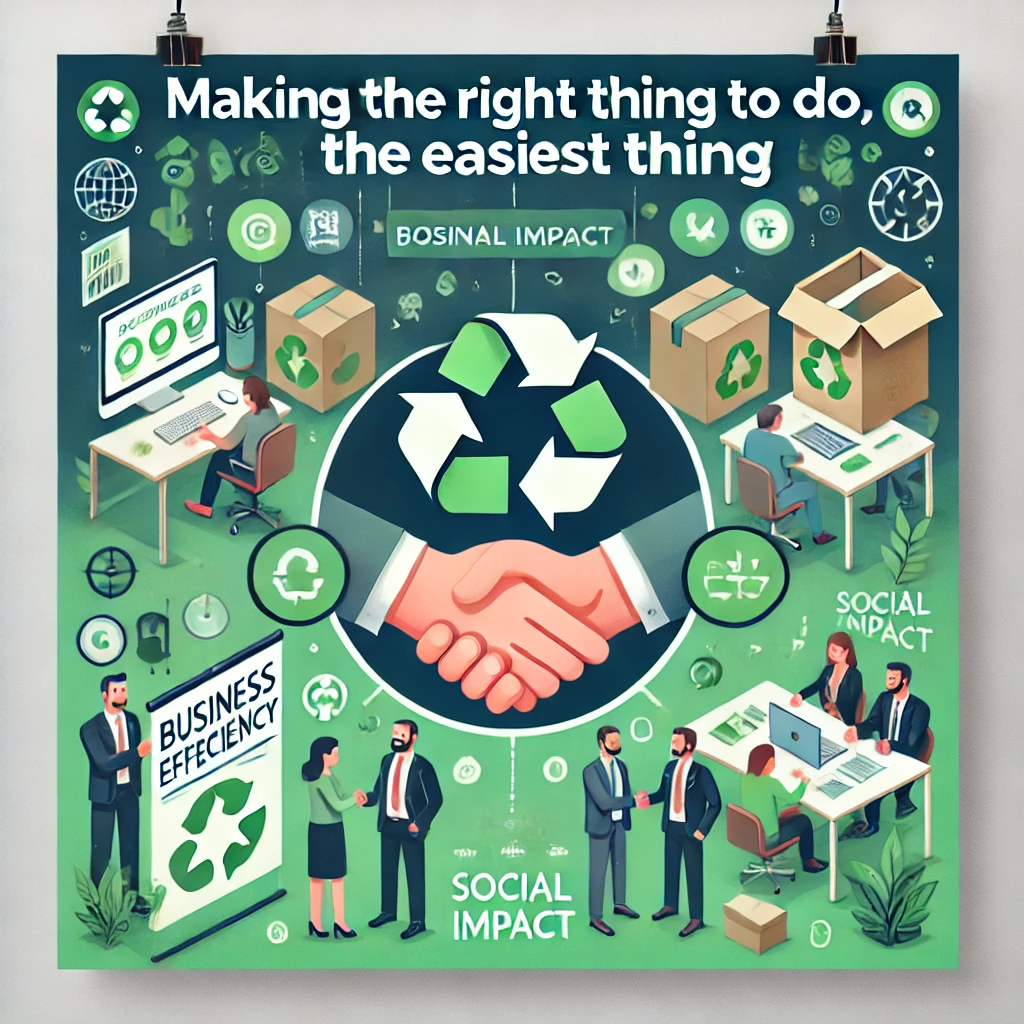
One of my most important insights from 30 years working in automation and business change is that if you want to guarantee change, then make that change easier than the status quo.
How can you both drive Efficiency and Social Impact?
Efficiency in business isn’t just about improving workflows or reducing costs—it’s also about making it easy to do the right thing for people and the planet. By integrating social impact into efficiency strategies, organisations can foster a culture where employees feel empowered, customers are engaged, and positive change is made easier. In line with the guiding principle of “making the right thing to do, the easiest thing to do,” here’s how organisations can drive efficiency and social impact in tandem.
1. Streamline Decision-Making with a Purpose
- Challenge: Traditional decision-making processes can be slow and overly complex, causing delays and frustration. When social impact is a priority, clarity becomes even more essential.
- Solution: Establish decision-making criteria that include both efficiency and social impact. Empower teams to prioritise sustainable and ethical choices without added approval layers.
- Example: Patagonia’s self-governed teams work towards environmental goals in addition to business objectives, creating an empowered culture. Patagonia Environmental Responsibility
2. Create Clear Communication with a Social Impact Focus
- Challenge: Over-communication and irrelevant messages can cloud an organisation’s mission.
- Solution: Streamline communication by focusing on high-priority information, particularly around social impact goals. Establish a “green communication day” where employees share updates on sustainability initiatives and socially responsible efforts.
- Example: Unilever’s commitment to sustainability is embedded into their communication channels, where employees and customers are updated regularly on the company’s impact and goals. Unilever’s Sustainable Living Plan
3. Prioritise Socially Responsible Tasks Over Busywork
- Challenge: It’s easy for employees to get caught up in tasks that add little social or environmental value.
- Solution: Reevaluate task priorities to focus on socially responsible activities. Create scorecards that help teams prioritise projects that have the highest social or environmental impact, reducing time spent on low-value work.
- Example: Salesforce’s “1-1-1” model (donating 1% of equity, products, and employee time) encourages employees to focus their time on projects with measurable social impact. Salesforce 1-1-1 Model
4. Leverage Technology for Efficiency and Social Good
- Challenge: Many tech solutions promise productivity gains but lack a social impact component.
- Solution: Invest in technology that improves efficiency while promoting sustainability or social causes. For example, AI-driven tools can optimise supply chains to reduce waste and carbon emissions.
- Example: Microsoft has used AI to optimise its operations while reducing its carbon footprint, part of their commitment to becoming carbon-negative by 2030. Microsoft Sustainability
5. Implement Autonomy with Social Impact Goals
- Challenge: Micromanagement stifles innovation, and a lack of autonomy can lead to burnout.
- Solution: Empower employees to take on social impact projects within their work autonomously. Give teams clear guidelines for achieving both business and social goals, creating a sense of ownership.
- Example: Google’s “20% Time” encourages employees to pursue projects that align with personal and company values, resulting in creative solutions, some with high social impact. Google’s Social Impact Initiatives
6. Refine Customer Experiences for Social Impact
- Challenge: Customers increasingly value ethical, sustainable experiences but often face cumbersome processes.
- Solution: Streamline customer journeys to promote ethical choices, such as eco-friendly purchase options or easy returns for recycling purposes.
- Example: IKEA’s commitment to sustainable living offers an online circular hub, where customers can find refurbished and recycled goods, making sustainable choices the easiest choice. IKEA Circular Hub
7. Integrate Social Impact in Organisational Structure
- Challenge: Hierarchical structures can hinder agility and social innovation.
- Solution: Design a flatter, more inclusive organisational structure where employees have both the freedom and responsibility to pursue projects with social benefits. Cross-functional teams can address community issues or environmental goals, promoting innovation and accountability.
- Example: B Lab, the non-profit behind the B Corp Certification, maintains a lean, flat structure to help them support companies in driving change effectively. B Lab and B Corp Certification
Real-World Applications: Efficiency + Social Impact in Action
- Decision-Making with Purpose: Danone North America’s commitment to sustainable food production drives decision-making that considers environmental and social impact alongside business goals. Danone’s Social Impact Mission
- Tech-Driven Sustainability: Walmart uses blockchain technology to improve traceability in its supply chain, which increases efficiency while promoting ethical sourcing. Walmart Blockchain for Sustainability
- Empowered Teams for Social Good: By giving teams ownership over social responsibility projects, Starbucks allows employees to support their local communities through initiatives like “Community Stores” that focus on local issues. Starbucks Community Impact
The Path Forward: Efficiency, Impact, and Alignment
When efficiency aligns with social impact, organisations become more agile, productive, and ethical. They foster an environment where employees are encouraged to make decisions that drive business results and promote positive change. As businesses adopt these principles, remember the mantra: “Making the right thing to do, the easiest thing to do.”
By embedding this ethos into workflows and policies, organisations can achieve both growth and social good, making efficiency gains that matter for everyone involved. As we move forward, adopting efficiency strategies that are also socially impactful ensures that doing well and doing good go hand-in-hand. Let’s create systems where making a difference isn’t just encouraged—it’s built into how work gets done.