

History classes in my 1970s Australian school were a predictable tour of English history, British royalty, and national events like the Eureka Stockade. Geography was a memory test of rivers and mountains. While we briefly touched upon European languages, culture itself remained an abstract concept. We understood Europe as a tapestry of distinct cultures, yet we generalised the vast continent of Asia with a single, monolithic label: “Asian.” Little did I know that my future work across the Asia-Pacific region would unravel that simplistic notion, revealing Asian cultures to be just as diverse and unique as European ones. This early realisation sparked my lifelong passion for cultural understanding.
Decades later, that passion is the cornerstone of my teaching philosophy for postgraduate students at UNSW. The journey from my own simplistic education to the rich complexity of my classroom is stark. Each semester, I begin by asking a student to draw a map of China on the whiteboard. Classmates then come up to mark their hometowns, creating a living map that vividly illustrates the nation’s immense diversity. This semester, a student from Ürümqi—the most inland city in the world—drove home the profound need for cultural humility. To truly connect, we must first appreciate the vastness of our students’ varied backgrounds.
This need for connection became especially clear during the challenges of teaching online through COVID-19. In a time of digital distance and strained engagement, even the smallest feedback felt precious. After one such class, a student described our session simply as “a good learning.” The phrase, rich with meaning, resonated deeply. It captured the emotional and moral essence of education that I strive for: a space built on connection, intention, and mutual respect.
Confucius said, “Education breeds confidence. Confidence breeds hope. Hope breeds peace.” This elevates our work. Creating learning environments grounded in mutual cultural understanding is not just good pedagogy; it’s an ethical commitment to fostering respect in a complex world.
Unlocking the ‘Why’: A Guide to Deeper Understanding
In my postgraduate classes, which are predominantly composed of students from China, I am constantly learning alongside them. A key that has unlocked deeper insights for me is Jinqi Xu’s recent book, Becoming an International Student (Xu, 2025). It is an invaluable guide for any educator wanting to move beyond surface-level observations.
Xu’s book thoughtfully unpacks the philosophical foundations Chinese students 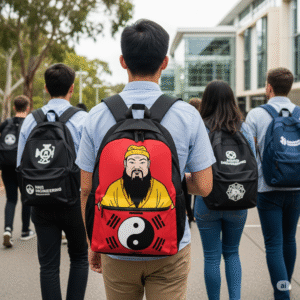 bring to Western postgraduate education. Many of their learning approaches are rooted in Confucian values such as moral cultivation, respect for authority, and collective harmony. In a Western context, these can be misinterpreted as passivity or a reliance on rote memorisation. However, Xu (2025) reframes these strategies as culturally embedded forms of intellectual engagement, a concept also explored by scholars like Biggs (1996) and Watkins & Biggs (2001).
A particularly illuminating aspect of Xu’s analysis is her application of the Chinese concept of yinyang to education. Unlike Western dialectics, which often aim to resolve contradictions, yinyang embraces their co-existence (Fang, 2011). This lens helps explain why a student might appear quiet in a group discussion yet produce written work of profound depth and insight. They are not being contradictory; they are balancing the dynamic interplay of listening and reflection. For an educator, this framework shifts the goal from ‘correcting’ a student’s behaviour to understanding its coherence within their own cultural logic.
As Confucius also noted, “Real knowledge is to know the extent of one’s ignorance.” Xu’s work inspires this humility, urging us to understand our students’ worlds rather than simply imposing our own norms. For anyone teaching business or management to Chinese postgraduate students, this book is indispensable (Xu, 2025).
Putting Cultural Humility into Practice: 7 Evidence-Based Actions
These actions, drawn from Xu’s book and the supporting literature, offer a practical bridge between theory and the tutorial room.
Action | Example and Source |
| 1. Acknowledge Confucian heritage and memorisation as valid learning tools | One student recited key concepts each tutorial—not as rote learning, but as a scaffold for deeper discussion (Xu, 2025, Ch. 6; Biggs, 1996; Watkins & Biggs, 2001). |
| 2. Use the yinyang lens to embrace learning contradictions | A student was quiet in class yet provided deeply insightful written reflections (Xu, 2025, Ch. 1 & 6; Fang, 2011). |
| 3. Make expectations and epistemologies explicit | Clarifying what “critical analysis” means with sample work and direct explanation boosted students’ confidence (Xu, 2025, Ch. 3; Ryan & Louie, 2007; Ballard & Clanchy, 1991). |
| 4. Scaffold transitions between educational systems | Weekly planners, structured check-ins, and explicit rubric decoding eased students’ adjustment to a new academic culture (Xu, 2025, Ch. 5; Carroll, 2015). |
| 5. Legitimise peer learning and community building | Allowing students to lead parts of tutorials in Mandarin to clarify complex concepts significantly increased participation and peer trust (Xu, 2025, Ch. 6; Ke & Su, 2018). |
| 6. Provide dialogic, respectful feedback | Framing feedback as a conversation (“Have you considered…?”) rather than a correction (“This is wrong”) aligns with AI literacy—emphasising seeking, not just searching (Xu, 2025, Ch. 7; Carless & Boud, 2018). |
| 7. Design for interaction, but allow for gradual participation | Allowing observational participation initially (‘legitimate peripheral participation’) encouraged eventual leadership and active contribution (Xu, 2025; Lave & Wenger, 1991). |
Seeking, Not Searching: A Mindset for AI and Ambiguity
The principle of offering dialogic feedback mirrors the most effective way to engage with AI. It’s about cultivating a mindset of seeking rather than searching.
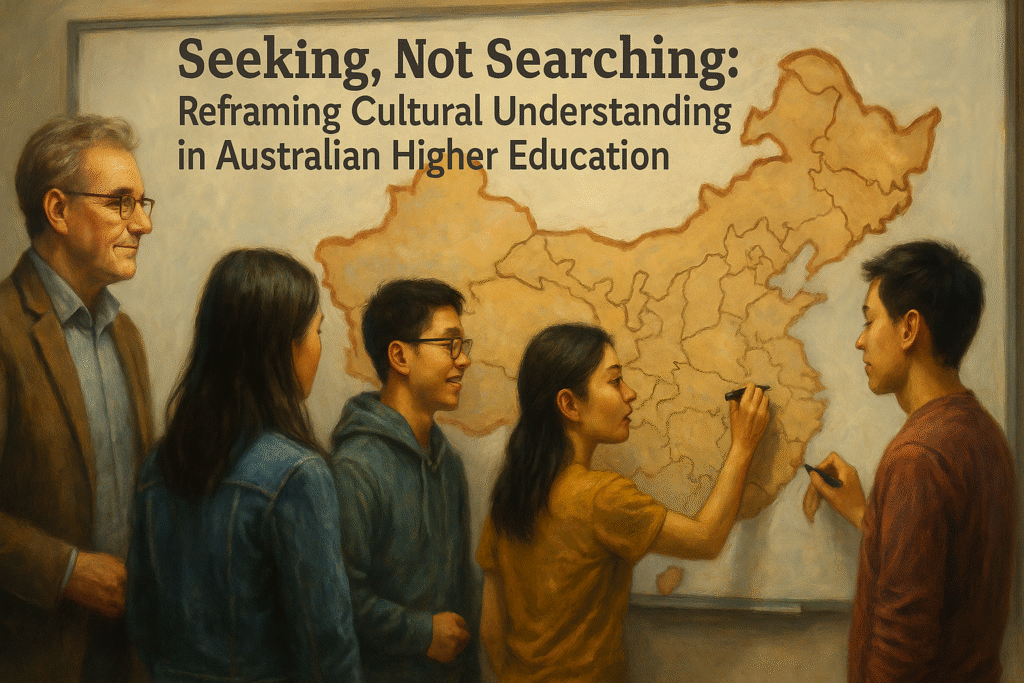
Searching is a hunt for a fixed answer. It’s transactional, like casting a fishing line and hoping for a bite. You type a query, you get a link.
Seeking, by contrast, is an open-ended, iterative dialogue. It involves exploring, re-framing questions, and following unexpected threads of meaning. In an AI context, seeking invites discovery, not just the retrieval of a pre-existing fact.
This “seeking” mindset is precisely what we want to nurture in students, especially when they face ambiguity and complexity (Carless & Boud, 2018; Xu, 2025). Helping students navigate ambiguity is a crucial life skill, particularly in fields like sustainability and ethical decision-making, where clear-cut answers are rare. Many of my students, coming from educational backgrounds that often emphasise certainty, initially find this uncomfortable (Xu, 2025).
To build this muscle, I consistently encourage them to expand their comfort zones in small ways: take a different route home, explore an unfamiliar suburb, or try a new cuisine. This simple practice develops their ability to handle uncertainty. More importantly, it nurtures respect and appreciation for diversity—the very foundation of ethical and sustainable business.
Conclusion: The Essence of a “Good Learning”
Ultimately, Xu’s book is more than a pedagogical guide; it’s a call for empathy and engagement. When we strive to know ourselves and seek to understand others—with genuine cultural humility—we create the conditions for shared discovery. By embracing this perspective, we move beyond just transferring information and create what my student so beautifully called “a good learning.”
References
Ballard, B., & Clanchy, J. (1991). Teaching students from overseas: A brief guide for lecturers and supervisors. Longman Cheshire. Biggs, J. (1996).
Western misperceptions of the Confucian-heritage learning culture. In D. A. Watkins & J. B. Biggs (Eds.),
The Chinese Learner: Cultural, Psychological and Contextual Influences (pp. 45–67). ACER. Carless, D., & Boud, D. (2018).
The development of student feedback literacy: Enabling uptake of feedback. Assessment & Evaluation in Higher Education, 43(8), 1315–1325. https://doi.org/10.1080/02602938.2018.1463354 Carroll, J. (2015).
Tools for teaching in an educationally mobile world. Routledge. Fang, T. (2011).
Yin Yang: A new perspective on culture. Management and Organization Review, 8(1), 25–50. https://doi.org/10.1111/j.1740-8784.2011.00221.x Ke, F., & Su, C. (2018).
Culturally responsive peer tutoring among Chinese international students. Innovations in Education and Teaching International, 55(6), 715–724. https://doi.org/10.1080/14703297.2017.1361404 Lave, J., & Wenger, E. (1991).
Situated Learning: Legitimate Peripheral Participation. Cambridge University Press. Ryan, J., & Louie, K. (2007).
False dichotomy? ‘Western’ and ‘Confucian’ concepts of scholarship and learning. Educational Philosophy and Theory, 39(4), 404–417. https://doi.org/10.1111/j.1469-5812.2007.00347.x
Watkins, D. A., & Biggs, J. B. (2001). The Chinese Learner: Cultural, Psychological and Contextual Influences. ACER. Xu, J. (2025). Becoming an International Stud