

Who can actually provide care, in this place, at this time?
That is not a small administrative weakness. It is a structural design flaw. A referral is not care. A list of providers is not capacity. An approval letter is not a service.
In that earlier piece, I argued that My Aged Care operates too much like a compliance marketplace, and not enough like a capacity marketplace. It records eligibility, referrals and process movement, but it does not make local service availability visible in a way that families can act upon. The result is a familiar contradiction in human services: the system appears to have done its job, while the person remains unsupported.
Since then, Stephanie Wood’s recent Good Weekend article in The Sydney Morning Herald sharpened the issue for me. Her article described the growing reality of adult children becoming the informal IT help desk for ageing parents: passwords, PDFs, multi-factor authentication, CRNs, portals, forms, logins, error messages, and digital rituals that were never designed around the lived experience of older people. Wood’s broader work can be found through her Sydney Morning Herald author page.
The article made visible a second failure.
My Aged Care does not only have a capacity blind spot. It also has a capability blind spot.
The meeting that made this more concrete
Today I met with our local federal member, Dr Gordon Reid MP, the Member for Robertson. Dr Reid is also a Central Coast local with a background as an emergency department doctor. His own biography notes his work in the emergency departments of Wyong and Gosford hospitals, giving him direct experience of the pressures that arise when community-based systems do not meet people’s needs early enough.
I raised the concern that My Aged Care remains too difficult for many ordinary families to navigate, especially when the person needing care is older, digitally excluded, cognitively fatigued, isolated, unwell, or already in crisis. Dr Reid listened carefully and acknowledged the seriousness of the issue. He indicated that he would look for appropriate ways to raise the concern through ministerial channels.
At the same time, he was realistic. Given the timing of the May Budget, he noted that it is unlikely that a proposal of this kind would gain immediate traction in this budget cycle. That is disappointing, but not surprising. In some ways, it clarifies the point. This is not a quick budget fix. It is a deeper design problem in the way aged care access is currently imagined, measured and administered.
The work still needs to begin.
The hidden assumption inside digital government
Aged care systems increasingly assume that the user is capable of navigating digital administration. That assumption is often false.
The imagined user appears to be someone who can access reliable internet, manage passwords, complete online forms, understand bureaucratic letters, compare providers, hold information across multiple steps, and advocate assertively when the system does not respond.
But many older Australians and their families experience something quite different.
| The system appears to assume | The reality for many older people and families |
|---|---|
| Reliable internet access | Access may be limited, costly, unreliable, or dependent on someone else |
| Confidence with passwords and multi-factor authentication | Security systems may lock out precisely the people most in need of support |
| Ability to understand bureaucratic language | Letters, codes, stages and classifications may be confusing or overwhelming |
| Capacity to compare providers | Families may not know which providers have actual local capacity |
| Confidence to advocate | The person may be tired, grieving, unwell, intimidated, or isolated |
| Family support is available | Some older people are alone; others depend on one already-stretched relative |
This is where Wood’s article is so important. It shows that digital access is not access if the person cannot realistically complete the steps.
A portal is not support. A login is not inclusion. A PDF form is not a pathway. A referral code is not care.
Administrative completion is not human completion
Public systems often confuse an administrative event with a human outcome. This confusion is not limited to aged care. It appears across many human service systems. A form is submitted, a letter is generated, a referral is issued, a case is closed, and the system records movement. Yet the human problem may remain unresolved.
| Administrative event | Human question that still remains |
|---|---|
| Assessment completed | Did the person understand the decision? |
| Referral issued | Did any provider accept the referral? |
| Provider list generated | Does anyone on the list have actual capacity? |
| Online account created | Can the older person realistically use it? |
| Letter sent | Was the meaning clear, timely and actionable? |
| Package approved | Has care actually commenced? |
This distinction is crucial. From the system’s perspective, a task may be complete. From the family’s perspective, the work may only be beginning.
That work includes phone calls, waiting on hold, scanning documents, translating bureaucratic language, chasing providers, resetting passwords, clarifying eligibility, coordinating siblings, calming parents, and trying to make decisions under emotional pressure.
This is unpaid labour. It is invisible labour. Increasingly, it is outsourced to families by design.
The family as unpaid systems integrator
One of the most revealing features of contemporary human services is that the family has become the informal integration layer.
Government builds the portal. Providers manage their own availability. Assessors perform eligibility work. Letters are generated. Referral codes are issued. Phone numbers are provided. Websites are refreshed.
But someone still has to make the system work as a lived experience. That person is often an adult daughter, an adult son, a spouse who is also ageing, a neighbour, a friend, a social worker, a GP receptionist, or a community volunteer.
They become the person who joins the fragments together. In technology language, they are the systems integrator. In family language, they are the one who gets the panicked phone call.
The danger is that policy-makers may treat this unpaid navigation work as if it is natural, available and endless. It is not.
The reforms make this question more urgent
Australia is already in a period of significant aged care reform. The new Aged Care Act commenced on 1 November 2025, alongside a refreshed My Aged Care website. The Support at Home program also began in November 2025, replacing the Home Care Packages Program and the Short-term Restorative Care Programme.
These reforms are substantial. They aim to improve the structure of in-home aged care and support older people to remain living independently at home for longer.
But reform is not only a matter of programme architecture. It is also a matter of access design.
A system can be reformed on paper and still be difficult to use in practice. A website can be refreshed and still assume more digital confidence than many people possess. A funding model can be redesigned and still fail to show whether local providers can actually deliver care.
Recent public concerns about algorithmic assessment in aged care add another layer to this question. Reporting by The Guardian has raised concerns about the Integrated Assessment Tool and complaints that algorithmic classifications may constrain human judgement in determining support for older Australians. The article also reported that the Commonwealth Ombudsman had begun investigating complaints about the tool.
That controversy points to the deeper question. Are we building an aged care system that can see the person, or are we building a system that can only see the transaction?
An older person is not a data object.
A carer is not a convenience.
A referral is not an outcome.
An algorithmic classification is not a relationship of care.
What My Aged Care should be able to see
The reform challenge is not simply to add more information to the website. The challenge is to redesign the system around observable human need.
At minimum, My Aged Care should be able to see four things.
| Blind spot | What should become visible |
|---|---|
| Provider capacity | Which providers are actually accepting clients, for which services, in which locations, and within what timeframe |
| Consumer capability | Whether the older person can realistically complete the administrative and digital steps required |
| Family burden | Whether navigation work is being shifted onto unpaid carers, family members, friends or neighbours |
| Access conversion | Whether assessment and approval actually result in care commencing |
The last point is especially important.
A system that measures approvals but not access is measuring its own paperwork.
A system that measures referrals but not service commencement is measuring intention rather than care.
A capacity dashboard is still needed
My earlier proposal was for a visible provider capacity model. This could begin as something quite simple: a regularly updated traffic-light dashboard showing whether providers are accepting new clients in particular locations and service categories.
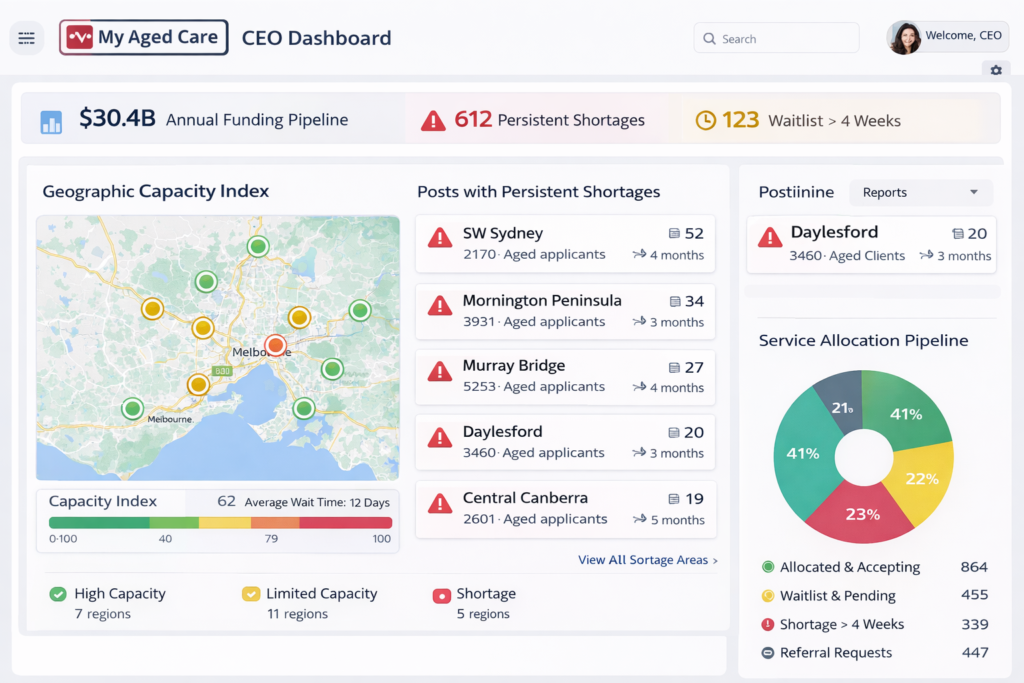
This would not solve every problem. But it would reduce the cruel fiction that families should ring provider after provider, only to discover that the published marketplace is not a real marketplace at all.
Markets only work when participants can see meaningful information. At present, many families are not choosing between available options. They are searching through a fog.
A capability dashboard is also needed
Wood’s article pushes the argument further. It is not enough to know whether providers have capacity. We also need to know whether consumers have the practical capability to access the system.
That does not mean patronising older people. It means respecting reality. A capability-aware aged care system would ask different questions.
| Question | Why it matters |
|---|---|
| Can the person use digital forms independently? | If not, online-first processes may become exclusionary |
| Does the person have someone trusted to assist them? | If not, escalation and assisted pathways are needed |
| Is cognitive decline, grief, stress or illness affecting navigation? | Administrative complexity compounds vulnerability |
| Are letters and decisions written in plain language? | Formal notification is not the same as understanding |
| Has the person moved from approval to actual service? | Outcomes should be measured beyond paperwork |
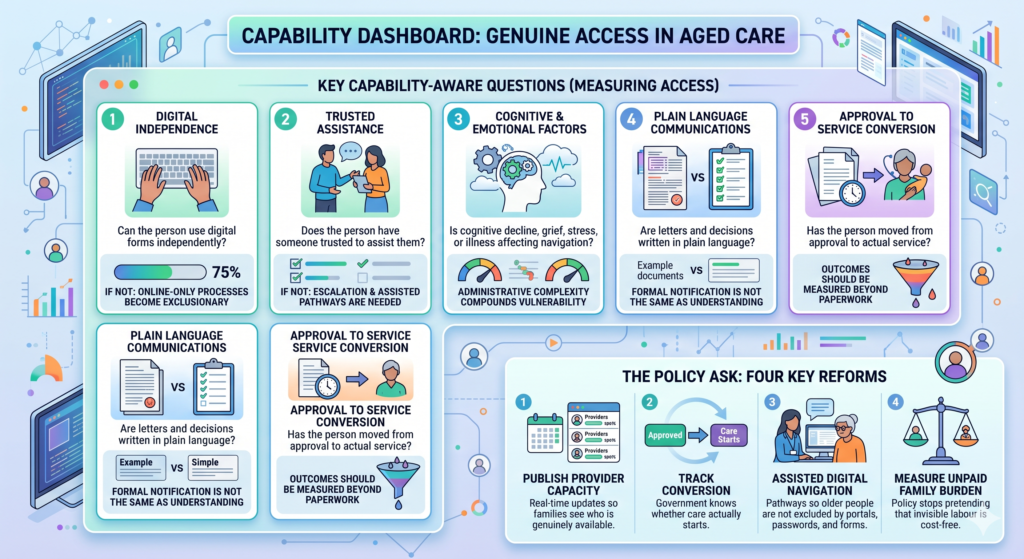
This is not a “nice to have”. It is central to access.
Aged care is not genuinely accessible if only digitally confident families can make it work.
The policy ask
The immediate policy ask does not need to be grandiose.
It could begin with a modest reform agenda: better visibility, better measurement, and better support for families trying to move from assessment to actual care.
| Reform | Purpose |
|---|---|
| Publish clearer provider capacity information | So families are not forced to ring through long provider lists to discover who is unavailable |
| Track approval-to-service conversion | So government can see whether assessment and approval actually lead to care commencing |
| Create assisted digital navigation pathways | So older people are not excluded by portals, passwords, forms and identity systems |
| Measure unpaid family navigation burden | So policy stops pretending that invisible labour is cost-free |
This may not be a May Budget measure, but it should become part of the reform agenda.
Aged care access should not depend on whether an older person has a digitally confident adult child, a persistent neighbour, or a family member with the time and literacy to keep pushing through the system.
The moral issue
There is a moral problem here. Older Australians have paid taxes, raised families, built communities, volunteered, cared, worked and contributed. When they become frail, confused, isolated or digitally excluded, they should not be forced to prove their worth by navigating administrative complexity.
Nor should families be quietly conscripted into unpaid bureaucratic labour simply because the system has failed to design for ageing.
A good aged care system should not require every family to have a project manager, a digital navigator, a health advocate and a call-centre veteran.
It should assume vulnerability and design accordingly.
From blind spot to public accountability
The phrase “capacity blind spot” still matters. But it now needs expanding.
My Aged Care has at least two linked blind spots.
| Blind spot | Policy failure |
|---|---|
| Capacity blind spot | The system cannot show whether care is actually available |
| Capability blind spot | The system cannot see whether people can realistically navigate access |
Together, they create a cruel policy paradox.
The person is approved, but unsupported.
The family is informed, but overwhelmed.
The provider is listed, but unavailable.
The portal exists, but cannot be used.
The system records progress, but the person remains stuck.
That is why this issue deserves attention.
Not because one family had a bad experience. Not because one website is clunky. Not because digital government is inherently wrong.
It deserves attention because the design logic is wrong.
Aged care should begin with the actual person in front of us: their frailty, their confusion, their dignity, their family context, their geography, and their need for timely care.
Until My Aged Care can see those things, it will continue to mistake administrative movement for human progress. And for older Australians waiting at home, that distinction is everything.
References
- Australian Government Department of Health, Disability and Ageing. (2026). The Hon Sam Rae MP. https://www.health.gov.au/ministers/the-hon-sam-rae-mp
- Australian Government Department of Health, Disability and Ageing. (2026). Support at Home program. https://www.health.gov.au/our-work/support-at-home
- Australian Parliament House. (2026). Dr Gordon Reid MP. https://www.aph.gov.au/Senators_and_Members/Parliamentarian?MPID=300126
- Frontiering. (2026). Fixing My Aged Care’s Capacity Blind Spot. https://www.frontiering.com.au/consumer-generated/fixing-my-aged-cares-capacity-blind-spot/
- My Aged Care. (2025). New Aged Care Act starts on 1 November. https://www.myagedcare.gov.au/news-and-updates/new-aged-care-act-starts-1-november
- My Aged Care. (2026). Support at Home program. https://www.myagedcare.gov.au/supportathome
- Reid, G. (n.d.). Dr Gordon Reid MP: Member for Robertson. https://drgordonreidmp.com.au/
- The Guardian. (2026). Labor’s controversial algorithm tool for aged care under investigation by ombudsman. https://www.theguardian.com/australia-news/2026/apr/14/labor-aged-care-algorithm-tool-ombudsman-investigation
- Wood, S. (2026). Stephanie Wood author page. The Sydney Morning Herald. https://www.smh.com.au/by/stephanie-wood-hve7c