

After Scarcity: Rethinking the University in the Age of AI
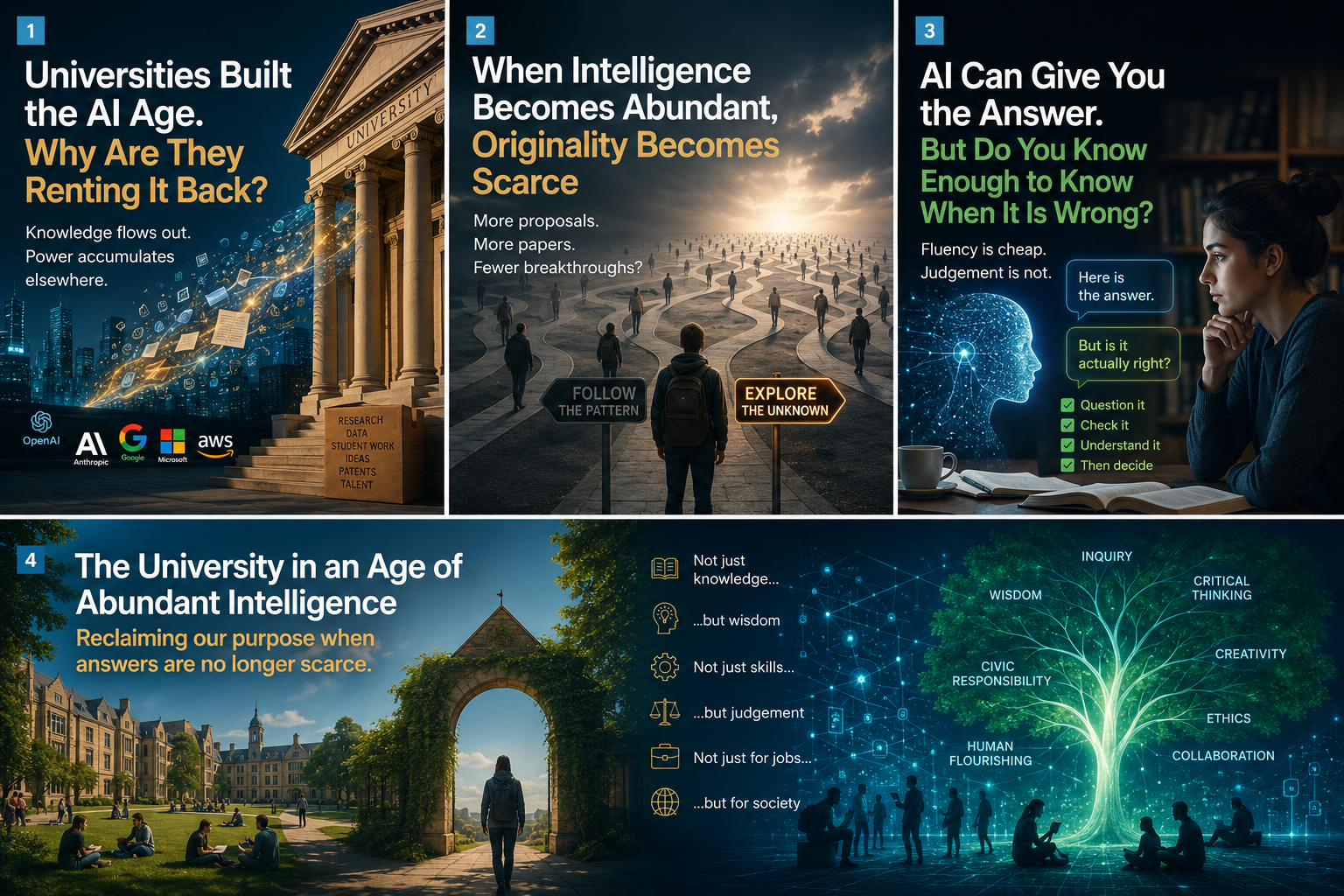
This article is part of a four-part Frontiering series exploring what happens to higher education when intelligence, explanation and content generation become abundant. Rather than asking simply how universities should use AI, After Scarcity asks a more fundamental set of questions: who retains power when knowledge is commercialised, what happens to originality when everyone has access to similar intelligence, why judgement and foundational knowledge may become more important rather than less, and ultimately what a university is for when answers are no longer scarce. Across the four essays, the argument moves from power → originality → judgement → purpose.
- Why Are They Renting It Back? — Power
- When Intelligence Becomes Abundant, Originality Becomes Scarce — Originality
- AI Can Give You the Answer. But Do You Know Enough to Know When It Is Wrong? — Judgement
- The University in an Age of Abundant Intelligence — Purpose

After Scarcity: Rethinking the University in the Age of AI
This article is part of a four-part Frontiering series exploring what happens to higher education when intelligence, explanation and content generation become abundant. Rather than asking simply how universities should use AI, After Scarcity asks a more fundamental set of questions: who retains power when knowledge is commercialised, what happens to originality when everyone has access to similar intelligence, why judgement and foundational knowledge may become more important rather than less, and ultimately what a university is for when answers are no longer scarce. Across the four essays, the argument moves from power → originality → judgement → purpose.
Part2: When Intelligence Becomes Abundant, Originality Becomes Scarce — Originality
Two stories from higher education caught my attention this week.
At first, they appear quite different.
The University of Tennessee Research Foundation has sued Anthropic, alleging that technology underpinning its AI systems infringes university patents relating to artificial neural networks. The patents emerged from research undertaken at the University of Tennessee years before generative AI became a multibillion-dollar industry (Custer, 2026).
Meanwhile, on the other side of the Atlantic, the University of Southampton has decided not to renew its contract with Turnitin after raising concerns about proposed changes that it says could have allowed student submissions to be used to train AI services. Turnitin disputes that characterisation and says it does not use customer or student work to train its Turnitin Clarity composition tool, although it acknowledges anonymised submissions may be used to improve some detection and assessment services (Luckhurst, 2026).
One dispute is about patents.
The other is about student work and data.
But I think they expose the same much larger question.
Who owns the value created inside a university?
Universities have played an extraordinary role in creating the intellectual foundations of artificial intelligence.
Alan Turing developed some of the earliest ideas about machine intelligence while working in academia. The term artificial intelligence emerged from the Dartmouth workshop. Neural networks, machine learning, natural-language processing and much of the science upon which contemporary AI rests have deep university origins.
That is how universities are supposed to work.
They create knowledge.
They publish it.
They educate people.
They exchange ideas.
They allow discoveries to spill over into society.
We should not suddenly start locking academic knowledge behind walls simply because some of it has become commercially valuable.
But something interesting happens when those open traditions encounter the economics of contemporary AI.
Knowledge moves out.
Capital accumulates around it.
Products are built.
And universities increasingly purchase access back.
There is something slightly peculiar about this cycle.
From knowledge creators to technology customers
Consider the value universities contribute to the AI ecosystem.
They produce:
- research;
- papers;
- datasets;
- intellectual property;
- highly trained graduates;
- academics who move into industry;
- student-generated knowledge;
- specialist expertise; and
- decades of publicly supported scientific discovery.
Private companies are exceptionally good at doing something universities are generally less good at doing: assembling enormous amounts of capital, computing infrastructure, engineering talent and product expertise to turn knowledge into technology that can operate at global scale.
That capability deserves recognition.
This is not an argument that OpenAI, Anthropic, Google, Microsoft or anyone else simply stole artificial intelligence from universities.
Innovation is cumulative.
Universities, governments, venture capital, entrepreneurs, researchers and corporations have all contributed.
But the distribution of value is becoming worth examining.
Universities may increasingly occupy two positions in the AI value chain:
upstream, as producers of knowledge, talent and intellectual property; and downstream, as customers purchasing AI capability from the companies that commercialise it.
That may be perfectly reasonable.
But it should at least be visible.
Southampton makes the question more uncomfortable
Student work adds another dimension.
Students submit essays, reports, dissertations, code and other intellectual work because universities require them to do so.
For years, much of that material has also passed through commercial academic-integrity infrastructure.
Turnitin's current end-user licence includes broad rights concerning material submitted through its services, although the precise legal and data-processing arrangements vary across jurisdictions and institutional agreements.
Until recently, most students probably thought very little about the potential economic value of that corpus.
Generative AI changes the context.
Large collections of authentic human writing suddenly have a value they did not appear to possess when plagiarism-detection systems were first created.
That does not mean Turnitin is secretly training a foundation model on everyone's undergraduate essays. It explicitly denies using student work in that way for Clarity.
The important point is broader.
The economic value of knowledge has changed.
Universities therefore need to reconsider the assumptions under which knowledge, data and intellectual property leave the institution.
Universities need something like AI sovereignty
I do not mean sovereignty in the nationalistic sense.
Nor do I think every university should build its own foundation model.
That would be enormously expensive and, in most cases, pointless.
I mean maintaining sufficient institutional capability that universities do not become completely dependent upon external companies for access to intelligence.
An AI sovereignty strategy might include:
- clear ownership and consent arrangements around student and researcher data;
- the ability to move institutional knowledge between AI providers rather than locking it into one platform;
- continued capacity to deploy open-weight models where appropriate;
- university-controlled knowledge repositories;
- transparency over how institutional data improve commercial systems;
- stronger technology-transfer strategies around university-created AI intellectual property;
- procurement contracts that preserve institutional choice;
- collective bargaining or infrastructure arrangements across the university sector; and
- deliberate investment in internal AI capability rather than outsourcing all expertise.
The objective is not independence from industry.
Universities and technology companies need each other.
The objective is avoiding dependence without leverage.
There is a broader lesson here
I recently wrote about the danger of confusing open access to AI with distributed power.
The same distinction applies to universities.
A university may have access to extremely capable artificial intelligence while possessing very little power over:
- how that intelligence is developed;
- what data it learns from;
- what it costs;
- what happens to institutional knowledge;
- which capabilities remain available;
- or what occurs when the supplier changes its terms.
Access is valuable.
But access is not ownership.
And access is not capability.
This may become one of the defining strategic questions for higher education over the next decade.
Universities have spent hundreds of years building systems for creating, testing, preserving and transmitting knowledge.
AI makes that knowledge considerably more powerful.
It may therefore also make it considerably more valuable.
The question universities should begin asking is not simply:
Which AI platform should we buy?
It is:
What intellectual capability must a university continue to own, control and understand for itself?
Because if universities eventually produce the knowledge, supply the talent, contribute the research and provide the data — while somebody else accumulates most of the economic power around it — we may discover that higher education helped build the AI age without securing much influence over what it became.
References
Custer, S. (2026, July 30). A first lawsuit tests what universities are owed for AI research. Inside Higher Ed.
Luckhurst, G. (2026, August 19). Southampton dumps Turnitin over use of students’ work to train AI. Times Higher Education.
Turnitin. (2026). Turnitin end-user licence agreement.