

In an interconnected world, the real battlefield is not territory—it is the system of relationships that sustain it.
What if the most dangerous assumption in strategy is not what we don’t know—but what we believe we can control?
There is a moment, just before strategy becomes history, when the map still appears legible.
In 1915, that map narrowed to a thin stretch of water—the Dardanelles. A confined, heavily defended channel, lined with artillery and mines, yet imagined by British planners as a gateway to systemic relief. If the strait could be forced, grain would flow from Russia, alliances would stabilise, and economic pressure at home would ease. The geography was visible. The system it sustained was not.
A century later, the Strait of Hormuz presents a different image, yet the same illusion. Not a corridor of battleships, but a wide, sensor-laden maritime artery, shaped by asymmetric threats and geopolitical signalling. Oil flows through it, but so too do financial expectations, insurance markets, and global stability.
The physical chokepoint remains. What has changed is the density—and fragility—of the system surrounding it.
In The War Lords and the Gallipoli Disaster, Nicholas Lambert argues that Gallipoli was not simply a failed military campaign, but an attempt to resolve a systemic crisis—rooted in food security, global trade, and financial stability—through a single leveraged intervention (Lambert, 2021).
The Dardanelles appeared to offer leverage across multiple domains at once. This is where the illusion of control emerges. Decision-makers believed that a targeted intervention at a strategic node could produce predictable, system-wide outcomes. The assumption was not that war would be easy, but that its effects would be contained.
They were not. Gallipoli revealed a deeper truth: when pressure is applied to a complex system, outcomes are not resolved—they are redistributed.
This pattern persists in contemporary geopolitics. In a recent discussion, Niall Ferguson draws a direct comparison between the Dardanelles and the Strait of Hormuz (School of War Podcast, 2026).
This is not a failure of strategy—it is the environment in which strategy must now operate.
Today, strategy no longer unfolds in clearly bounded domains. Instead, it operates in conditions defined by:
- Ambiguity — where intentions, actions, and consequences are only partially visible
- Plausible deniability — where actors deliberately obscure attribution and responsibility
- Incremental escalation — where pressure is applied gradually, below the threshold of formal conflict
This “grey zone” is not an exception to strategy—it is now its dominant form.
One of the recurring responses to chokepoint vulnerability—both historically and today—has been the search for alternatives. If a narrow passage concentrates risk, diversification appears to offer resilience.
In the case of the Dardanelles, Britain explored alternative supply arrangements to reduce reliance on Russian grain. Yet these measures were slow, politically constrained, and insufficient to address immediate pressures (Lambert, 2021).
Similarly, the vulnerability of the Strait of Hormuz has prompted efforts to diversify energy flows—through pipelines, strategic reserves, and the gradual transition towards renewable energy systems. These represent attempts to reduce reliance on concentrated geographic risk.
The reason lies in a fundamental tension:
- Adapt the system over time, or
- Attempt to control the system through decisive intervention
Diversification is slower, more complex, and requires coordination across stakeholders. Intervention, by contrast, offers immediacy—the promise of a single action with system-wide effect.
It is this promise that makes chokepoints persistently attractive—and persistently dangerous.
To understand why, stakeholder theory provides a critical lens. As articulated by R. Edward Freeman, organisations—and by extension states—must consider the interests of all stakeholders affected by their actions, not only those directly involved (Freeman, 1984; Freeman et al., 2010).
Seen through this perspective, Gallipoli becomes more than a military miscalculation. It becomes a failure to account for a complex stakeholder network.
The decision implicated:
- Allied nations dependent on supply flows
- Domestic populations exposed to economic volatility
- Financial systems under strain
- Civilian populations within the conflict zone
Yet strategic focus remained narrowly defined.
The same dynamic persists today. A disruption in the Strait of Hormuz affects:
- Global energy markets
- Shipping and insurance industries
- National economies
- Vulnerable populations experiencing cost-of-living pressures
These are not peripheral actors—they are central to the system.
The consequences of failing to account for such systems are increasingly visible.
The Russia-Ukraine War provides a clear example. Disruptions to Ukrainian grain exports—combined with sanctions and logistical constraints—contributed to rising food prices across parts of Africa and the Middle East. The conflict, geographically contained, produced systemic consequences far beyond its immediate theatre.
Similarly, the COVID-19 pandemic exposed the fragility of global supply chains. Decades of optimisation for efficiency—particularly lean inventory systems—had reduced redundancy. When disruption occurred, shortages followed: medical supplies, semiconductors, and basic goods became constrained. Efficiency had come at the expense of resilience.
In both cases, the consequences extended beyond economics. They intersected with broader global priorities, including the United Nations Sustainable Development Goals (SDGs)—particularly:
- SDG 2: Zero Hunger
- SDG 8: Decent Work and Economic Growth
- SDG 12: Responsible Consumption and Production
These examples illustrate a central point: unintended consequences are not anomalies—they are features of interconnected systems.
What intensifies this challenge is the transformation of capability. As Ferguson notes, relatively inexpensive technologies—such as drone systems—enable smaller actors to impose disproportionate disruption (School of War Podcast, 2026).
- The cost of disruption has collapsed
- The cost of protection has escalated
This creates an ethical dilemma. Harm is no longer contained within a battlefield—it is distributed across systems, affecting stakeholders who are neither decision-makers nor combatants.
Rather than presenting strategy as a set of answers, it is more useful to frame it as a structured set of questions.
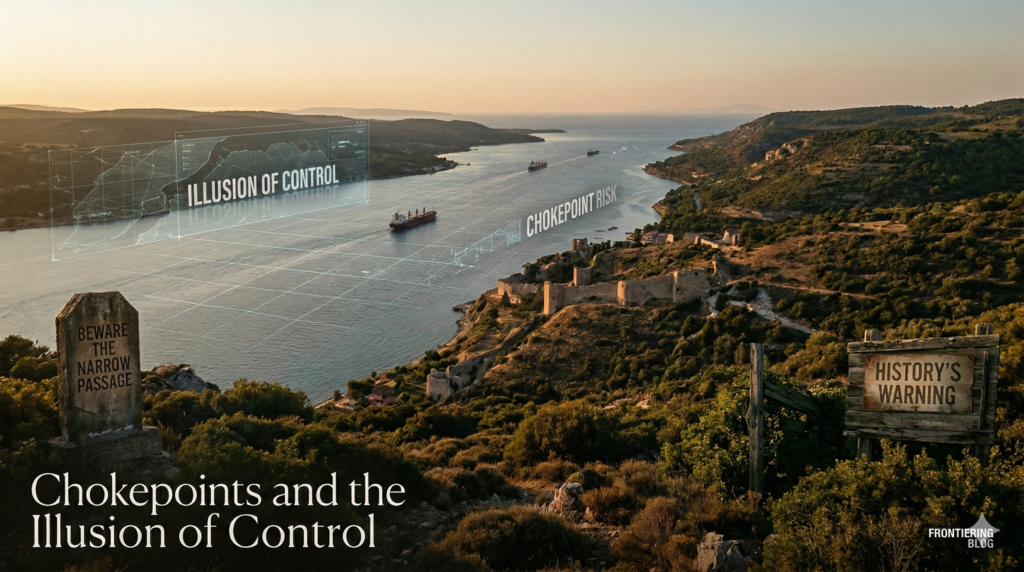
The challenge of navigating geopolitical chokepoints can be simplified through this warning.
Each element—political, economic, technological, and ethical—does not operate independently. It interacts, often in ways that amplify rather than contain risk. The task of leadership, particularly in the grey zone, is therefore not to eliminate uncertainty, but to recognise its structure. The diagnostic above translates complex theory into a practical tool for navigating ambiguity. At its core, it reveals that the challenge is rarely a lack of information. It is a failure to see the system as a whole.
Three recurring patterns emerge:
- Reductionism: complex systems reduced to singular objectives
- Stakeholder blindness: peripheral actors ignored until consequences materialise
- Temporal myopia: immediate gains prioritised over long-term stability
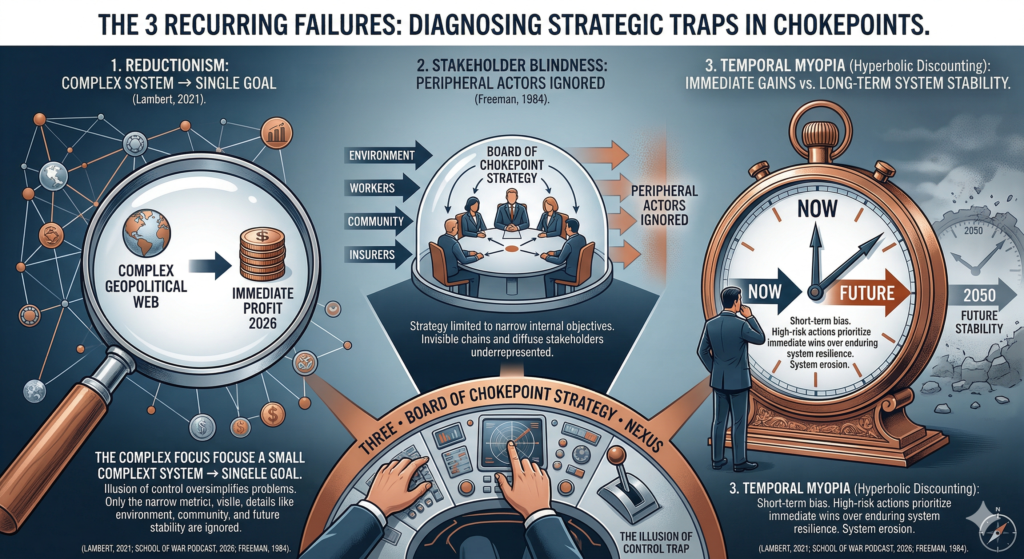
Each element—political, economic, technological, and ethical—does not operate independently. It interacts with the others, often in ways that amplify rather than contain risk. The task of leadership, particularly in the grey zone, is therefore not to eliminate uncertainty, but to recognise its structure.
The diagnostic above translates complex theory into a practical tool for navigating ambiguity. Its purpose is not to promise certainty, but to make visible the stakeholder impacts, system interdependencies, and long-term consequences that are often obscured by the illusion of control.
These are not failures of intent. They are failures of perspective.
A more effective approach begins with disciplined questioning.
A Rapid Diagnostic for Decision-Makers
The 5Ws (system awareness):
- Who bears the consequences beyond immediate actors?
- What is the true objective—stated and unstated?
- Where will second-order effects emerge?
- When will consequences unfold, and for how long?
- Why is intervention prioritised over alternatives?
PESTLE (system stress test):
- Political: What escalation pathways are triggered?
- Economic: Who absorbs the cost of disruption?
- Technological: Does innovation amplify asymmetry?
- Legal/Ethical: Are actions operating below accountability thresholds?
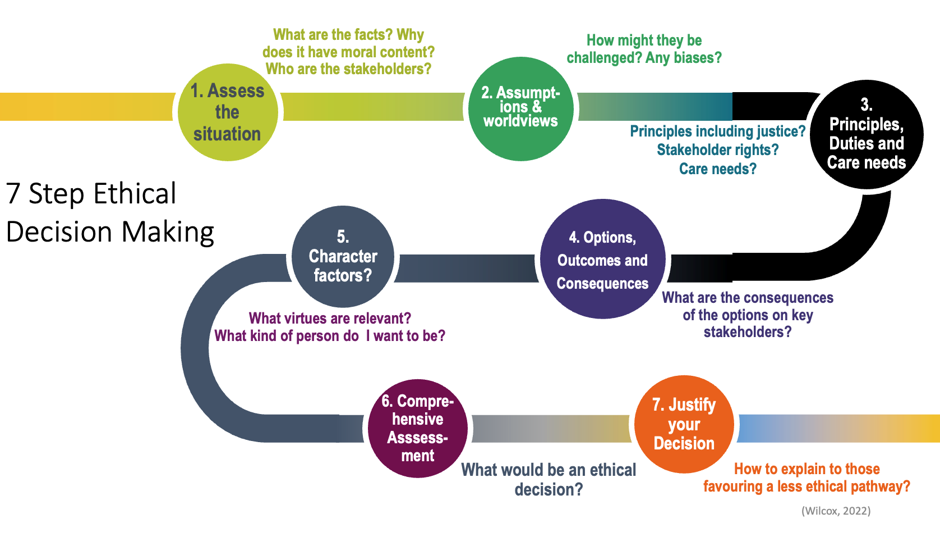
Ethical reflection (decision integrity):
- Have all stakeholders been meaningfully considered?
- Have non-military alternatives been explored?
- Has the decision been stress-tested for unintended consequences?
- Who benefits—and who absorbs the harm?
These frameworks do not eliminate uncertainty. They render it visible.
What follows is not a solution, but a diagnostic—a way of making ambiguity visible before it becomes irreversible.
Each element—political, economic, technological, and ethical—does not operate independently. It interacts with the others, often in ways that amplify rather than contain risk. The task of leadership, particularly in the grey zone, is therefore not to eliminate uncertainty, but to recognise its structure.
The framework below translates that complexity into a practical tool for navigating ambiguity. Its purpose is not to promise certainty, but to make visible the stakeholder impacts, system interdependencies, and long-term consequences that are often obscured by the illusion of control.
Read together, the 5Ws, PESTLE, and ethical decision-making model provide a way to test whether apparent control is actually strategic overconfidence.
Integrated Analytical Table: Navigating Chokepoint Decisions Across Frameworks
| Framework | Key Questions | Gallipoli Insight | Contemporary Insight (Hormuz / Iran) | Ethical Tension |
|---|---|---|---|---|
| 5Ws | Who is affected? | Britain, Russia, the Ottoman Empire, and civilian populations dependent on food and financial stability. | Regional actors, global energy consumers, shipping firms, insurers, and economically vulnerable populations. | Diffuse stakeholders are underrepresented in strategic deliberation. |
| What is the objective? | Restore grain flows, relieve pressure on Russia, and stabilise wartime economic conditions. | Pressure an adversary, preserve deterrence, and maintain strategic influence over a critical waterway. | Means and ends can become misaligned when urgency overrides reflection. | |
| Where does impact occur? | The Dardanelles became a local theatre with global food-market implications. | The Strait of Hormuz is a regional chokepoint with system-wide consequences for energy and trade. | Local interventions create global consequences far beyond the battlefield. | |
| When do effects occur? | Immediate military costs were followed by prolonged strategic and political failure. | Immediate market shocks can trigger longer-term instability, inflation, and geopolitical spillover. | Short-term logic often obscures delayed and cumulative harms. | |
| Why intervene? | Economic pressure, alliance maintenance, and the search for a decisive breakthrough. | Security signalling, coercive pressure, and the management of regional power balances. | Mixed motives can disguise risk and blur accountability. | |
| PESTLE | Political | Alliance preservation and wartime credibility shaped British decision-making. | Regional deterrence, proxy dynamics, and great-power signalling drive escalation risk. | Political imperatives can crowd out broader stakeholder consideration. |
| Economic | Grain access, prices, and wartime finance were central to the campaign’s logic. | Oil flows, shipping costs, insurance premiums, and supply-chain disruption shape the stakes. | The burden of disruption is distributed unevenly across societies. | |
| Social | Domestic morale and material hardship were part of the strategic context. | Rising living costs and energy insecurity affect households far from the conflict zone. | Those least involved in decisions often bear the greatest social cost. | |
| Technological | Naval power promised a decisive advantage, though it proved insufficient. | Drones, mines, sensors, and autonomous systems amplify asymmetry and uncertainty. | Cheap disruption can impose expensive systemic harm. | |
| Legal | Action occurred within formal wartime structures and conventions. | Contemporary manoeuvres often operate in grey zones marked by plausible deniability. | Ambiguity can weaken accountability and complicate ethical judgement. | |
| Environmental | Environmental impacts received minimal strategic attention. | Disruption raises risks of oil spills, marine damage, and wider ecological harm. | Environmental costs are frequently externalised or ignored. | |
| 7-Step Ethical Decision Model | 1. Identify the problem | The crisis was framed narrowly as a strategic blockage to be forced open. | The problem is often framed as a security challenge rather than a systems challenge. | Problem simplification encourages overconfident intervention. |
| 2. Gather the facts | Economic and alliance pressures were recognised, but not fully integrated into strategy. | Modern decisions require military, economic, technological, and humanitarian data together. | Partial information can still generate false certainty. | |
| 3. Evaluate stakeholders | Stakeholders beyond primary military actors were insufficiently weighed. | Stakeholder mapping remains fragmented in system-wide crises. | Stakeholder blindness distorts both ethics and strategy. | |
| 4. Consider alternatives | Alternatives existed, but indirect force appeared faster and more decisive. | Diversification, diplomacy, resilience-building, and deterrence may reduce dependence on intervention. | Military options often appear more actionable than systemic adaptation. | |
| 5. Make the decision | A high-risk intervention was chosen under pressure. | Escalatory choices are often made incrementally, below formal thresholds of war. | Incremental escalation can normalise risk without full scrutiny. | |
| 6. Test the decision | Scenario testing was limited and overconfidence remained high. | Stress-testing is often politically constrained, especially in ambiguous environments. | Lack of ethical stress-testing leaves unintended consequences underexplored. | |
| 7. Reflect on the outcome | Reflection came after failure, often through narrow attribution of blame. | Retrospective critique remains common, but systemic learning is often shallow. | Without reflection, ambiguity becomes a repeated pattern rather than a lesson. |
The table above does not resolve uncertainty; it helps decision-makers see where uncertainty sits, who bears its consequences, and how apparently limited interventions can produce disproportionate systemic effects.
In that sense, the value of these questions is not that they eliminate ambiguity, but that they help leaders navigate it more deliberately—making visible the trade-offs, stakeholders, and long-term consequences that are otherwise obscured by the illusion of control.
It forces decision-makers to ask:
- Who is affected beyond the immediate actors?
- Where will consequences emerge?
- What trade-offs are being made across time and stakeholders?
In doing so, it directly addresses the conditions in which modern strategy operates.
Because if strategy today is defined by:
- Ambiguity
- Plausible deniability
- Incremental escalation
Then effective decision-making must be defined by:
- Clarity of stakeholder impact
- Awareness of system interdependencies
- Recognition of long-term consequences
Gallipoli stands as an early example of systemic miscalculation. The Strait of Hormuz, and other contemporary chokepoints, represent its modern evolution.
The lesson is not that decisive action should be avoided. It is that decisive action, undertaken without a systemic understanding of stakeholders, cognitive bias, and ethical consequence, is unlikely to produce the control it promises. More often, it exposes its limits.
And in a world defined by ambiguity, plausible deniability, and incremental escalation, the discipline of asking better questions may be the closest thing we have to control—and the only reliable defence against its illusion.
References (APA 7)
- R. Edward Freeman
Freeman, R. E. (1984). Strategic management: A stakeholder approach. Pitman. - R. Edward Freeman
Freeman, R. E., Harrison, J. S., Wicks, A. C., Parmar, B. L., & De Colle, S. (2010). Stakeholder theory: The state of the art. Cambridge University Press. - Nicholas Lambert
Lambert, N. A. (2021). The war lords and the Gallipoli disaster. Oxford University Press. - Niall Ferguson
School of War Podcast. (2026, March 20). Did Trump miscalculate on Iran? with Niall Ferguson - United Nations
United Nations. (2015). Transforming our world: The 2030 agenda for sustainable development. https://sdgs.un.org/2030agenda