

Lessons from Ashesi, UTS Sri Lanka and the future of international education.

For me, this image carries a particular memory. When we helped estabislish UTS Sri Lanka in Colombo, the beginning was small. Very small. We initially struggled and managed only four students. Not forty. Not four hundred. Four.
In institutional life, four students can look like a problem. It can look like an awkward line in a report, a nervous update to senior management, or a quiet question about whether the whole idea is viable.
But within three years, that small beginning had grown to around 45–50 students. More importantly, it had become a credible pathway to UTS. It allowed students to begin in Colombo and imagine themselves continuing into Sydney. It created value for students, families, the local educational ecosystem and the university.
"From the centre of Colombo to the centre of Sydney", became a strong appeal to potential students. That phrase has stayed with me because it was not merely geographic. It was ethical. It suggested that global opportunity did not have to begin somewhere else. It could begin in Colombo. It could begin where students already were. It could begin locally and still lead outward.
This is why I have been so struck by the story of Ashesi University in Ghana.
Global learning, local purpose
Patrick Awuah’s story is compelling because it is not simply the story of a successful institution. It is the story of what can happen when global education is carried home and reworked around local purpose.
Awuah grew up in Ghana and later studied in the United States, first at Swarthmore College, where he encountered a liberal arts education that emphasised critical thinking, questioning and problem-solving. He then worked at Microsoft, gaining experience in technology, organisational discipline and global business. Later, at the Haas School of Business at UC Berkeley, he used his MBA not simply as a credential, but as a laboratory for building the institution he wanted to create.
That detail matters.
While many MBA students use the degree to move into consulting, finance or corporate leadership, Awuah used the tools of business education to design a social-impact institution. The business school classroom became a place where he could test and refine the model for a university in Ghana. The case running through his mind was not theoretical. It was Ashesi.
As part of that process, he and a team of Berkeley students conducted a feasibility study in Ghana. They surveyed students and parents, spoke with business leaders, tested assumptions about demand, and explored what a private university would need to become credible in the Ghanaian context.
This was not social impact by sentiment alone. It was social impact disciplined by evidence.
That is one of the first lessons from Ashesi.
Good intentions are not enough. If values are to shape an institution, they need to be translated into research, strategy, governance, curriculum, funding models and operational choices.
Ashesi began with a moral question, but it did not stop there.
What kind of education?
would Ghana need if it wanted to form a new generation of ethical, entrepreneurial leaders?
What kind of graduates?
would be needed to strengthen institutions, create ventures, challenge corruption, solve problems and build civic life?
What kind of university?
could take students seriously not only as future employees, but as future citizens?
These questions gave Ashesi its distinctive force.
Social impact as the centre, not the side project
What inspires me most about Ashesi is not simply its tenacity, though there was plenty of that. It is not just that the university survived, grew and gained recognition, though that is impressive.
The deeper beauty of Ashesi is that social impact values appear to sit at the heart of the institution.
They are not an elective. They are not a branding layer. They are not a paragraph in a strategic plan.
They shape the priorities. They shape the curriculum. They shape the student culture. They shape the way leadership is understood. They shape the university’s relationship with Ghana and Africa.
That is what makes the story so powerful. Ashesi shows what can happen when a university does not merely teach about values, but tries to live them through its design.
This is a crucial distinction.
Many universities speak about ethics, leadership, inclusion and impact. These words are not rare. They appear in mission statements everywhere. But the harder question is whether those values shape institutional choices when the choices become difficult.
That is what I mean by values becoming the operating system.
Borrowing legitimacy, then building from within
One of the most interesting parts of the Ashesi story is that it did not begin with complete autonomy.
In its early years, Ashesi borrowed legitimacy from global models and institutions. That was necessary. A new university in Ghana had to earn trust from regulators, parents, students, employers and donors. International associations, liberal arts models, business school networks and global social innovation frameworks helped create credibility.
But the achievement of Ashesi was not that it copied those models. The achievement was that it gradually adapted, tested and reworked them until they became locally meaningful.
This is important because one of the great risks in international education is assuming that a model that works in one setting can simply be transferred into another.
It rarely can.
Education is not just curriculum. It is trust, culture, family expectation, regulation, employment aspiration, institutional reputation and social imagination. Students and families are not buying an abstract model. They are making decisions about risk, hope, identity and future possibility.
Ashesi had to understand this deeply. It had to show that ethical leadership, critical thinking, community engagement and entrepreneurial action were not foreign add-ons to Ghanaian education. They had to become part of a Ghanaian institutional identity.
The movement that interests me most is this:
From imported model
to local meaning
From borrowed legitimacy
to earned trust
From global aspiration
to grounded practice
The Stanford connection and the Ghanaian purpose
There is something powerful in the fact that Ashesi’s story is now studied through a Stanford Graduate School of Business case.
On one level, that makes perfect sense. It is a story about entrepreneurship, leadership, funding, strategy, institutional growth and the hard work of building something new.
But at another level, there is a beautiful circularity in it.
A Ghanaian student leaves home, encounters new educational possibilities in the United States, develops professionally at Microsoft, uses an MBA environment to design a university, returns the idea to Ghana, and then creates an institution that inspires local students to become leaders in their own context.
Then that story returns to elite business school classrooms as a case study aptly named "Changemaker U". That movement is important.
The real achievement is not that Ghana becomes visible to Stanford. The real achievement is that a Ghanaian educational experiment becomes a source of learning for the world.
This reverses the usual direction of educational prestige. It is not simply the Global North teaching the Global South. It is a Ghanaian institution offering lessons in how values, strategy and social impact can be integrated.
That is exactly what makes Ashesi inspirational. It does not reject global knowledge. It uses it. But it refuses to be defined by it. It takes what is useful, translates it into local purpose, and then produces something that others can learn from.
Colombo as a pathway of possibility
This is where I see the connection to UTS Sri Lanka.
I do not want to overstate the comparison. Ashesi is a university founded around a profound national and continental mission. UTS Sri Lanka was a pathway campus connected to an Australian university. They are different kinds of institutions.
But they share an important educational question:
In Colombo, the work was not only about enrolments. It was about trust. Students and families needed to believe that beginning in Colombo could genuinely lead somewhere. They needed to trust the academic standards, the pathway, the support and the promise.
At its best, that pathway was not merely a commercial pipeline. It was a bridge.
A bridge between Colombo and Sydney. A bridge between local study and international opportunity. A bridge between aspiration and access. A bridge between where students were and where they might go.
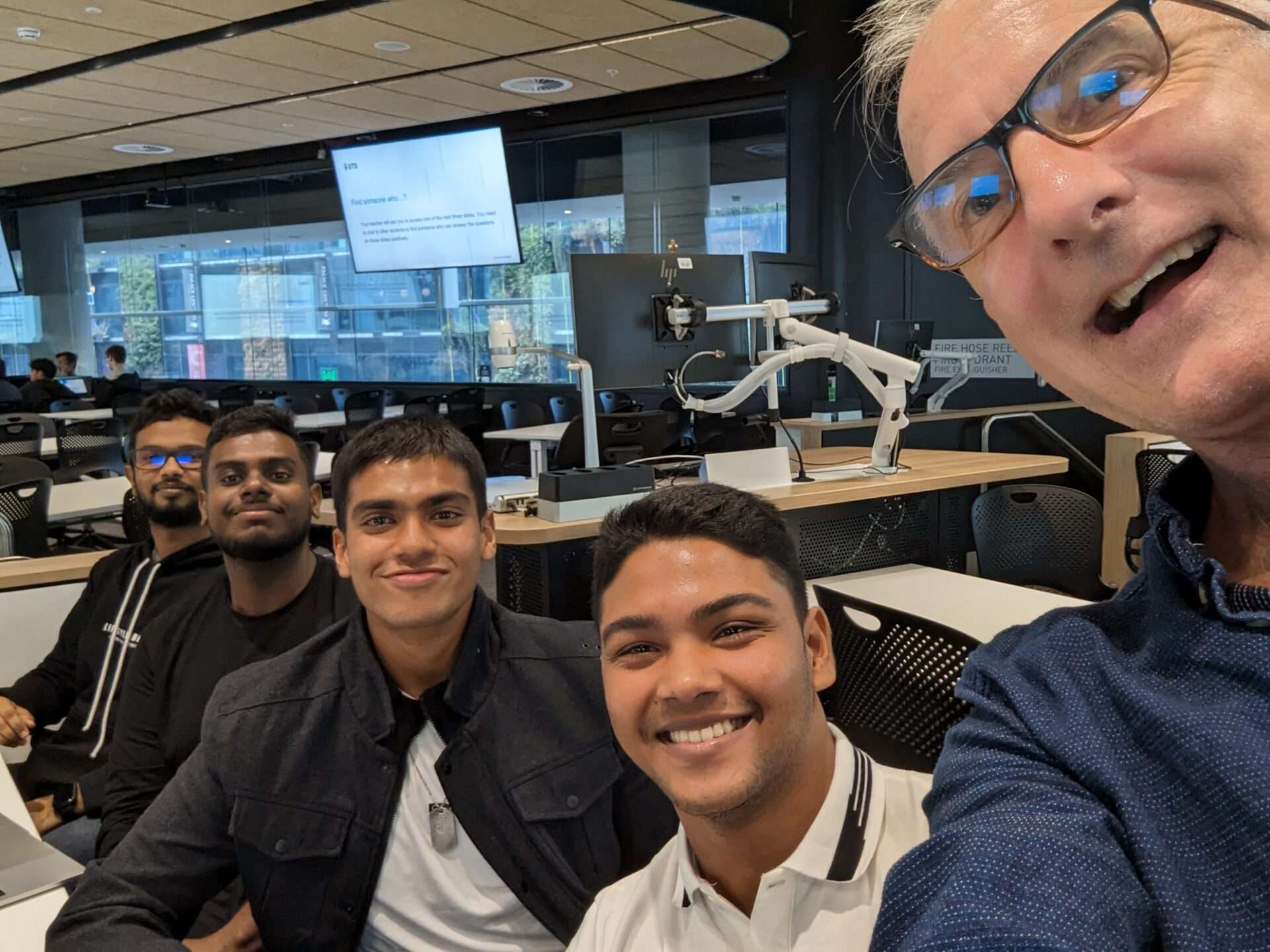
I think of this when I look at the photograph of three Sri Lankan students I taught in one class in Australia at UTS. In that image, the pathway becomes human. It is no longer a campus proposal, a market entry strategy or an enrolment target. It is three students sitting in a classroom in Sydney, having travelled through an educational bridge that someone first had to imagine, build and sustain.
That is where the value becomes visible. Not in the announcement. Not in the partnership document. Not in the slide deck.
But in the student who arrives, participates, grows, belongs and begins to see a wider future.
Education as formation
Both Ashesi and Colombo remind me that education is never only about content delivery.
Education forms people.
It forms what students notice. It forms what they believe is possible. It forms how they understand responsibility. It forms the kind of future they feel entitled, invited or obligated to help create.
That is why Ashesi’s emphasis on ethical leadership is so significant. It asks not only whether graduates can get jobs, but what kind of leaders they might become. It asks whether students can think critically, act responsibly, serve communities and build institutions that matter.
This is a much richer view of education than the narrow language of employability alone.
Employability matters. Of course it does. Students need pathways into meaningful work. Families need confidence that education will lead to opportunity. Universities need to demonstrate outcomes.
But employability without ethical formation is too thin.
That is the social-impact question at the heart of education.
The results matter because the values became real
The success of Ashesi is inspiring because it gives credibility to a values-centred model.
The university began in 2002 with a small first class and grew into a recognised institution enrolling students from across Africa. It developed a reputation for academic quality, ethical leadership, employability and social innovation. Its graduates moved into roles across business, technology, entrepreneurship, public life and civil society.
But the important point is not only that the institution grew. The important point is that it grew without abandoning the values that made it distinctive, and that can often be hard.
Many institutions begin with strong ideals and gradually dilute them under pressure. Growth brings complexity. Funding brings compromise. Regulation brings constraint. Market demand brings temptation. Success itself can become a threat to purpose.
Ashesi’s achievement is that it kept returning to the deeper question of formation: what kind of graduate are we trying to develop, and what kind of society are we trying to help build?
That is what I find inspirational.
The discipline of translating values into systems
The lesson here is not that every institution should copy Ashesi. In fact, that would miss the point.
The lesson is that every educational institution should ask what values it claims to hold, and then examine where those values actually appear in the system.
If we value access
Where is that visible?
If we value integrity
How is assessment designed?
If we value social impact
Where do students practise it?
This is why Ashesi matters for anyone interested in education, social enterprise or institutional design. It reminds us that values are not decorations. They are design commitments.
That is also why the Colombo memory matters to me.
The work of building UTS Sri Lanka was not simply about expanding a brand. At its best, it was about translating an educational promise into a local pathway. It was about building enough trust for students to step onto that pathway and enough quality for the pathway to mean something when they arrived in Sydney.
Four students became 45–50 not merely because the numbers improved, but because the promise became more credible.
That is how impact often works. It starts as belief. Then it becomes a pathway. Then it becomes evidence. Then, if we are careful, it becomes a model others can learn from.
A call to Australian universities: 1 for 1 + 3
This leads to a practical challenge for Australian universities.
International education has become one of Australia’s great export industries. It brings enormous value to universities, cities, employers and the national economy. It also brings remarkable students to Australia, many of whom enrich our classrooms, communities and workplaces.
But there is an ethical tension we should be honest about.
Much of international education is only accessible to students from families who can afford expensive degrees, relocation costs, accommodation, visas, health cover and years of living away from home. In other words, we often teach the already-privileged students of less wealthy countries, while many equally capable students in those same countries remain outside the gates.
That does not make international education wrong. Far from it. But it does mean Australian universities should ask a harder question:
How can we ensure that international education creates reciprocal public value, not just institutional revenue?
One possible answer is a simple initiative:
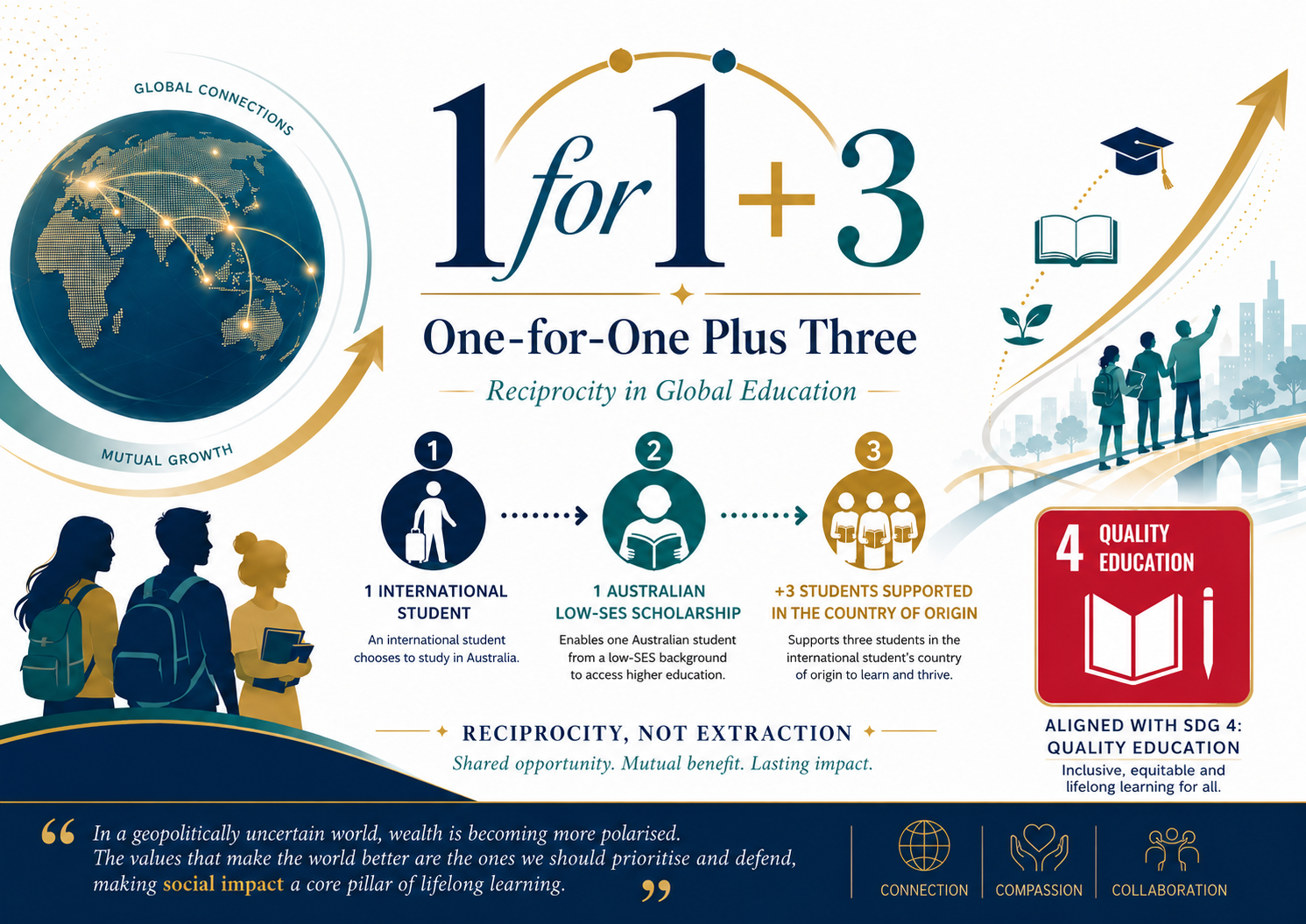
1 for 1 + 3
- 1. One local Australian low-SES scholarship
Fund one scholarship, bursary or access pathway for a low socio-economic status Australian student. - 2. Three students supported in the source country
Provide meaningful teaching, mentoring, micro-credentials, online learning, English-language support, discipline tasters, career development or pathway preparation for three students from that same country who could not otherwise afford an Australian degree. - 3. A genuine partnership model
Build the program through local universities, schools, NGOs, teacher networks, community organisations or social enterprises, rather than treating the country merely as a recruitment market.
Aligned with SDG 4: Quality Education
The initiative aligns with the global goal of inclusive, equitable and quality education, and the promotion of lifelong learning opportunities for all.
The principle is simple:
This is not charity. It is reciprocity.
It would allow universities to align international education with public purpose. It would strengthen partnerships with institutions in countries such as Sri Lanka, Ghana, India, Nepal, Vietnam, Indonesia, the Philippines and many others. It would create opportunities for teacher exchanges, curriculum collaboration, joint projects, online classrooms and locally relevant micro-learning.
It would also help Australian students. A low-SES scholarship funded through international education revenue would make the benefits of global education visible at home. It would show that internationalisation and domestic equity are not competing agendas. They can be mutually reinforcing.
The “plus three” component is equally important. For every student who comes to Australia, three more students in the country of origin could access some form of university-supported learning. It might not be a full degree. It may be a short course, a mentoring program, an online module, a design challenge, a social enterprise bootcamp, a teacher-supported project, or a pathway preparation experience.
But it would be something real.
Something that says: we value your country not only as a source of students who can pay, but as a partner in building educational capacity.
This would shift the moral frame of international education.
From recruitment
to reciprocity
From market expansion
to mutual capacity building
From mobility for the few
to opportunity for the many
That is the deeper lesson I take from Ashesi.
Patrick Awuah encountered powerful educational models in the United States, but he did not simply remain within those systems. He carried the learning home and reworked it into a Ghanaian institution designed to form ethical, entrepreneurial and socially responsible leaders.
That is the challenge for Australian universities now.
Can we take the enormous benefits of global education and use them to build pathways that are more reciprocal, more inclusive and more aligned with social impact?
Can we imagine international education not only as an export sector, but as a global public-good partnership?
Can we ensure that when one student travels from Colombo, Accra, Mumbai, Kathmandu, Hanoi or Jakarta to Sydney, Melbourne, Brisbane, Perth or Adelaide, others in that student’s home country also benefit?
1 for 1 + 3 would make possible.
One Australian low-SES scholarship.
Three students supported in the country of origin.A bridge in both directions.
What this means for social enterprises
A social enterprise cannot simply declare its values. It has to design around them.
Part of that is actually defining your why statement. Who is it for? What problem is it solving? Who benefits? Who might be excluded? What trade-offs are being made? What evidence would show that the work is making a difference? How do the values shape the model, not just the message?
Ashesi provides a powerful educational example of this. It shows that social innovation is strongest when it is not treated as a side program, but as an institutional orientation. It becomes part of how the organisation thinks, decides, teaches, measures and evolves.
That is the kind of discipline social enterprises need.
From Colombo to Ghana, and back again
The more I think about Ashesi and Colombo together, the more I see a shared pattern.
A person encounters an educational possibility somewhere else. They imagine how it might serve students in another context. They return, translate, adapt and build.
The beginning is uncertain. Trust has to be earned. The model has to be made credible. Students have to be supported. Families have to believe. Standards have to hold.
And if the work is done well, the pathway becomes more than a pathway. It becomes a lived expression of values. That is what inspires me about Ashesi.
It is not only the determination, though the determination is extraordinary. It is the alignment. The mission, the curriculum, the culture, the strategy and the results all point in the same direction.
And that is what I think we were reaching for, in our own smaller way, with UTS Sri Lanka: taking the possibilities of a global university and making them meaningful for local students in Sri Lanka. Not as charity. Not as marketing. But as pathway-building. As educational trust. As social impact in practice.
Conclusion: values that travel, values that take root
The lesson I take from Ashesi is that educational values become powerful when they travel — but only if they also take root.
A value that travels without taking root becomes ideology. A model that travels without adaptation becomes imitation. A pathway that travels without trust becomes marketing.
But when values are translated carefully into local context, they can become transformative.
Ashesi began with global influences, but became Ghanaian in its practice and African in its ambition. UTS Sri Lanka began with the promise of a pathway to Sydney, but its value depended on whether students in Colombo could see themselves in that promise.
This is the work that matters.
To connect local students with wider possibilities. To make global education locally meaningful. To put social impact values at the centre of strategy, not the margins. To build institutions and pathways that help students become more than credential holders. To help them become contributors.
Ashesi reminds us that a university can be more than a place of instruction. It can be a social-impact institution. Colombo reminds me that a pathway can be more than a pipeline. It can be a bridge of possibility.
1 for 1 + 3 asks Australian universities to take that bridge seriously.
For every international student who can afford to come here, we should ask what responsibility we carry to students who cannot.
For every international enrolment that strengthens our institutions, we should ask how we might strengthen educational opportunity at home and abroad.
For every pathway into Australia, we should consider building another pathway back into the communities from which our students come.
Not guilt. Not charity. Not public relations.
Just a more ethical form of international education: one that recognises that if we profit from global aspiration, we also carry a responsibility to widen it.
The photograph of those Sri Lankan students at UTS reminds me that educational impact is not abstract.
It has faces. It has names. It sits in classrooms. It travels across cities. It begins with trust.
And sometimes, if we are patient enough, it moves from the centre of Colombo to the centre of Sydney — and from a beginning in Ghana to a model that can inspire the world.
References and further reading
- Stanford Graduate School of Business. Ashesi University. Case study.
- Stanford Social Innovation Review. Changemaker U: Ashesi University Teaches Social Innovation With Unique Ghanaian Framework.
- United Nations. Sustainable Development Goal 4: Quality Education.
- UTS College Sri Lanka.
```