

When we think about tackling climate change, managing migration or responding to the power of artificial intelligence, we usually look to national governments. They negotiate treaties, control borders and make the major funding announcements.
Yet some of the most practical questions emerging from New York this month came from city leaders: how do we make homes affordable, protect people from extreme weather, support newcomers and ensure that investment improves the communities receiving it?
Cities are asserting a stronger role in shaping the rules, resources and partnerships needed to answer those questions. That deserves more attention.
Anthony Albanese’s United Nations engagements provided an important national counterpart:
- Australia’s Security Council bid, announced on 21 September: the official announcement seeks a non-permanent seat for 2029–2030, with an emphasis on cooperation and the voices of smaller and middle-sized states.
- His AI speech on 22 September: “Shape the digital world or it will shape us”, delivered at a UN event on children’s rights and protection in the age of AI, argued for shared standards to address risks that cross borders.
- His General Assembly address on 25 September: Australia’s national statement connected international cooperation with climate change, emerging technology and the Security Council campaign.
Alongside that diplomacy, mayors were developing an agenda closer to the institutions and organisations that implement change.
Cities are asking for the power to deliver
According to C40’s account of the 2026 Urban 20 Summit, the meeting brought together mayors and leaders from more than 35 G20 cities. C40 describes the U20 grouping as representing more than 500 million people and approximately one-third of global GDP.
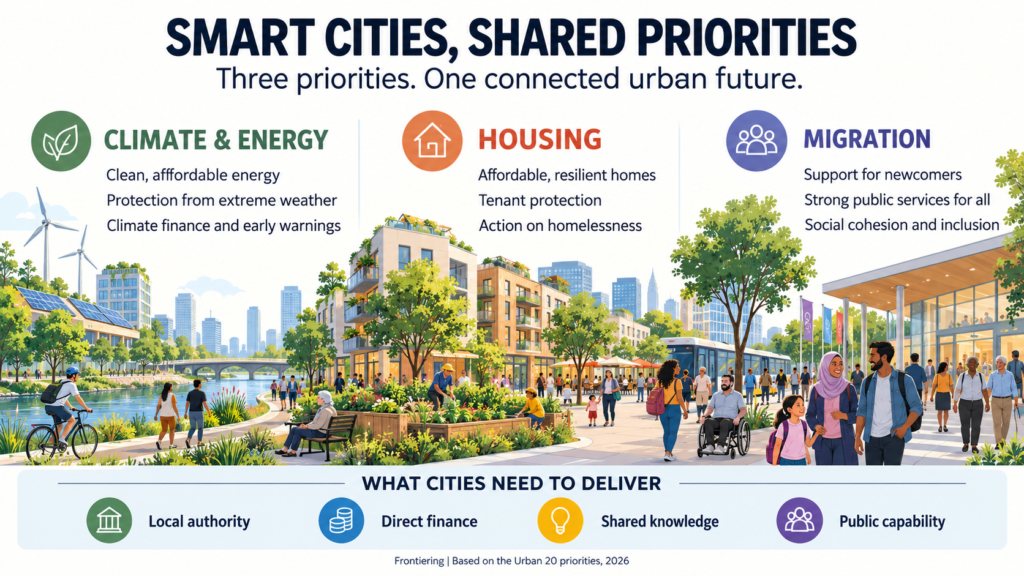
The communiqué connects three priorities:
| Priority | What cities want to advance |
|---|---|
| Climate and energy | A fair transition to clean energy, affordable bills, healthier communities and protection from extreme weather, supported by finance, usable data and early warnings. |
| Housing | Affordable, resilient homes, tenant protection and responses to homelessness, with stronger local authority and access to finance. |
| Migration | Support for newcomers alongside reliable services and social cohesion for all residents, with a greater local policy role and direct funding. |
C40 describes this as the first U20 communiqué to set out cities’ own actions alongside requests to national governments. That emphasis matters: it connects demands for greater authority with responsibility for implementation.
For residents, these priorities overlap. A poorly insulated home can be unaffordable to cool. Extreme heat can deepen existing disadvantage. Migration policy takes local form through housing, employment and access to services.
Shared problems create a reason to share solutions
This is why I think cities have a particular opportunity to strengthen international cooperation. Different institutions face different incentives to share what they know.
| Institution | Incentives and constraints around sharing knowledge |
|---|---|
| Universities | Publication an d international research partnerships have traditionally helped knowledge travel across borders. Security screening and geopolitical conditions now place additional constraints on some exchanges. |
| Businesses | Multinational companies can share knowledge extensively between their own teams across countries, while protecting intellectual property and commercially sensitive information from competitors. The company boundary has often mattered more than the national border. |
| Cities | Mayors face many of the same practical problems. Sharing a useful approach can improve another community without reducing its value to the residents who first benefited. |
I saw this work well at Mars. We shared knowledge across countries within the business. That experience is one reason I see such potential in cities learning directly from one another.
Universities have a strong tradition of open international exchange, although research has always had boundaries. There is documented evidence of recent tightening: the ARC strengthened security screening for schemes opened after 1 July 2024, and SBS reported stricter UNSW approval requirements in April 2026 for collaborations involving Iran, Russia, Belarus and North Korea. These measures make some exchanges more conditional.
Cities do compete for investment, businesses and talent. But a successful heat-response plan does not lose its usefulness when another city adopts it. Neither does a better approach to tenant support, welcoming newcomers or managing a public contract.
A city does not need to keep a solution scarce for its residents to benefit from it.
That creates a strong basis for cooperation: shared problems, useful knowledge and benefits that can grow through adoption. My proposal is to make that exchange more systematic and connect it directly to the organisations doing the work.
Private investment has a local footprint
The same logic applies to AI infrastructure. The
digital economy occupies physical places, draws on electricity and water, and affects surrounding communities.
At Climate Week NYC, C40 mayors brought finance experts and business leaders into discussions about the Global Urban Data Centres Pact. The pact had launched during London Climate Action Week on 23 June; the New York discussions built on that initiative.
The pact itself sets expectations covering:
- Location and planning: fit development into city plans and minimise displacement and health burdens.
- Energy and resources: secure additional renewable energy and/or storage, reduce water impacts and use waste heat where beneficial.
- Infrastructure costs: make developers contribute fairly to necessary upgrades and local benefits.
- Accountability: publish measurable performance information, engage communities and support local employment and procurement.
This is an attempt to shape the terms on which investment arrives. Shared expectations could help both communities and responsible investors plan with greater confidence. The broader proposition also applies to housing and other infrastructure: cities should help define the affordability, resilience and community benefits investment is expected to deliver.
The pact is a shared vision, however, rather than an enforceable global planning regime. Its value will depend on how commitments translate into decisions, agreements and measurable results within each jurisdiction.
National borders are reshaping access to technology
I explored the consequences of economic nationalism in How to navigate geopolitical unpredictability for business and government. We now need to consider what happens when national restrictions reach inside the international networks through which businesses and universities share knowledge.
Trade barriers provide part of the context. The WTO reported a more than fourfold increase in the value of imports covered by new tariffs and other import measures in the year to mid-October 2025, compared with the preceding year. It also recorded measures that facilitated trade. The United States remains a WTO member, but membership alone does not prevent governments from erecting barriers.
AI introduces a more direct form of control: deciding who can use a capability. Stanford’s 2026 AI Index documents concentrated model production in the United States and China, with industry producing more than 90% of notable frontier models in 2025.
There are already concrete examples of national restrictions. On 12 June 2026, Anthropic reported a US directive restricting access to Fable 5 and Mythos 5 by foreign nationals, including its own employees. It suspended both models for all users to comply. The controls were lifted on 30 June, with global Fable access restored on 1 July. That episode shows how national policy can interrupt sharing even within a single company.
Access remains differentiated. As at 26 September, Anthropic’s Mythos page says Mythos 5.1 is available only to selected US organisations. Its generally available Fable counterpart uses the same underlying model with stronger safeguards. The distinction concerns particular capabilities and their conditions of use, including security safeguards.
Some technology companies support selected restrictions: Anthropic explicitly advocates export controls to preserve America’s AI advantage. Yet it challenged the June directive. Industry support is selective, and cannot fairly be described as unanimous endorsement of excluding overseas users.
For businesses outside the US, access to particular capabilities can therefore be delayed, interrupted or conditional.
My concern is the dependence this creates: essential tools can be governed by decisions in which the organisations relying on them have little voice.
The AI divide could become a social welfare divide
The consequences could extend well beyond company profits. If local firms lose opportunities to innovate and grow, employment and the tax base supporting public services could suffer. If councils, charities, disability organisations and care providers face higher costs or delayed access to useful tools, they may have less capacity to improve the services people depend on.
Consider the possible uses: helping residents navigate services in their own language, making information more accessible, reducing administrative work or helping staff coordinate support. Where these applications prove effective, unequal access could mean that some communities wait longer for the benefits.
My greatest concern is for people with the fewest alternatives. A household that cannot purchase private care, tutoring or advice depends more heavily on the quality and capacity of public and community provision. Technological inequality could therefore deepen existing social disadvantage within countries, as well as differences between them.
That concern has support in UNDP’s The Next Great Divergence. It warns that countries with weaker infrastructure, skills and institutions may experience AI’s disruptions while struggling to capture its benefits. This supports the risk of widening inequality; the particular welfare consequences described here remain an argument about what could follow.
The 2025 Human Development Report also stresses that access alone is insufficient. Benefits depend on how technology strengthens people’s capabilities. Public services need suitable tools, skilled staff, sound judgement and accountable implementation. The newest model is only one possible ingredient.
The SDGs connect the technology question to everyday wellbeing
This brings the argument back to the United Nations. Its Sustainable Development Goals provide a way to judge technological progress through the lives people can lead:
| UN goal | What is at stake for communities |
|---|---|
| SDG 1 — No poverty | Target 1.3 calls for social protection; 1.4 includes access to basic services and appropriate technology. |
| SDG 3 — Good health and wellbeing and SDG 4 — Quality education | Whether improvements in healthcare, learning and accessibility reach people who cannot afford private alternatives. |
| SDG 10 — Reduced inequalities | Whether technology supports inclusion, including for people with disabilities and migrants, or widens existing gaps. |
| SDG 11 — Sustainable cities and communities and SDG 13 — Climate action | Affordable housing, reliable services and greater protection from heat, floods and other hazards. |
| SDG 17 — Partnerships for the goals | Cooperation that shares knowledge, technology and the capacity to put them to use. |
SDG 17 is particularly relevant. Target 17.6 calls for international cooperation and knowledge sharing in science and technology; targets 17.16 and 17.17 support partnerships that pool expertise and resources across institutions.
City partnerships could put that ambition into practice. A shared method, an evaluated service improvement or a staff exchange can spread useful capability to organisations that could not develop it alone. The test is whether this improves residents’ lives, especially where resources are scarce.
Public money needs public capability
There is a deeper issue beneath all these ambitions: who retains the knowledge needed to turn policy into results?
In From Builders to Buyers: What We Lost and What We Must Rebuild, I began with my father’s career in public telecommunications and his belief that engineering competence was a public duty. His example framed the shift from a builder state towards a purchaser state.
The distinction I drew was between thin government and capable government. Commissioning services still requires technical understanding, sound contract design, independent quality assurance and responsibility for long-term outcomes. As I wrote:
We may no longer build everything ourselves. But we must never outsource the intelligence required to safeguard what we build.
The concern has support beyond a general frustration with bureaucracy or contractors. Market-oriented public-sector reforms associated with neoliberalism encouraged a greater separation between government’s role in deciding policy and external providers’ role in delivering it. The consequences depend on what is outsourced and whether government retains the expertise to direct and assess the work.
Several sources help make that argument precise:
| Evidence | What it supports |
|---|---|
| Helen Dickinson, UNSW, 2023 | Her analysis links market-oriented reforms and persistent consultancy dependence with losses of public-service knowledge, skills and institutional memory. |
| O’Flynn and Sturgess, ANZSOG research commissioned for the APS Review, 2019 | The research identifies an embedded procurement mindset and problems including weak service specification, unrealistic cost assumptions and poor contract management. |
| NSW Audit Office, Internal controls and governance 2026 | Limited evaluation of consultancy performance impedes agencies’ ability to determine whether engagements achieved intended outcomes or value for money. |
These findings support a criticism of how governments organise and retain capability. They do not establish that every private provider is exploitative, or that outsourcing explains every delay and cost overrun.
My argument is that large funding allocations and contracts become blunt instruments when government lacks the expertise to specify the work, challenge assumptions, recognise problems and adjust implementation. Commercial incentives can reward what a contract measures while leaving wider public needs unresolved.
Capable public teams are therefore essential partners for capable private and community providers. Governments need people who understand the service, can interrogate advice and retain what each project teaches them.
There are already efforts to rebuild that capacity. The current APS Strategic Commissioning Framework prioritises bringing core work in house and requires attention to knowledge transfer when external expertise is used. Its July 2026 update also reports that most agencies said they outsourced little or no core work in 2025.
The challenge is to make stronger public capability durable, and to connect it with the local organisations delivering change.
Mayors can strengthen the coalition for cooperation
I see an opportunity for city leaders to reinforce the cooperative approach associated with middle powers. Neither can assume that the priorities of the largest states or companies will automatically serve their communities.
The participation of American mayors in these networks also reminds us that a country contains many centres of leadership. International relationships can continue through local institutions even when national politics becomes more adversarial.
Mayors are not inherently more reasonable or effective than national leaders. Cities can also exclude people and concentrate power. Their useful contribution is proximity to implementation, combined with the ability to learn across borders.
National and, in Australia, state governments remain essential. They hold many of the fiscal, legislative and infrastructure powers cities need. The opportunity is to give local leadership a stronger place within that system, with clear accountability and support for communities beyond the largest metropolitan centres.
Give sister-city partnerships a stronger practical purpose
This is where I would renew the sister-city concept.
Networks such as U20, C40 and United Cities and Local Governments already provide a foundation. We could strengthen that cooperation through sustained relationships between the people doing the work: planners, housing providers, universities, public servants, social enterprises and community organisations. Those relationships could help rebuild the institutional intelligence described in my earlier article, with learning retained by the organisations responsible for long-term public value.
The partnerships could organise around specific problems:
| Shared challenge | What partner cities could develop together |
|---|---|
| Affordable housing | Compare delivery and financing approaches, then assess what can be adapted to local laws, resources and community needs. |
| Extreme heat | Share heat-mapping methods, cooling strategies and ways to reach residents at greatest risk. |
| Migration and inclusion | Exchange approaches to language access, employment pathways, service coordination and community participation. |
| AI and data centres | Develop common assessment questions for resource use, procurement, accessibility and measurable community benefits. |
| Public delivery capability | Arrange staff exchanges, peer reviews and shared learning about contracts, implementation and evaluation. |
A useful starting point would be three partner cities, one shared problem and a funded twelve-month programme. Each would nominate a delivery team, involve affected residents and publish what changed, what it cost and what did not work.
- Universities could support evaluation.
- Community organisations could test whether improvements reached people facing disadvantage.
- Business partners could contribute expertise under clear expectations about public benefit and knowledge transfer.
Participation would need resources: staff time, translation where required and support for partners with smaller budgets. Sharing methods and appropriately governed evidence would be more useful than assuming that sensitive data or policy models can move freely between countries.
The test for a renewed sister-city partnership should be concrete:
what did local teams learn, what did residents gain, and is the public sector better equipped to deliver the next improvement?
That would connect the cooperation Albanese advocates at the UN with practical progress towards its Sustainable Development Goals.
Mayors can help turn international commitments into shared capability, and shared capability into better housing, stronger services and communities better prepared for climate change.