

Artificial intelligence is making capability abundant. The question is no longer only what AI enables us to do, but what happens to us when extraordinary capability becomes available to almost everyone.
Artificial intelligence is making people capable of doing things that, until very recently, required years of specialist training, expensive tools or entire teams.
A person who cannot code can build software.
Someone without design training can create sophisticated visual material.
A small organisation can analyse data, produce research, develop marketing campaigns and automate processes that once required multiple specialists.
A student can have something resembling an expert tutor available at any hour.
An idea that might once have remained an idea can now become a working prototype before lunch.
That is an extraordinary shift.
But I increasingly think the interesting question is no longer simply:
What can AI enable us to do?
It is:
What happens to us when capability itself becomes abundant?
That question follows directly from my recent After Scarcity series.
There, I argued that artificial intelligence does not eliminate scarcity. It moves it.
When sophisticated intelligence becomes readily available, other things become relatively more valuable: power, originality, judgement and purpose.
Across those four essays, I became increasingly convinced that the university’s role cannot simply be the transmission of information or even the development of conventional intellectual capability.
AI is already changing both.
The university’s deeper role may increasingly be the formation of people capable of using abundant intelligence well.
But that leaves a rather large question unanswered.
What does a capable person actually look like when extraordinary capability is available to almost everyone?
That is the question behind this new series.
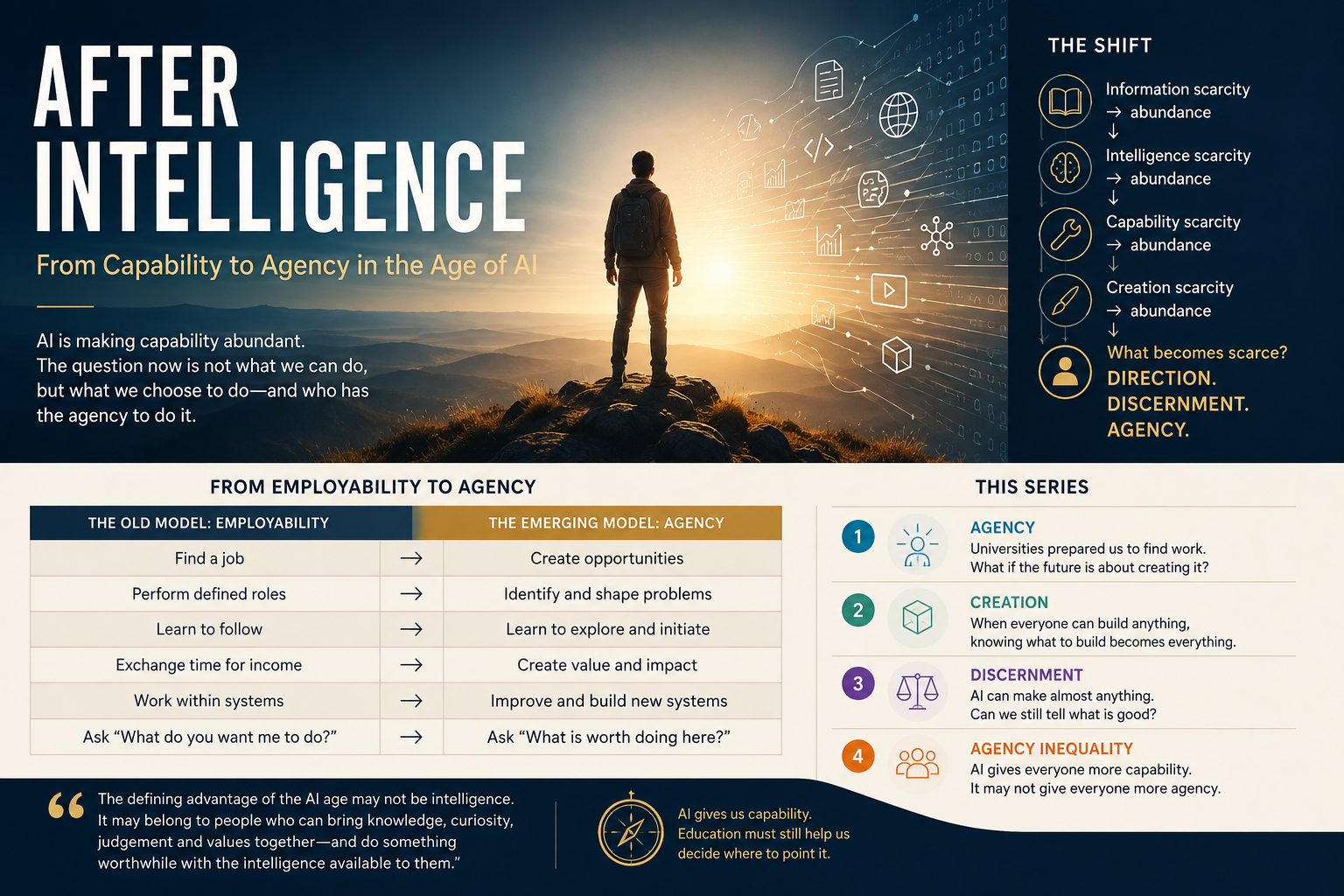
From intelligence scarcity to capability abundance
For most of modern history, capability has been expensive.
If you wanted to build sophisticated software, you needed programmers.
If you wanted professional design, you needed designers.
If you wanted detailed legal analysis, financial modelling, research synthesis or translation, you generally needed someone with the appropriate expertise.
This did more than determine how work was organised.
It shaped how we thought about careers.
Education largely prepared people to acquire specialised capability and then exchange that capability within organisations.
Learn something valuable.
Gain a qualification.
Find an occupation requiring that knowledge.
Become competent.
Build experience.
Progress.
This remains important. Deep disciplinary knowledge is not suddenly irrelevant because an AI system can produce plausible answers.
But something else is changing.
AI increasingly separates what someone can produce from what they personally know how to produce unaided.
That distinction is profound.
The individual is no longer necessarily the unit of capability.
The combination of person + artificial intelligence is.
And as that capability increases, an old limitation begins to weaken.
For many things, the question is becoming less:
Do I know how to do this?
and more:
Can I work out what needs to be done?
That sounds like a subtle distinction.
I suspect it is an enormous one.
The creator revolution
Daniel Miessler recently described this transition through what he calls the move from “Human 2.0” to “Human 3.0”.
His argument is deliberately provocative.
Industrial society, he suggests, organised education around producing workers: people able to learn prescribed knowledge, enter established organisations, perform defined roles and exchange their time and expertise for income.
AI dramatically lowers the barriers to doing something different.
People who previously needed permission, capital, technical expertise or an organisation around them can increasingly create things themselves.
Miessler describes this as a shift from workers to builders and creators.
There is something important in that idea.
But I would frame the change slightly differently.
I am not convinced the future belongs simply to “creators”.
Most people will continue to work inside organisations.
We will still need excellent nurses, teachers, engineers, researchers, managers, public servants, tradespeople and countless other professionals.
Not everyone needs to become an entrepreneur.
Nor should they.
The more interesting distinction may be between people who wait for capability to be organised around them and people who possess the agency to organise capability around a problem.
That is a much broader idea.
A teacher can exercise agency.
A nurse can exercise agency.
A student can exercise agency.
A researcher inside a university can exercise agency.
A public servant working inside a large bureaucracy can exercise agency.
Agency does not necessarily mean starting a company.
It means recognising that something could be different and believing that you have some capacity to make it so.
From employability to agency
Universities frequently talk about graduate employability.
Understandably so.
Students invest considerable time and money in education partly because they expect it to improve their prospects of meaningful work.
But perhaps employability is becoming too narrow a concept for what education now needs to develop.
Employability asks:
Can you contribute effectively within the opportunities that exist?
Agency asks something different:
Can you recognise, shape and sometimes create opportunities that do not yet exist?
Those abilities overlap.
But they are not identical.
A highly employable graduate may be excellent at responding to a clearly defined task.
An agentic graduate might ask whether it is the right task in the first place.
They might notice a problem nobody has assigned them.
They might bring together people and technologies that were previously disconnected.
They might prototype an alternative rather than write a report explaining why change is difficult.
They may not ask:
“What exactly do you want me to do?”
They may instead ask:
“What is worth doing here?”
That may become one of the defining capabilities of the AI era.
But something strange happens when everyone can create
There is another consequence.
If AI lowers the barriers to creating things, then creation itself becomes less scarce.
We can already see this with text.
Producing competent prose was once relatively expensive. It required considerable time and at least reasonable writing capability.
Now millions of people can produce polished text almost instantly.
The same transition is occurring with images, software, video, music, analysis, presentations, research synthesis and increasingly complex digital products.
This is enormously empowering.
But abundance creates its own paradox.
Once everyone can make things, making things is no longer enough.
The scarcity moves again.
We begin with:
Information scarcity
which becomes
Information abundance
Then:
Intelligence scarcity
becomes
Intelligence abundance
Then:
Technical capability scarcity
becomes
Capability abundance
And eventually:
Creation scarcity
becomes
Creation abundance
At each stage, the value moves somewhere else.
What becomes scarce when almost anyone can create?
Perhaps:
- knowing what deserves to be created;
- recognising an important problem;
- choosing between hundreds of plausible ideas;
- understanding what is genuinely original;
- recognising quality;
- rejecting things that are technically impressive but pointless;
- understanding consequences; and
- deciding what not to build.
Miessler calls one part of this taste: AI may be able to make almost anything, while knowing what is worth making remains a human advantage.
I think that insight deserves much more attention.
Because it means the next frontier is not simply creativity.
It is discernment.
The agency divide
There is also a less comfortable side to this argument.
We frequently talk about democratising AI.
And in one sense, that is exactly what is happening.
Powerful capabilities that previously belonged to large organisations or highly trained specialists are increasingly available through a browser for relatively little money.
That matters enormously.
But equal access to a tool does not produce equal outcomes.
Give two people the same AI system and their responses may be completely different.
One asks:
“Can you help me complete this task?”
The other asks:
“What could I do now that I couldn’t do before?”
The difference is not access to intelligence.
It is agency.
And agency itself is not distributed equally.
It can depend upon:
- confidence;
- curiosity;
- disciplinary knowledge;
- economic security;
- social networks;
- opportunity;
- experience;
- willingness to experiment;
- tolerance of ambiguity;
- freedom to fail;
- an ability to recognise problems worth solving; and
- perhaps most importantly, the belief that you are entitled to act.
This creates an important possibility.
AI may narrow the capability divide while widening the agency divide.
Those who already possess confidence, knowledge, networks and autonomy may use AI to multiply their effectiveness.
Others may use precisely the same technology primarily to become more efficient at completing tasks determined by somebody else.
The technology is identical.
The outcomes may be radically different.
That should concern educators.
Because if agency becomes increasingly important, then simply providing students with AI tools — or teaching them how to prompt them — will not be enough.
What should universities develop?
This brings us back to the question that concluded After Scarcity.
If information becomes abundant, universities should not define themselves primarily by access to information.
If explanations become abundant, they should not compete primarily on explanation.
If competent outputs become abundant, assessment cannot remain focused entirely upon whether students can produce competent outputs.
And if capability increasingly becomes abundant, perhaps universities should concentrate much more seriously on developing the human qualities that determine how capability gets directed.
That means helping students learn to:
- identify problems rather than merely receive them;
- ask worthwhile questions;
- explore without knowing the answer;
- initiate rather than simply respond;
- distinguish interesting ideas from important ones;
- exercise judgement under uncertainty;
- collaborate across disciplines;
- test ideas in the real world;
- tolerate failure;
- recognise unintended consequences;
- understand when AI is wrong;
- develop their own standards of quality; and
- take responsibility for what they choose to do.
These are not soft skills sitting around the edge of disciplinary education.
They may increasingly be what allows disciplinary knowledge to matter.
The next scarcity may be human direction
This is why I think the AI debate is moving into another stage.
The first stage was largely about access.
Who has these tools?
The second was about capability.
What can they do?
We are now moving towards a third question:
What will people choose to do with them?
That question is far more human.
AI can increasingly propose.
Generate.
Analyse.
Design.
Code.
Optimise.
Simulate.
Explain.
Perhaps eventually it will do all of these things extraordinarily well.
But abundance does not determine direction.
Someone still has to decide:
What matters?
What should we pursue?
What should we ignore?
What is good enough?
Who might be harmed?
What is worth our attention?
What kind of future are we trying to create?
Those questions sit somewhere between judgement, values, curiosity, purpose and agency.
They may become precisely the questions that matter most.
After Intelligence: a four-part series
1. Agency
Universities Prepared Us to Find Work. What If the Future Is About Creating It?
If AI makes sophisticated capability widely available, employability may no longer be enough.
The first essay asks whether universities need to move from developing people who can perform prescribed work towards developing people able to recognise problems, initiate action and create opportunities.
The shift: Employability → Agency
2. Creation
When Everyone Can Build Anything, Knowing What to Build Becomes Everything
AI radically lowers the cost of turning ideas into artefacts.
But if creation itself becomes abundant, producing something is no longer sufficient evidence that it is worthwhile.
The second essay examines the paradox of democratised creation.
The shift: Capability → Creation
3. Discernment
AI Can Make Almost Anything. Can We Still Tell What Is Good?
When ideas, images, products, strategies and solutions can be generated endlessly, selection becomes more important than generation.
Taste, judgement and the ability to recognise quality may become increasingly valuable.
The shift: Creation → Discernment
4. Agency Inequality
AI Gives Everyone More Capability. It May Not Give Everyone More Agency.
AI may democratise access to extraordinary capability.
But people do not begin from equal positions of confidence, knowledge, autonomy, networks or opportunity.
The final essay asks whether the next digital divide will be less about who has access to intelligence and more about who possesses the agency to use it.
The shift: Access → Agency

From After Scarcity to After Intelligence
The previous series explored what becomes valuable when intelligence becomes abundant.
Power → Originality → Judgement → Purpose
This series turns the question around.
Instead of asking what happens to the university, it asks:
What kind of person should the university help develop?
And perhaps the emerging answer looks something like:
Agency → Creation → Discernment → Contribution
I don’t yet know whether that is the final formulation.
That is partly why I want to explore it.
But I am increasingly persuaded of one thing.
The defining advantage of the AI age may not be intelligence.
It may not even be technical capability.
Both are becoming extraordinarily abundant.
The advantage may belong to people who can bring knowledge, curiosity, judgement and values together and then do something worthwhile with the intelligence available to them.
AI gives us capability.
Education must still help us decide where to point it.
And perhaps that is what agency really means.
This article introduces After Intelligence, a four-part Frontiering series exploring agency, creation, discernment and inequality in an age when sophisticated artificial intelligence is becoming widely available. It follows the earlier series, After Scarcity: Rethinking the University in the Age of AI, which explored power, originality, judgement and purpose as intelligence becomes abundant.
References
Farmer, I. (2026). After Scarcity: Rethinking the University in the Age of AI. Frontiering.
Miessler, D. (2025, September 25). The Problem with Human 2.0 and the Promise of Human 3.0. Daniel Miessler.